Power Electronics
AC and DC Drives
Practice questions from AC and DC Drives.
9
Total0
Attempted0
Correct0
IncorrectA 220 V, 20 A, 1000 rpm, separately excited dc motor has an armature resistance of 2.5Ω. The motor is controlled by a step down chopper with a frequency of 1 kHz. The input dc voltage to the chopper is 250 V. The duty cycle of the chopper for the motor to operate at a speed of 600 rpm delivering the rated torque will be
Sign in to see the solution
Log in to view the explanation, track your attempts, and keep your progress.
Sign in to UnlockA 220V, 1400 rpm, 40A separately excited dc motor has an armature resistance of 0.4Ω. The motor is fed from a single phase circulating current dual converter with an input ac line voltage of 220V (RMS). The approximate firing angles of the dual converter for motoring operation at 50% of rated torque and 1000 rpm will be
Sign in to see the solution
Log in to view the explanation, track your attempts, and keep your progress.
Sign in to UnlockAn electric motor, developing a starting torque of 15 Nm, starts with a load torque of 7 Nm on its shaft. If the acceleration at start is , the moment of inertia of the systems must be (neglecting viscous and Coulomb/friction).





Sign in to see the solution
Log in to view the explanation, track your attempts, and keep your progress.
Sign in to UnlockA variable speed drive rated for 1500 rpm, 40 Nm is reversing under no load. Figure shows the reversing torque and the speed during the transient. The moment of inertia of the drive is
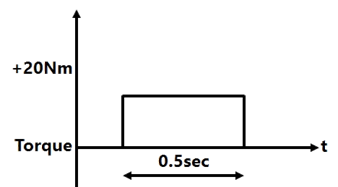
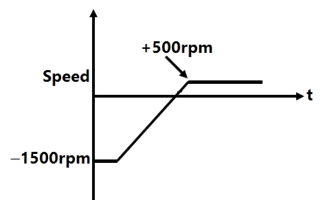




Sign in to see the solution
Log in to view the explanation, track your attempts, and keep your progress.
Sign in to UnlockIn case of an armature controlled separately excited dc motor drive with closed-loop speed control, an inner current loop is useful because it
Sign in to see the solution
Log in to view the explanation, track your attempts, and keep your progress.
Sign in to UnlockA separately excited dc motor is controlled by varying its armature voltage using a single phase full-converter bridge as shown in figure; the field current is kept constant at the rated value. The motor has an armature resistance of 0.2Ω, and the motor voltage constant is 2.5V (rad/sec). The motor is driving a mechanical load having a constant torque of 140 Nm. The triggering angle of the converter is.

The armature current can be assumed to be continuous and ripple free.
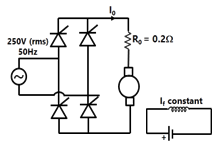
(a) Calculate the motor armature current
(b) Evaluate the motor speed in rad/sec
(c) Calculate the RMS value of the fundamental component of the input current to the bridge.
Sign in to see the solution
Log in to view the explanation, track your attempts, and keep your progress.
Sign in to UnlockA dc motor with armature resistance is fed from a step down chopper in the continuous mode, and operates at some known speed and known excitation current. The motor current rises from in the ON period of the chopper; and drops from in the OFF period of the same circuit. Both the rise and fall of the current may be assumed to be approximately linear.




What is the average power loss in the machine armature?

Sign in to see the solution
Log in to view the explanation, track your attempts, and keep your progress.
Sign in to UnlockIn a speed controlled d.c. motor drive, the load torque is 40Nm. At time t=0, the operation is under steady state condition and speed is 500rpm. Under this condition at , the generated torque is instantly increased to 100Nm. The inertia of the drive is . The friction is negligible


(a) Write down the differential equation governing the speed of the drive for t>0
(b) Evaluate the time taken for the speed to reach 1000 rpm
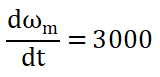
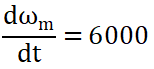
Time taken for the speed to reach 1000 rpm = 4.46 ms
Time taken for the speed to reach 1000 rpm = 8.73 ms
Sign in to see the solution
Log in to view the explanation, track your attempts, and keep your progress.
Sign in to UnlockA separately excited d.c. motor is fed from a chopper operating at 500 Hz with a duty cycle of 50% and is drawing an average current of 10A from a 200V d.c. source. A free wheeling diode is connected across it. The motor has negligible armature resistance; a field inductance of 50mH and a torque constant of 0.5 N-m/A. determine the minimum and maximum motor current, motor back e.m.f. and the mechanical torque developed.


Developed Torque = 5 N-m
Developed Torque = 10 N-m
Sign in to see the solution
Log in to view the explanation, track your attempts, and keep your progress.
Sign in to Unlock