Signals and Systems
Z Transform
Practice questions from Z Transform.
20
Total0
Attempted0
Correct0
IncorrectConsider the infinite-length, discrete-time sequence , where is an integer. The region of convergence of its Z-transform is given by: (Note: is a complex variable)







such that such that



Sign in to see the solution
Log in to view the explanation, track your attempts, and keep your progress.
Sign in to UnlockIf the -transform of a finite-duration discrete-time signal is , then the transform of the signal is








Sign in to see the solution
Log in to view the explanation, track your attempts, and keep your progress.
Sign in to UnlockThe Z-transform of a discrete signal is


Which one of the following statements is true?
Discrete-time Fourier transform of converges if is


Discrete-time Fourier transform of converges if is

Discrete-time Fourier transform of converges if is such that is a left-sided sequence
Discrete-time Fourier transform of converges if is such that is a rightsided sequence
Sign in to see the solution
Log in to view the explanation, track your attempts, and keep your progress.
Sign in to UnlockThe causal signal with z-transform is (u[n] is the unit step signal)





Sign in to see the solution
Log in to view the explanation, track your attempts, and keep your progress.
Sign in to UnlockConsider a signal , where u[n] = 0 if n < 0, and u[n] = 1 if n ≥ 0. The z-transform x[n – k], k > 0 is with region of convergence being


Sign in to see the solution
Log in to view the explanation, track your attempts, and keep your progress.
Sign in to UnlockThe pole-zero plots of three discrete-times systems P, Q and R on the z-plane are shown below.
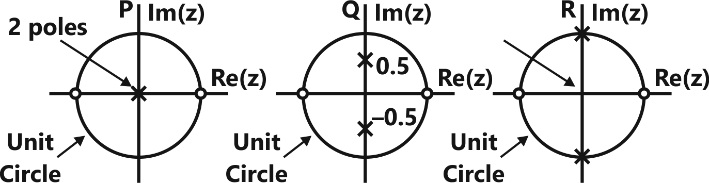
Which one of the following is TRUE about the frequency selectivity of these systems?
Sign in to see the solution
Log in to view the explanation, track your attempts, and keep your progress.
Sign in to UnlockConsider a discrete time signal given by

The region of convergence of its Z – transform would be
Sign in to see the solution
Log in to view the explanation, track your attempts, and keep your progress.
Sign in to UnlockLet be the Z – transform of a causal signal x[n], Then, the values of x[2] and x[3] are

Sign in to see the solution
Log in to view the explanation, track your attempts, and keep your progress.
Sign in to UnlockIf , then the region of convergence (ROC) of its Z-transform in the Z-plane will be





Sign in to see the solution
Log in to view the explanation, track your attempts, and keep your progress.
Sign in to UnlockThe z-transform of a signal x[n] is given by. It is applied to a system, with a transfer function. Let the output be y(n). Which of the following is true?


y(n) is non casual with finite support
y(n) is casual with infinite support

;;



Sign in to see the solution
Log in to view the explanation, track your attempts, and keep your progress.
Sign in to UnlockH(z) is a transfer function of a real system. When a signal is the input to such a system, the output is zero. Further the Region of Convergence (ROC) of is the entire Z-plane (except z = 0). It can then be inferred that H(z) can have a minimum of


Sign in to see the solution
Log in to view the explanation, track your attempts, and keep your progress.
Sign in to UnlockGiven with , the residue of at for will be









Sign in to see the solution
Log in to view the explanation, track your attempts, and keep your progress.
Sign in to UnlockConsider the discrete-time system shown in the figure where the impulse response of G(z) is g(0) = 0, g(1) = g(2) = 1, g(3) = g(4) = ……. = 0
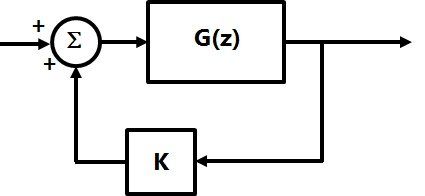
This system is stable for range of values of K




Sign in to see the solution
Log in to view the explanation, track your attempts, and keep your progress.
Sign in to Unlock, are Z-transforms of two signals x[n], y[n] respectively. A linear time invariant system has the impulse response h[n] defined by these two signals as , where * denotes discrete time convolution. Then the output of the system for the input




Has Z-transform


Has Z-transform

Does not satisfy any of the above three.
Sign in to see the solution
Log in to view the explanation, track your attempts, and keep your progress.
Sign in to UnlockA signal is processed by a causal filter with transfer function G(s). For a distortion free output signal waveform, G(s) must
Sign in to see the solution
Log in to view the explanation, track your attempts, and keep your progress.
Sign in to Unlockis a low-pass digital filter with a phase characteristics same as that of the above question if





Sign in to see the solution
Log in to view the explanation, track your attempts, and keep your progress.
Sign in to UnlockThe discrete time signal , where ↔ denotes a transform-pair relationship, is orthogonal to the signal.






Sign in to see the solution
Log in to view the explanation, track your attempts, and keep your progress.
Sign in to Unlocky[n] denotes the output and x[n] denotes the input of a discrete-time system given by the difference equation y[n] – 0.8y[n – 1] = x[n] + 1.25x[n + 1]. Its right-sided impulse response is
Sign in to see the solution
Log in to view the explanation, track your attempts, and keep your progress.
Sign in to UnlockA discrete real all pass system has a pole at : it, therefore
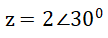
also has a pole at

has a constant phase response over the -plane:


is stable only if it is anti-causal
has a constant phase response over the unit circle:

Sign in to see the solution
Log in to view the explanation, track your attempts, and keep your progress.
Sign in to UnlockIf u(t) is the unit step and δ(t) is the unit impulse function, the inverse z-transform of for k ≥ 0 is:





Sign in to see the solution
Log in to view the explanation, track your attempts, and keep your progress.
Sign in to Unlock