Control Systems
Root Locus Technique
Practice questions from Root Locus Technique.
18
Total0
Attempted0
Correct0
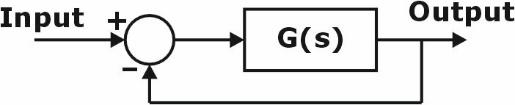
IncorrectThe open-loop transfer function of the system shown in the figure, is

For , which of the following real axis point(s) is/are on the root locus?

Sign in to see the solution
Log in to view the explanation, track your attempts, and keep your progress.
Sign in to UnlockConsider the closed-loop system shown in the figure with

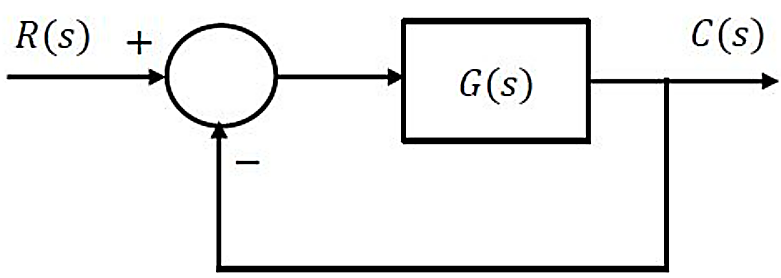
The root locus for the closed-loop system is to be drawn for . The angle of departure (between and ) of the root locus branch drawn from the pole , in degrees, is __________ (rounded off to the nearest integer)




Sign in to see the solution
Log in to view the explanation, track your attempts, and keep your progress.
Sign in to UnlockThe root locus of the feedback control system having the characteristic equation where K>0, enters into the real axis at

s = –1

s = –5

Sign in to see the solution
Log in to view the explanation, track your attempts, and keep your progress.
Sign in to UnlockThe gain at the breakaway point of the root locus of a unity feedback system with open loop transfer function is

Sign in to see the solution
Log in to view the explanation, track your attempts, and keep your progress.
Sign in to UnlockThe open loop poles of a third order unity feedback system are at 0, -1, -2. Let the frequency corresponding to the point where the root locus of the system transit to unstable region be K. Now suppose we introduce a zero in the open loop transfer function at -3, while keeping all the earlier open loop poles intact. Which one of the following is TRUE about the point where the root locus of the modified system transits to unstable region?
Sign in to see the solution
Log in to view the explanation, track your attempts, and keep your progress.
Sign in to UnlockAn open loop transfer function G(s) of a system is

For a unity feedback system, the breakaway point of the root on the real axis occurs at,
Sign in to see the solution
Log in to view the explanation, track your attempts, and keep your progress.
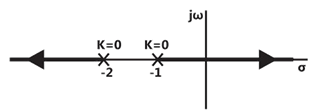
Sign in to UnlockThe root locus of a unity feedback system is shown in the figure
The closed loop transfer function of the system is




Sign in to see the solution
Log in to view the explanation, track your attempts, and keep your progress.
Sign in to UnlockThe open loop transfer function G(s) of a unity feedback control system is given as,1

From the root locus, it can be inferred that when k tends to positive infinity,
three roots with nearly equal real parts exist on the left half of the s-plane
one real root is found on the right half of the s-plane
the root loci cross the axis for a finite value of k;


three real roots are found on the right half of the s-plane
Sign in to see the solution
Log in to view the explanation, track your attempts, and keep your progress.
Sign in to UnlockThe characteristics equation of a closed-loop system is
. Which of the following statements is true?

Its root are always real
It cannot have a breakaway point in the range

Two of its roots land to infinity along the asymptotes

If may have complex roots in the right half plane.
Sign in to see the solution
Log in to view the explanation, track your attempts, and keep your progress.
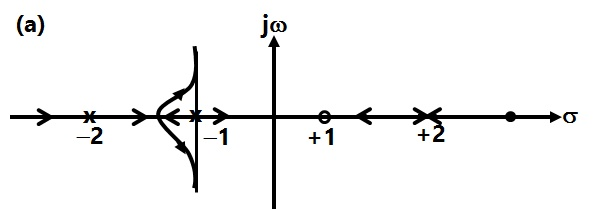
Sign in to UnlockA closed loop system has the characteristic function . Its root locus plot against K is

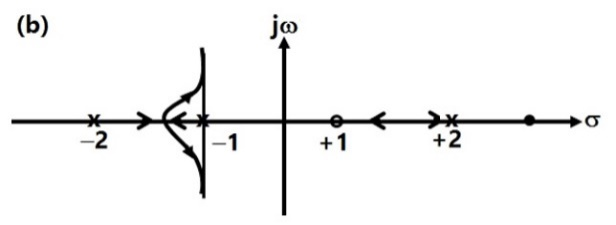
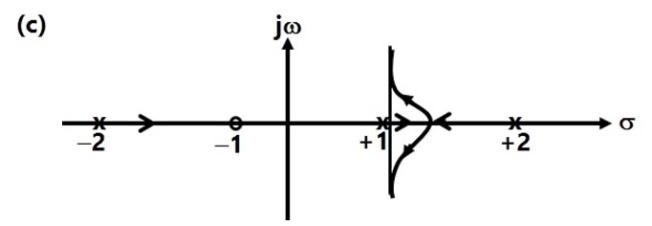
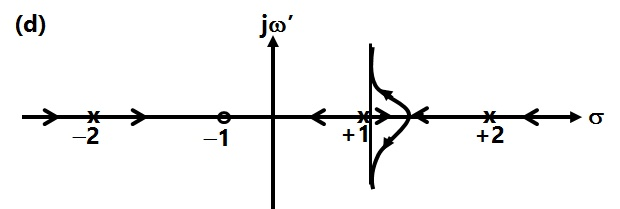
Sign in to see the solution
Log in to view the explanation, track your attempts, and keep your progress.
Sign in to UnlockThe figure shows the root locus plot (location of poles not given) of a third-order system whose open-loop transfer function is
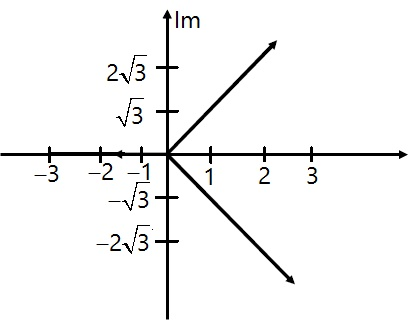




Sign in to see the solution
Log in to view the explanation, track your attempts, and keep your progress.
Sign in to UnlockA unity feedback system has an open loop transfer function, . The root locus plot is

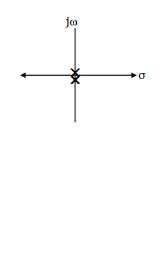
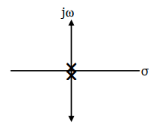
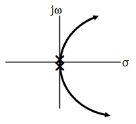
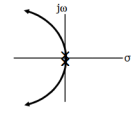
Sign in to see the solution
Log in to view the explanation, track your attempts, and keep your progress.
Sign in to UnlockThe open loop transfer function of a unity feedback system is given by

Find the angle and real axis intercept of the asymptotes, breakaway points and the imaginary axis crossing points, if any.
Sign in to see the solution
Log in to view the explanation, track your attempts, and keep your progress.
Sign in to UnlockGiven the characteristic equation

Sketch the root locus as K varies from zero to infinity. Find the angle and real axis intercept of the asymptotes, break-away/break-in points, and imaginary axis crossing points, if any.
Root Locus diagram
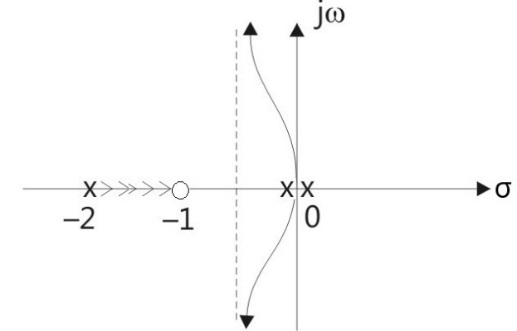
Angle of asymptotes
= 90

= 270

breakaway point s=0 and Centroid = -0.5
breakaway point s=1 and Centroid = -0.5
Sign in to see the solution
Log in to view the explanation, track your attempts, and keep your progress.
Sign in to UnlockA unity feedback system has open-loop transfer function

(a) Draw a rough sketch of the root locus plot; given that the complex roots of the characteristic equation move along a circle.
(b) As K increases, does the system become stable? Justify your answer.
(c) Find the value of K (if it exists) so that the damping of the complex closed loop poles is 0.3

(a)
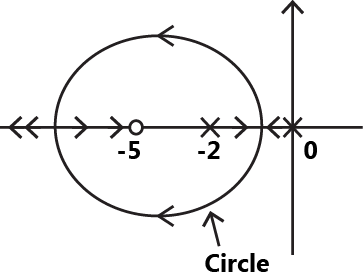
(b) As k increases. The branches of root locus move left and hence system becomes more stable.
(c) no such value of k exists such that

None of these
Sign in to see the solution
Log in to view the explanation, track your attempts, and keep your progress.
Sign in to UnlockWhich of the following figure(s) represent valid root loci in the s-plane for positive K? Assume that the system has a transfer function with real co-efficient.
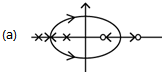
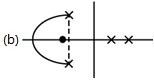
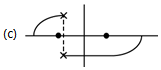
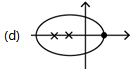
Sign in to see the solution
Log in to view the explanation, track your attempts, and keep your progress.
Sign in to UnlockA unity feedback system has an open-loop transfer function of the form

Which of the loci shown in figure can be valid root-loci for the system?
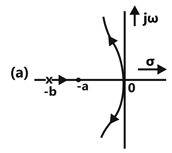
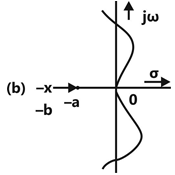
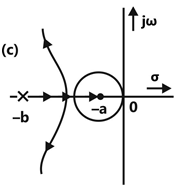
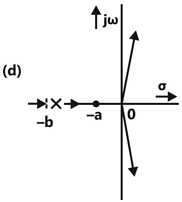
Sign in to see the solution
Log in to view the explanation, track your attempts, and keep your progress.
Sign in to UnlockA unity feedback system has the forward loop transfer function

(c) Without calculating the real-axis breakaway
points. Sketch the form of root loci for the system
Range of K for stable operation: K>2
Imaginary axis crossover points
and


Root loci for the system
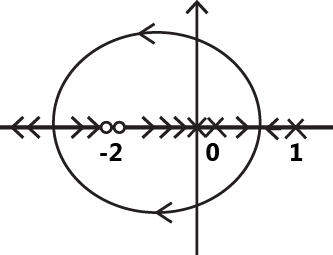
Range of K for stable operation: K<2
Sign in to see the solution
Log in to view the explanation, track your attempts, and keep your progress.
Sign in to Unlock