Measurement
Error Analysis
Practice questions from Error Analysis.
15
Total0
Attempted0
Correct0
IncorrectThe maximum percentage error in the equivalent resistance of two parallel-connected resistors of and with each having a maximum error is _________ % (round off to nearest integer value).



Sign in to see the solution
Log in to view the explanation, track your attempts, and keep your progress.
Sign in to UnlockA non-ideal Si-based pn junction diode is tested by sweeping the bias applied across its terminals from –5 V to +5 V. The effective thermal voltage, , for the diode is measured to be (29 ± 2) mV. The resolution of the voltage source in the measurement range is 1 mV. The percentage uncertainty (rounded off to 2 decimal places) in the measured current at a bias voltage of 0.02 V is _______.

Sign in to see the solution
Log in to view the explanation, track your attempts, and keep your progress.
Sign in to UnlockThe temperature of the coolant oil bath for a transformer is monitored using the circuit shown. It contains a thermistor with a temperature-dependent resistance, , where T is the temperature in °C. The temperature coefficient, , is – (4 ± 0.25) %/°C. Circuit parameters: , , . The error in the output signal (in V, rounded off to 2 decimal places) at 150°C is __________.






Sign in to see the solution
Log in to view the explanation, track your attempts, and keep your progress.
Sign in to UnlockThe following measurements are obtained on a single phase load:
, and . If the power factor is calculated using these measurements, the worst-case error in the calculated power factor in percent is ________. (Given answer up to one decimal place).



Sign in to see the solution
Log in to view the explanation, track your attempts, and keep your progress.
Sign in to UnlockTwo resistors with nominal resistance values and have additive uncertainties, respectively. When these resistances are connected in parallel, the standard deviation of the error in the equivalent resistance R is







Sign in to see the solution
Log in to view the explanation, track your attempts, and keep your progress.
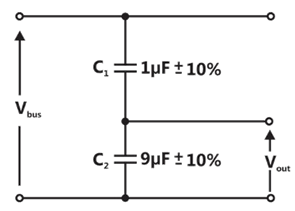
Sign in to UnlockA capacitive voltage divider is used to measure the bus voltage in a high-voltage 50Hz AC system as shown in figure. The measurement capacitors and have tolerance of on their nominal capacitance values. If the bus voltage is 100kV rms, the maximum rms output voltage (in kV), considering the capacitance tolerances, is _________





Sign in to see the solution
Log in to view the explanation, track your attempts, and keep your progress.
Sign in to UnlockSuppose the resistors and are connected to in parallel to give an equivalent resistor R. If resistors and have tolerance of 1% each, the equivalent resistor R for resistors and will have tolerance of




Sign in to see the solution
Log in to view the explanation, track your attempts, and keep your progress.
Sign in to UnlockThe mean thickness and variance of silicon steel laminations are 0.2mm and 0.02 respectively. The varnish insulation is applied on both the sides of the laminations. The mean thickness of one side insulation and its variance are 0.1mm and 0.01 respectively. If the transformer core is made using 100 such varnish coated laminations, the mean thickness and variance of the core respectively are
Sign in to see the solution
Log in to view the explanation, track your attempts, and keep your progress.
Sign in to UnlockThe measurement system shown in the figure uses three sub-systems in cascade whose gains are specified as and . The relative small errors associated with each respective subsystem as and are and . The error associated with the output is:










Sign in to see the solution
Log in to view the explanation, track your attempts, and keep your progress.
Sign in to UnlockA variable w is related to three other variables x, y, z as . The variables are measured with meters of accuracy ±0.5% reading, ±1%of full scale value and ±1.5% reading. The actual readings of the three meters are 80, 20 and 50 with 100 being the full scale value for all three. The maximum uncertainty in the measurement of w will be

Sign in to see the solution
Log in to view the explanation, track your attempts, and keep your progress.
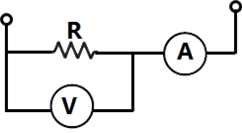
Sign in to UnlockThe set-up in figure is used to measure resistance R. The ammeter and voltmeter resistances are 0.01Ω and 2000Ω, respectively. Their readings are 2A and 180V, respectively, giving a measured resistance of 90Ω. The percentage error in the measurement is:
Sign in to see the solution
Log in to view the explanation, track your attempts, and keep your progress.
Sign in to UnlockResistances and have, respectively nominal values of 10Ω and 5Ω, and tolerances of ±5% and ±10%. The range of values for the parallel combination of and is
Sign in to see the solution
Log in to view the explanation, track your attempts, and keep your progress.
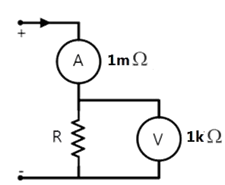
Sign in to UnlockIn the circuit shown in figure, for measuring resistance ‘R’ if the ammeter indicates 1A and the voltmeter indicates 100V, then the value of R is_____ Ohms and the error in measurement using the ratio V/I is _____ %
Sign in to see the solution
Log in to view the explanation, track your attempts, and keep your progress.
Sign in to UnlockA precise measurement guarantees accuracy of the measured quantity (True=1/False=0).
Sign in to see the solution
Log in to view the explanation, track your attempts, and keep your progress.
Sign in to UnlockA resistance is measured by the voltmeter ammeter method employing d.c. excitation and a voltmeter of very high resistance connected directly across the unknown resistance. If the voltmeter and ammeter readings are subject to maximum possible errors of respectively, then the magnitude of the maximum possible percentage error in the value of resistance deducted from the measurement is nearly

Sign in to see the solution
Log in to view the explanation, track your attempts, and keep your progress.
Sign in to Unlock