Electrical Machines
DC Machines
Electromechanical Energy Conversion
Questions mapped to Electromechanical Energy Conversion under DC Machines.
6
Total0
Attempted0
Correct0
IncorrectThe four stator conductors and of a rotating machine are carrying currents of the same value, the directions of which are shown in the figure (i). The rotor coils - ' and - ' are formed by connecting the back ends of conductors ' ' and ' ' and ' ' and ' ', respectively, as shown in figure (ii). The e.m.f. induced in coil - ' and coil - are denoted by and , respectively. If the rotor is rotated at uniform angular speed in the clockwise direction then which of the following correctly describes the and ?









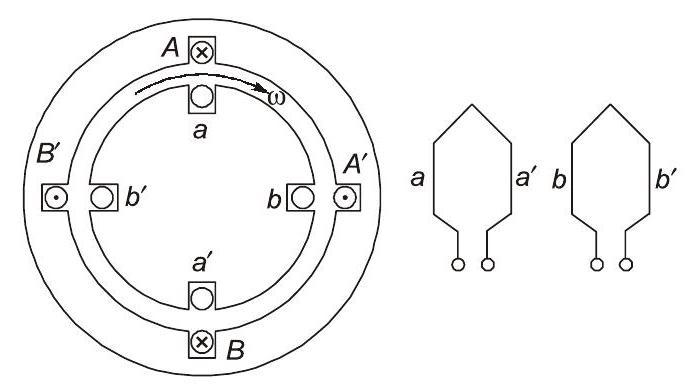
fig. (i) cross-section view fig. (ii) rotor winding connection diagram
and have finite magnitudes and are in the same phase.
and , have finite magnitudes with leading
and have finite magnitudes with leading

Sign in to see the solution
Log in to view the explanation, track your attempts, and keep your progress.
Sign in to UnlockFor a linear electromagnetic circuit, the following statement is true.
Sign in to see the solution
Log in to view the explanation, track your attempts, and keep your progress.
Sign in to UnlockWhen Stator and Rotor windings of a 2-pole rotating electrical machine are excited, each would produce a sinusoidal MMF distribution in the air gap with peak values and respectively. The rotor MMF lags stator MMF by a space angle δ at any instant as shown in Figure. Thus, half of stator and rotor surfaces will form one pole with the other half forming the second pole. Further, the direction of torque acting on the rotor can be clockwise or counter-clockwise.


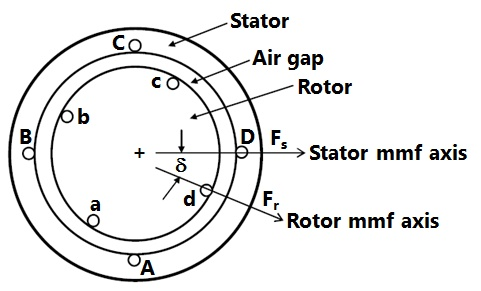
The following Table gives four sets of statements regarding poles and torque. Select the correct set corresponding to the MMF axis as shown in Figure
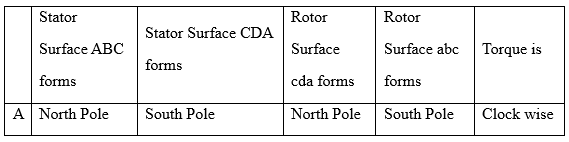
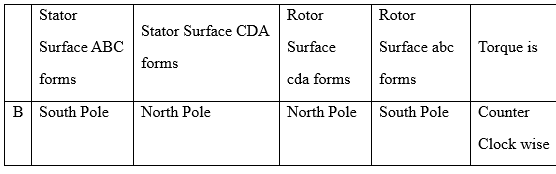
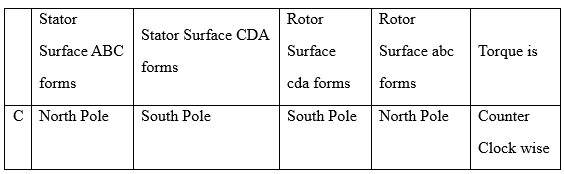
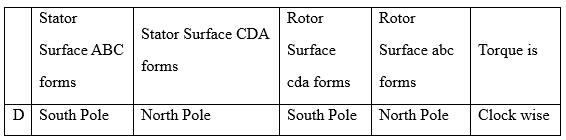
Sign in to see the solution
Log in to view the explanation, track your attempts, and keep your progress.
Sign in to UnlockFigure below, shows the details of an electromagnet with an operating coil rated for 230V, 50 Hz. The coil has 1500 turns. Find the average force of attraction on the armature of the electromagnet and the current drawn by the coil. Omit winding resistance and core losses and assume infinite permeability for the core.
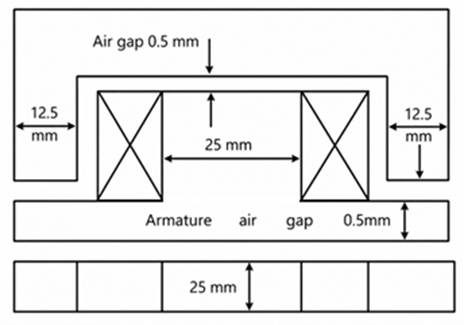
Sign in to see the solution
Log in to view the explanation, track your attempts, and keep your progress.
Sign in to UnlockNeglecting all losses, the developed torque (T) of a d.c. separately excited motor, operating under constant terminal voltage, is related to its output power (P) as under



T independent of P
Sign in to see the solution
Log in to view the explanation, track your attempts, and keep your progress.
Sign in to UnlockThe developed electromagnetic force and/or torque in electro-mechanical energy conversion systems act in a direction that tends
Sign in to see the solution
Log in to view the explanation, track your attempts, and keep your progress.
Sign in to Unlock