EMFT EE
Electrostatics
Electric Potential and Potential Gradient
Questions mapped to Electric Potential and Potential Gradient under Electrostatics.
13
Total0
Attempted0
Correct0
IncorrectAs shown in the figure below, two concentric conducting spherical shells, centered at r = 0 and having radii r = c and r= d are maintained at potentials such that the potential V(r) at r = c is and V(r) at r = d is . Assume that V(r) depends only on r, where r is the radial distance. The expression for V(r) in the region between r = c and r = d is






Sign in to see the solution
Log in to view the explanation, track your attempts, and keep your progress.
Sign in to UnlockThe vector function expressed by

represents a conservative field, where , , are unit vector along x, y and z directions, respectively. The values of constants , , are given by:










Sign in to see the solution
Log in to view the explanation, track your attempts, and keep your progress.
Sign in to UnlockIn cylindrical coordinate system, the potential produced by a uniform ring charge is given by , where f is a continuous function of r and z. Let be the resulting electric field. Then the magnitude of



Sign in to see the solution
Log in to view the explanation, track your attempts, and keep your progress.
Sign in to UnlockTwo electric charges q and -2q are placed at (0,0) and (6,0) on the x-y plane. The equation of the zero equipotential curve in the x-y plane is
x=-2
y=2


Sign in to see the solution
Log in to view the explanation, track your attempts, and keep your progress.
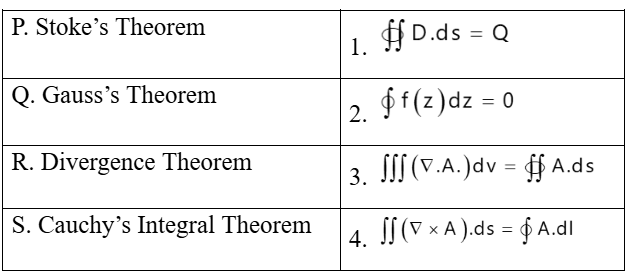
Sign in to UnlockMatch the following:
Sign in to see the solution
Log in to view the explanation, track your attempts, and keep your progress.
Sign in to UnlockIf is the electric field intensity, is equal to



Null vector
Zero
Sign in to see the solution
Log in to view the explanation, track your attempts, and keep your progress.
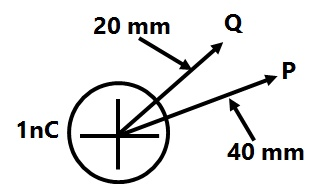
Sign in to UnlockA point charge of +1nC is placed in a space with a permittivity of as shown in Figure. The potential difference between two points P and Q at distances of 40 mm and 20 mm respectively from the point charge is


Sign in to see the solution
Log in to view the explanation, track your attempts, and keep your progress.
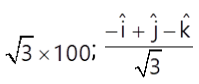
Sign in to UnlockGiven the potential function in free space to be volts, the magnitude (in volts/metre) and the direction of the electric field at a point (1, -1, 1), where the dimensions are in metres, are




Sign in to see the solution
Log in to view the explanation, track your attempts, and keep your progress.
Sign in to UnlockIn a uniform electric field, field lines and equipotentials
Sign in to see the solution
Log in to view the explanation, track your attempts, and keep your progress.
Sign in to UnlockIf v, w, q stand for voltage, energy and charge, then v can be expressed as




Sign in to see the solution
Log in to view the explanation, track your attempts, and keep your progress.
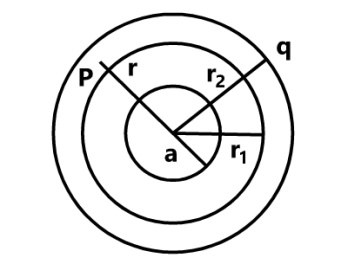
Sign in to UnlockA spherical conductor of radius ‘a’ with charge ‘q’ is placed concentrically inside an uncharged and unearthed spherical conducting shell of inner and outer radii respectively. Taking potential to be zero at infinity, the potential at any point P within the shell will be:






Sign in to see the solution
Log in to view the explanation, track your attempts, and keep your progress.
Sign in to UnlockA hollow conductor is at a potential V. The potential at any point inside the hollow is V. ( True=1, False=0)
Sign in to see the solution
Log in to view the explanation, track your attempts, and keep your progress.
Sign in to UnlockAn electrostatic potential is given by volts in the rectangular co-ordinate system. The magnitude of the electric field at , is _____________ V/m



Sign in to see the solution
Log in to view the explanation, track your attempts, and keep your progress.
Sign in to Unlock