Electrical Machines
Induction Machines
Power and Efficiency
Questions mapped to Power and Efficiency under Induction Machines.
13
Total0
Attempted0
Correct0
IncorrectA three phase, pole induction motor runs at . The stator copper loss, core loss, and the rotational loss of the motor can be neglected. The percentage efficiency of the motor is


Sign in to see the solution
Log in to view the explanation, track your attempts, and keep your progress.
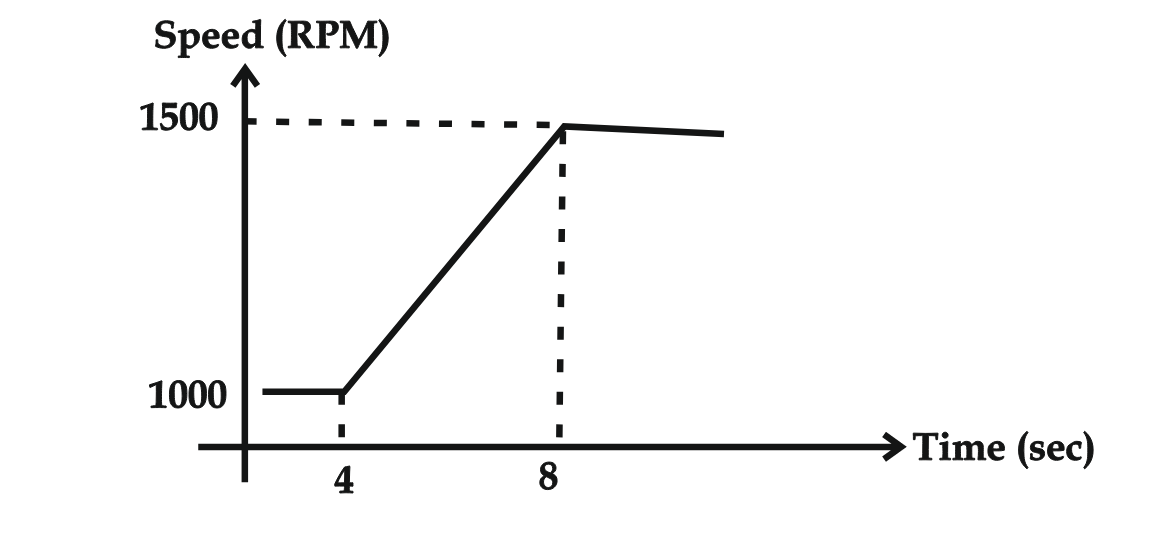
Sign in to UnlockA 4-pole induction motor with inertia of drives a constant load torque of 2 Nm. The speed of the motor is increased linearly from 1000 rpm to 1500 rpm in 4 seconds as shown in the figure below. Neglect losses in the motor. The energy, in joules, consumed by the motor during the speed change is ……… (round off to nearest integer).

Sign in to see the solution
Log in to view the explanation, track your attempts, and keep your progress.
Sign in to UnlockThe power input to a 500 V, 50 Hz, 6-pole. 3-phase induction motor running at 975 RPM is 40 kW. The total stator losses are 1 kW. If the total friction and windage losses are 2.025 kW. then the efficiency is __________ %.
Sign in to see the solution
Log in to view the explanation, track your attempts, and keep your progress.
Sign in to UnlockA three-phase, 50 Hz, 4-pole induction motor runs at no-load with a slip of 1 %. With full load, the slip increases to 5 %. The % speed regulation of the motor (rounded off to 2 decimal places) is
Sign in to see the solution
Log in to view the explanation, track your attempts, and keep your progress.
Sign in to UnlockConsider a system consisting of a synchronous generator working at a lagging power factor, a synchronous motor working at an overexcited condition and a directly grid-connected induction generator. Consider capacitive VAr to be a source and inductive VAr to be a sink of reactive power. Which one of the following statements is TRUE?
Sign in to see the solution
Log in to view the explanation, track your attempts, and keep your progress.
Sign in to UnlockA 400 V, 50 Hz, 30 hp, three-phase induction motor is drawing 50 A current at 0.8 power factor lagging. The stator and rotor copper losses are 1.5 kW and 900 W respectively. The friction and windage losses are 1050W and the core losses are 1200 W. The air-gap power of the motor will be
Sign in to see the solution
Log in to view the explanation, track your attempts, and keep your progress.
Sign in to UnlockFor an induction motor, operating at a slip s, the ratio of gross power output to air gap power is equal to:

(1 – s)


Sign in to see the solution
Log in to view the explanation, track your attempts, and keep your progress.
Sign in to UnlockUnder no load condition, if the applied voltage to an induction motor is reduced from the rated voltage to half the rated value,
Sign in to see the solution
Log in to view the explanation, track your attempts, and keep your progress.
Sign in to UnlockA 400V, 15 kW, 4 poles, 50 Hz, Y-connected induction motor has full load slip of 4%. The output torque of the machine at full load is
Sign in to see the solution
Log in to view the explanation, track your attempts, and keep your progress.
Sign in to UnlockThe power input to a 415V, 50 Hz, 6 pole, 3-phase induction motor running at 975 rpm is 40 kW. The stator losses are 1 kW and friction and windage losses total 2kW. The efficiency of the motor is
Sign in to see the solution
Log in to view the explanation, track your attempts, and keep your progress.
Sign in to UnlockA three phase, wound rotor induction motor is to be operated with slip energy recovery in the constant torque mode, when it delivers an output power at slip s. Then theoretically, the maximum power that is available for recovery at the rotor terminals, is equal to





Sign in to see the solution
Log in to view the explanation, track your attempts, and keep your progress.
Sign in to UnlockA 3 phase squirrel cage induction motor has a full load efficiency of 0.8 and a maximum efficiency of 0.9. it is operated at a slip of 0.6 by applying a reduced voltage. The efficiency of the motor at this operating point is:
Sign in to see the solution
Log in to view the explanation, track your attempts, and keep your progress.
Sign in to UnlockA 50 hp, 6 pole, 50 Hz slip-ring induction motor runs at 960 rpm on full load with a rotor current of 40A. Allowing 300W for the copper loss in the short circuiting gear and 1200W for mechanical losses, find the resistance per phase of the 3 phase rotor winding.

Sign in to see the solution
Log in to view the explanation, track your attempts, and keep your progress.
Sign in to Unlock