Electrical Machines
Induction Machines
Speed Control
Questions mapped to Speed Control under Induction Machines.
20
Total0
Attempted0
Correct0
IncorrectA three phase , 6-pole, squirrel cage induction motor drives a constant torque load at rated speed operating from rated supply and delivering rated output. If the supply voltage and frequency are reduced by , the resultant speed of the motor in RPM (neglecting the stator leakage impedance and rotational losses) is _________ (Round off to the nearest integer).



Sign in to see the solution
Log in to view the explanation, track your attempts, and keep your progress.
Sign in to UnlockIn a constant V/f induction motor drive, the slip at the maximum torque
Sign in to see the solution
Log in to view the explanation, track your attempts, and keep your progress.
Sign in to UnlockA three-phase, 4-pole, self-excited induction generator is feeding power to a load at a frequency . If the load is partially removed, the frequency becomes . If the speed of the generator is maintained at 1500 rpm in both the cases, then


and


and


and


and

Sign in to see the solution
Log in to view the explanation, track your attempts, and keep your progress.
Sign in to UnlockIn a constant V/f control of induction motor, the ratio V/f is maintained constant from 0 to base frequency, where V is the voltage applied to the motor at fundamental frequency f. Which of the following statements relating to low frequency operating of the motor is TRUE?
Sign in to see the solution
Log in to view the explanation, track your attempts, and keep your progress.
Sign in to UnlockA separately excited dc machine is coupled to a 50Hz, three-phase. 4-pole induction machine as shown in the figure. The dc machine is energized first and the machines rotate at 1600rpm. Subsequently the induction machine is also connected to a 50Hz, three-phase source, the phase sequence being consistent with the direction of rotation, in steady state.

Sign in to see the solution
Log in to view the explanation, track your attempts, and keep your progress.
Sign in to UnlockA 400 V, 50 Hz, 4 pole, 1400 rpm, Star connected squirrel cage induction motor has the following parameters referred to the stator:

Neglect stator resistance and core and rotational losses of the motor.
The motor is controlled from a 3-phase voltage Source inverter with constant V/f control. The stator line-to-line voltage (RMS) and frequency to obtain the maximum torque at starting will be:
Sign in to see the solution
Log in to view the explanation, track your attempts, and keep your progress.
Sign in to UnlockA 3-phase, 440 V, 50 Hz, 4-pole, slip ring induction motor is fed from the rotor side through an autotransformer and the stator is connected to a variable resistance as shown in the figure.
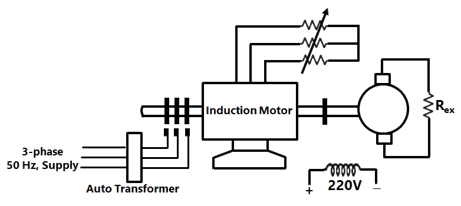
The motor is coupled to a 220V, separately excited, dc generator feeding power to fixed resistance of10Ω. Two-wattmeter method is used to measure the input power to induction motor. The variable resistance is adjusted such that the motor runs at 1410 rpm and the following readings were recorded:
,


The speed of rotation of stator magnetic field with respect to rotor structure will be
Sign in to see the solution
Log in to view the explanation, track your attempts, and keep your progress.
Sign in to UnlockA 3-phase, 440 V, 50 Hz, 4-pole, slip ring induction motor is fed from the rotor side through an autotransformer and the stator is connected to a variable resistance as shown in the figure.
The motor is coupled to a 220V, separately excited, dc generator feeding power to fixed resistance of10Ω. Two-wattmeter method is used to measure the input power to induction motor. The variable resistance is adjusted such that the motor runs at 1410 rpm and the following readings were recorded:
,
Neglecting all losses of both the machines, the dc generator power output and the current through resistance will respectively be

Sign in to see the solution
Log in to view the explanation, track your attempts, and keep your progress.
Sign in to UnlockA voltage source inverter is used to control the speed of a three-phase, 50 Hz, squirrel cage induction motor. Its slip for rated torque is 4%. The flux is maintained at rated value. If the stator resistance and rotational losses are neglected, then the frequency of the impressed voltage to obtain the rated torque at starting should be
Sign in to see the solution
Log in to view the explanation, track your attempts, and keep your progress.
Sign in to UnlockThe speed of a 3-phase, 440 V, 50 Hz induction motor is to be controlled over a wide range from zero speed to 1.5 times the rated speed using a 3-phase voltage source inverter. It is desired to keep the flux in
the machine constant in the constant torque region by controlling the terminal voltage as the frequency changes. The inverter output voltage vs frequency characteristics should be
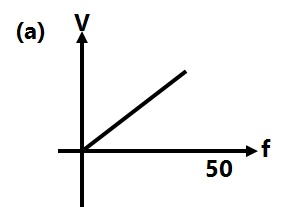
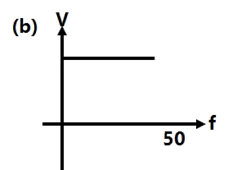
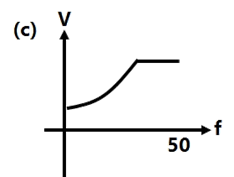
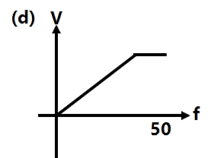
Sign in to see the solution
Log in to view the explanation, track your attempts, and keep your progress.
Sign in to UnlockThe speed of a 4-pole induction motor is controlled by varying the supply frequency while maintaining the ratio of supply voltage to supply frequency (V/fJ constant. At rated frequency of 50 Hz and rated voltage of 400 V its speed is 1440 rpm. Find the speed at 30 Hz, if the load torque is constant.
Sign in to see the solution
Log in to view the explanation, track your attempts, and keep your progress.
Sign in to UnlockDetermine the correctness or otherwise of the following Assertion [a] and the Reason [r].
Assertion: Under V/f control of induction motor, the maximum value of the developed torque remains constant over a wide range of speed in the sub-synchronous region.
Reason: The magnetic flux is maintained almost constant at the rated value by keeping the ratio V/f constant over the considered speed range.
Sign in to see the solution
Log in to view the explanation, track your attempts, and keep your progress.
Sign in to UnlockAn ac induction motor is used for a speed control application. It is driven from an inverter with a constant V/f control. The motor nameplate details are as follows
V: 415 V Ph: 3 f: 50Hz N: 2850 rpm
The motor is run with the inverter output frequency set at 40 Hz, and with half the rated slip. The running speed of the motor is
Sign in to see the solution
Log in to view the explanation, track your attempts, and keep your progress.
Sign in to UnlockA 3-phase Inductor Motor is driving a constant torque load at rated voltage and frequency. If both voltage and frequency are halved, following statements related to the new condition if stator resistance, leakage reactance and core loss are ignored.
P The difference between synchronous speed and actual speed remains same
Q The air-gap flux remains same
R The stator current remains same
S The p.u. slip remains same
Among the above, correct statements are
Sign in to see the solution
Log in to view the explanation, track your attempts, and keep your progress.
Sign in to UnlockIf a 400V, 50 Hz, star connected, 3 phase squirrel cage induction motor is operated from a 400 V, 75 Hz supply, the torque that the motor can now provide while drawing rated current from the supply?
Sign in to see the solution
Log in to view the explanation, track your attempts, and keep your progress.
Sign in to UnlockA 230V, 20 hp, 60 Hz, 6-pole, 3-phase induction motor driving a constant torque load at rated frequency, rated voltage and rated horse-power, has a speed of 1175 rpm and an efficiency of 92.1%. Determine the new operating speed if a system disturbance causes 10% drop in voltage and 6% drop in frequency. Assume that friction, windage and stray power losses remain constant.
Sign in to see the solution
Log in to view the explanation, track your attempts, and keep your progress.
Sign in to UnlockA 3-phase, 20kW, 400V, 1470rpm, 50Hz squirrel cage induction motor develops a torque of 100 N-m at a speed of 1400rpm. If the motor is connected to a 30Hz supply, for keeping the same air-gap flux, then supply voltage should be… V and for the same load torque, the new speed will be…. Rpm
Sign in to see the solution
Log in to view the explanation, track your attempts, and keep your progress.
Sign in to UnlockA 50 Hz, 440V, three-phase, 4-pole induction motor develops half the rated torque at 1490rpm. With the applied voltage magnitude remaining at the rated value. What should be its frequency if the motor has to develop the same torque at 1600rpm? Neglect stator and rotor winding resistances, leakage reactances and iron losses.
Sign in to see the solution
Log in to view the explanation, track your attempts, and keep your progress.
Sign in to UnlockIn a variable frequency induction motor drive, the voltage must be varied linearly to the frequency. (True=1/False=0)
Sign in to see the solution
Log in to view the explanation, track your attempts, and keep your progress.
Sign in to UnlockA prime mover drives a 6 pole, 3-phase induction frequency converter. The converter is connected to 60 Hz, 3-phase supply on the primary. If the prime mover speed is 3000 rpm, the frequencies of the possible outputs from the converter are
Sign in to see the solution
Log in to view the explanation, track your attempts, and keep your progress.
Sign in to Unlock