Signals and Systems
Laplace Transform
Laplace Transform Calculation
Questions mapped to Laplace Transform Calculation under Laplace Transform.
10
Total0
Attempted0
Correct0
IncorrectIf is the unit step function, then the region of convergence (ROC) of the Laplace transform of the signal is






Sign in to see the solution
Log in to view the explanation, track your attempts, and keep your progress.
Sign in to UnlockThe inverse Laplace transform of
is





Sign in to see the solution
Log in to view the explanation, track your attempts, and keep your progress.
Sign in to UnlockThe Laplace Transform of is





Sign in to see the solution
Log in to view the explanation, track your attempts, and keep your progress.
Sign in to UnlockConsider a causal LTI system characterized by differential equation . The response of the system to the input , where u(t) denotes the unit step function, is






Sign in to see the solution
Log in to view the explanation, track your attempts, and keep your progress.
Sign in to UnlockConsider an LTI system with impulse response. If the output of the system is then the input, x(t), is given by






Sign in to see the solution
Log in to view the explanation, track your attempts, and keep your progress.
Sign in to UnlockThe impulse response of a system is h(t)=t u(t) . for an input u(t-1), the output is




Sign in to see the solution
Log in to view the explanation, track your attempts, and keep your progress.
Sign in to UnlockGiven f(t) and g(t) as shown below:
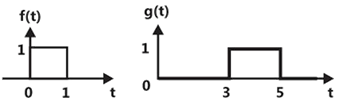
g(t) can be expressed as




Sign in to see the solution
Log in to view the explanation, track your attempts, and keep your progress.
Sign in to UnlockGiven f(t) and g(t) as shown below:
The Laplace transform of g(t) is




Sign in to see the solution
Log in to view the explanation, track your attempts, and keep your progress.
Sign in to UnlockThe running integrator, given by

Sign in to see the solution
Log in to view the explanation, track your attempts, and keep your progress.
Sign in to UnlockA rectangular current pulse of duration T and magnitude I has the Laplace transform




Sign in to see the solution
Log in to view the explanation, track your attempts, and keep your progress.
Sign in to Unlock