Signals and Systems
LTI Systems
Discrete Convolution
Questions mapped to Discrete Convolution under LTI Systems.
7
Total0
Attempted0
Correct0
IncorrectConsider a discrete-time linear time-invariant (LTI) system , where


Let
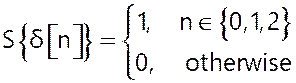
where is the discrete-time unit impulse function. For an input signal , the output is






Sign in to see the solution
Log in to view the explanation, track your attempts, and keep your progress.
Sign in to UnlockTwo discrete-time linear time-invariant systems with impulse responses and are connected in cascade, where is the Kronecker delta. The impulse response of the cascaded system is







Sign in to see the solution
Log in to view the explanation, track your attempts, and keep your progress.
Sign in to UnlockConsider a causal and stable LTI system with rational transfer function H(z), whose corresponding impulse response begins at n = 0. Furthermore,
. The poles of H (z) are for k = 1, 2, 3, 4.


The zeros of H(z) are all at z = 0. Let . The value of g[8] equals ___________________. (Given the answer up to three decimal places).

Sign in to see the solution
Log in to view the explanation, track your attempts, and keep your progress.
Sign in to UnlockA cascade system having the impulse responses and is shown in the figure below, where symbol denotes the time origin.




The input sequence x(n) for which the cascade system produces an output sequence is





Sign in to see the solution
Log in to view the explanation, track your attempts, and keep your progress.
Sign in to UnlockLet y[n] denote the convolution of h[n] and g[n], where and g[n] is a casual sequence. If and , then g[1] equals



0

1
3/2
Sign in to see the solution
Log in to view the explanation, track your attempts, and keep your progress.
Sign in to UnlockGiven the finite length input x[n] and the corresponding finite length output y[n] of an LTI system as shown below, the impulse response h[n] of the system is
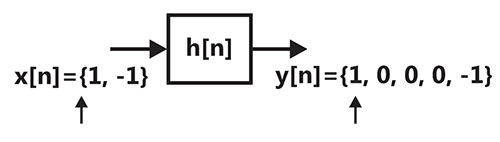




Sign in to see the solution
Log in to view the explanation, track your attempts, and keep your progress.
Sign in to Unlockx[n] = 0; n <-1&n>0, x[-1]=-1, x[0]=2 is the input and y[n]=0; n<-1&n>2, y[-1]=–1=y[1], y[0]=3, y[2]=-2 is the output of a discrete time LTI system. The system impulse response h[n] will be
Sign in to see the solution
Log in to view the explanation, track your attempts, and keep your progress.
Sign in to Unlock