Signals and Systems
Signals
Practice questions from Signals.
26
Total0
Attempted0
Correct0
IncorrectConsider a continuous-time signal

where is the continuous-time unit step function. Let be the continuous time unit impulse function. The value of is



Explanation Locked!
Unlock this branch to view the explanation, track, bookmark and more.
Sign in to UnlockA continuous time periodic signal x(t) is

If is the period of , then __________ (round off to the nearest integer).



Explanation Locked!
Unlock this branch to view the explanation, track, bookmark and more.
Sign in to UnlockThe input and the output of a system are related as



Explanation Locked!
Unlock this branch to view the explanation, track, bookmark and more.
Sign in to UnlockConsider the discrete-time systems and defined as follows:




Which one of the following statements is true?
and are BIBO stable.


and are not BIBO stable.
is BIBO stable but is not BIBO stable.
is not BIBO stable but is BIBO stable.
Explanation Locked!
Unlock this branch to view the explanation, track, bookmark and more.
Sign in to UnlockIf the energy of a continuous-time signal is and the energy of the signal is , then is ________ (rounded off to 1 decimal place).




Explanation Locked!
Unlock this branch to view the explanation, track, bookmark and more.
Sign in to UnlockThe period of the discrete-time signal described by the equation below is __________ (Round off to the nearest integer).



Explanation Locked!
Unlock this branch to view the explanation, track, bookmark and more.
Sign in to Unlockand are, respectively, the rms and average values of x(t) = x(t — T) , and similarly, and are, respectively, the rms and average values of . k,T are independent of t . Which of the following is true?









Explanation Locked!
Unlock this branch to view the explanation, track, bookmark and more.
Sign in to UnlockConsider the two continuous-time signals defined below:


These signals are sampled with a sampling period of T=0.25 seconds to obtain discrete-time signalsand , respectively. Which one of the following statements is true?


The energy of is greater than the energy of.
The energy of is greater than the energy of.
and have equal energies.
Neither nor is a finite-energy signal.
Explanation Locked!
Unlock this branch to view the explanation, track, bookmark and more.
Sign in to UnlockThe signal energy of the continuous-time signal





Explanation Locked!
Unlock this branch to view the explanation, track, bookmark and more.
Sign in to UnlockThe mean square value of the given periodic waveform f(t) is ______
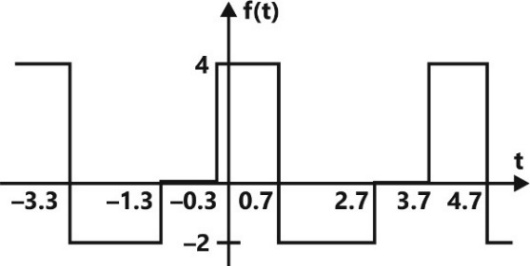
Explanation Locked!
Unlock this branch to view the explanation, track, bookmark and more.
Sign in to UnlockThe value of , where is the Dirac delta function, is






Explanation Locked!
Unlock this branch to view the explanation, track, bookmark and more.
Sign in to UnlockA moving average function is given by . If the input u is a sinusoidal signal of frequency, then in steady state, the output y will lag u (in degree) by___________.


Explanation Locked!
Unlock this branch to view the explanation, track, bookmark and more.
Sign in to UnlockThe function shown in the figure can be represented as
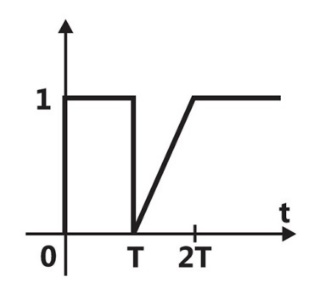




Explanation Locked!
Unlock this branch to view the explanation, track, bookmark and more.
Sign in to UnlockThe impulse response of a continuous time system is given by h(t)=δ(t-1)+δ(t-3). The value of the step response at t=2 is
Explanation Locked!
Unlock this branch to view the explanation, track, bookmark and more.
Sign in to UnlockA zero mean random signal is uniformly distributed between limits –a and +a and its mean square value is equal to its variance. Then the RMS value of the signal is




Explanation Locked!
Unlock this branch to view the explanation, track, bookmark and more.
Sign in to UnlockThe period of the signal is





Explanation Locked!
Unlock this branch to view the explanation, track, bookmark and more.
Sign in to UnlockGiven a sequence x(n], to generate the sequence, which one of the following procedures would be correct?

First delay x[n] by 3 samples to generate , then pick every samples of to generate , and then finally time reverse to obtain y[n].



First advance x[n] by 3 samples to generate , then pick every samples of to generate , and then finally time reverse to obtain y[n]
First pick every fourth sample of x[n] to generate , time reverse to obtain , and finally advance by 3 samples to obtain y[n]


First pick every fourth sample of x[n] to generate , time reverse to obtain , and finally delay by 3 samples to obtain y[n]
Explanation Locked!
Unlock this branch to view the explanation, track, bookmark and more.
Sign in to UnlockWhich of the following is true
A finite signal is always bounded
A bounded signal always possesses finite energy
A bounded signal is always zero outside the interval for some


None
Explanation Locked!
Unlock this branch to view the explanation, track, bookmark and more.
Sign in to UnlockFor the triangular waveform shown in Figure, the RMS value of the voltage is equal to
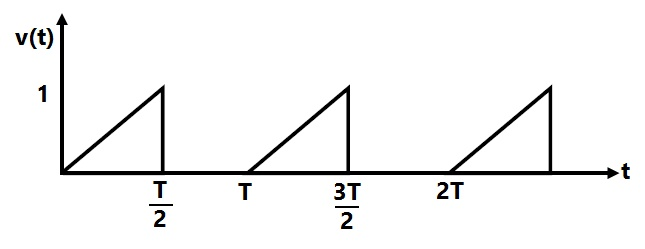




Explanation Locked!
Unlock this branch to view the explanation, track, bookmark and more.
Sign in to UnlockThe RMS value of the periodic waveform given in figure is
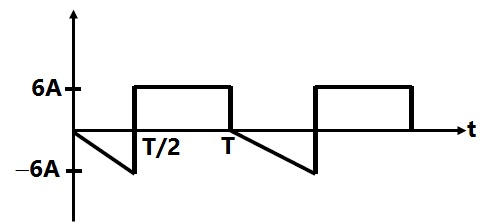



1.5 A
Explanation Locked!
Unlock this branch to view the explanation, track, bookmark and more.
Sign in to UnlockA current impulse, , is forced through a capacitor C. The voltage, , across the capacitor is given by


5t
5u(t) − C


Explanation Locked!
Unlock this branch to view the explanation, track, bookmark and more.
Sign in to UnlockWhat is the RMS value of the voltage waveform shown in Figure?
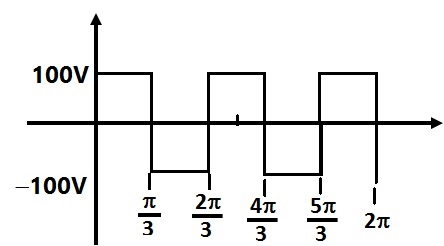


200 V
100 V
Explanation Locked!
Unlock this branch to view the explanation, track, bookmark and more.
Sign in to UnlockThe RMS value of a half-wave rectified symmetrical square wave current of 2A is:

1A


Explanation Locked!
Unlock this branch to view the explanation, track, bookmark and more.
Sign in to UnlockThe RMS value of the periodic waveform S(t), shown in figure is:
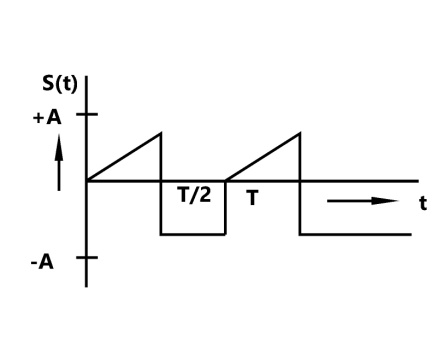



Explanation Locked!
Unlock this branch to view the explanation, track, bookmark and more.
Sign in to UnlockMatch the waveforms on the left-hand side with the correct mathematical description listed on the right-hand side.
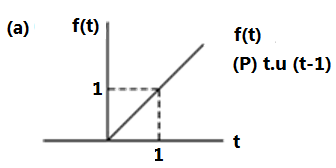
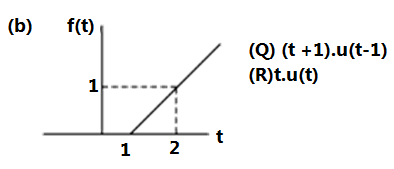
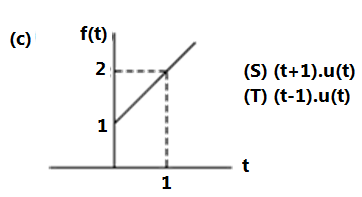
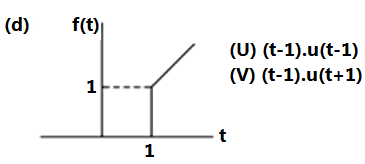
Explanation Locked!
Unlock this branch to view the explanation, track, bookmark and more.
Sign in to UnlockThe value of the integral is equal to ______________



Explanation Locked!
Unlock this branch to view the explanation, track, bookmark and more.
Sign in to Unlock