Electrical Machines
Synchronous Machines
Voltage Regulation - Synchronous Machines
Questions mapped to Voltage Regulation - Synchronous Machines under Synchronous Machines.
11
Total0
Attempted0
Correct0
IncorrectA three-phase cylindrical rotor synchronous generator has a synchronous reactance and a negligible armature resistance. The magnitude of per phase terminal voltage is and the magnitude of per phase induced emf is . Considering the following two statements, P and Q,



P: For any three phase balanced leading load connected across the terminals of this synchronous generator, is always more than
Q: For any three-phase balanced lagging load connected across the terminals of this synchronous generator, is always less than
Which of the following options is correct?
Sign in to see the solution
Log in to view the explanation, track your attempts, and keep your progress.
Sign in to UnlockA cylindrical rotor synchronous generator with constant real power output and constant terminal voltage is supplying 100 A current to a 0.9 lagging power factor load. An ideal reactor is now connected in parallel with the load, as a result of which the total lagging reactive power requirement of the load is twice the previous value while the real power remains unchanged. The armature current is now _________ A (Rounded off to 2 decimal places).
Sign in to see the solution
Log in to view the explanation, track your attempts, and keep your progress.
Sign in to UnlockIf a synchronous motor is running at a leading power factor, its excitation induced voltage () is

Equal to terminal voltage

Higher than the terminal voltage
Less than terminal voltage
Dependent upon supply voltage
Sign in to see the solution
Log in to view the explanation, track your attempts, and keep your progress.
Sign in to UnlockA non-salient pole synchronous generator having synchronous reactance of 0.8 pu is supplying 1 pu power to a unity power factor load at a terminal voltage of 1.1 pu. Neglecting the armature resistance, the angle of the voltage behind the synchronous reactance with respect to the angle of the terminal voltage in degrees is ______________.
Sign in to see the solution
Log in to view the explanation, track your attempts, and keep your progress.
Sign in to UnlockA stand-alone engine driven Synchronous generator is feeding a partly inductive load. A capacitor is now connected across the load to completely nullify the inductive current. For this operating condition.
Sign in to see the solution
Log in to view the explanation, track your attempts, and keep your progress.
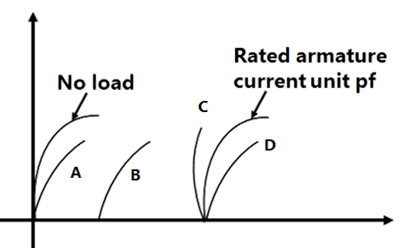
Sign in to UnlockFigure shows the magnetization curves of an alternator at rated armature current, unity power factor and also at no load. The magnetization curve for rated armature current, 0.8 power factor leading is given by
Sign in to see the solution
Log in to view the explanation, track your attempts, and keep your progress.
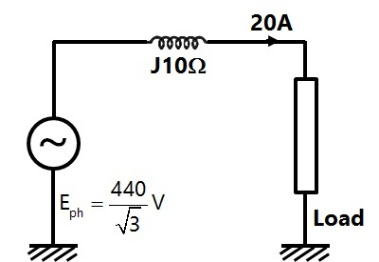
Sign in to UnlockA star-connected 440 V, 50 Hz alternators has per phase synchronous reactance of 10Ω. It supplies a balanced capacitive load current of 20A, as shown in the per phase equivalent circuit of Figure. It is desirable to have zero voltage regulation. The load power factor should be
Sign in to see the solution
Log in to view the explanation, track your attempts, and keep your progress.
Sign in to UnlockA single-phase, 2000V alternator has armature resistance and reactance of 0.8 ohms and 4.94 ohms respectively. The voltage regulation of the alternator at 100A load at 0.8 leading power-factor is:
Sign in to see the solution
Log in to view the explanation, track your attempts, and keep your progress.
Sign in to UnlockA single-phase alternator has a synchronous reactance of 2 ohms and negligible resistance. If it supplies 10A to a purely capacitive load at 200V, then generated e.m.f will be… V and the regulation will be…%
Sign in to see the solution
Log in to view the explanation, track your attempts, and keep your progress.
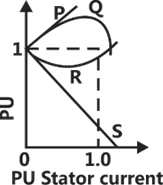
Sign in to UnlockFigure depicts the load characteristics of an isolated three-phase alternator, running at constant speed. Match the following sets of operating conditions with the given characteristics. Disregard the effects of saliency, saturation and stator resistance.
(a) Constant excitation and non-zero leading power-factor
(b) Constant excitation and zero power-factor leading
(c) Constant terminal voltage and zero power-factor leading
(d) Constant terminal voltage and non-zero leading power-factor
Sign in to see the solution
Log in to view the explanation, track your attempts, and keep your progress.
Sign in to UnlockA 10 kVA, 380V, 4-pole, 50 Hz, star-connected cyclindrical rotor alternator has a stator resistance and synchronous reactance of 1 ohm and 15 ohms respectively. It supplies a load of 8 kW at rated voltage and 0.8 power factor lagging.
Sign in to see the solution
Log in to view the explanation, track your attempts, and keep your progress.
Sign in to Unlock