Engineering Mathematics
Transform Theory
Practice questions from Transform Theory.
6
Total0
Attempted0
Correct0
IncorrectLet where. The value of d in the range , such that is __________.




Explanation Locked!
Unlock this branch to view the explanation, track, bookmark and more.
Sign in to UnlockThe signum function is given by

The Fourier series expansion of sgn has

Explanation Locked!
Unlock this branch to view the explanation, track, bookmark and more.
Sign in to UnlockLet be a function defined by , where [x] represents the integer part of x. (That is, it is the largest integer which is less than or equal to x). The value of the constant term in the Fourier series expansion of g(x) is __________.


Explanation Locked!
Unlock this branch to view the explanation, track, bookmark and more.
Sign in to UnlockA function y(t) satisfies the following differential equation: , where δ(t) is the delta function. Assuming zero initial condition and denoting the unit step function by u(t), y(t) can be of the form





Explanation Locked!
Unlock this branch to view the explanation, track, bookmark and more.
Sign in to UnlockFor the system
with u as unit impulse and with zero initial state, the output, y, becomes





Explanation Locked!
Unlock this branch to view the explanation, track, bookmark and more.
Sign in to UnlockA single input single output system with y as output and u as input, is described by

For the above system find an input u(t), with zero initial condition, that produces the same output as with no input and with the initial conditions.

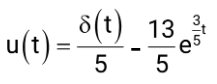

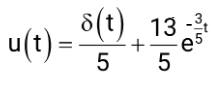
None of these
Explanation Locked!
Unlock this branch to view the explanation, track, bookmark and more.
Sign in to Unlock