Power Systems
Transmission and Distribution
HVDC
Questions mapped to HVDC under Transmission and Distribution.
10
Total0
Attempted0
Correct0
IncorrectConsider a HVDC link which uses thyristor based line- commutated converter as shown in the figure. For a power flow of 750 MW from system 1 to system 2, the voltages at the two ends, and the current are given by: =500 kV, and I=1.5 kA. If the direction of power flow is to be reversed (that is from system 2 to system 1) without changing the electrical connections, then which one of the following combinations is feasible?


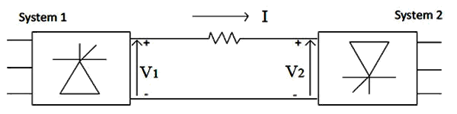
and I = 1.5 kA

and I =1.5 kA

and I = – 1.5kA

and I = – 1.5 kA
Sign in to see the solution
Log in to view the explanation, track your attempts, and keep your progress.
Sign in to UnlockPower is transferred from system A to system B by an HVDC link as shown in the figure. If the voltages and are as indicated in the figure and l > 0, then


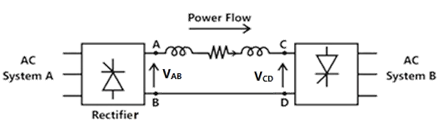




Sign in to see the solution
Log in to view the explanation, track your attempts, and keep your progress.
Sign in to UnlockTwo regional systems, each having several synchronous generators and loads are interconnected by an ac line and a HVDC link as shown in the figure. Which of the following statements is true in the steady state:
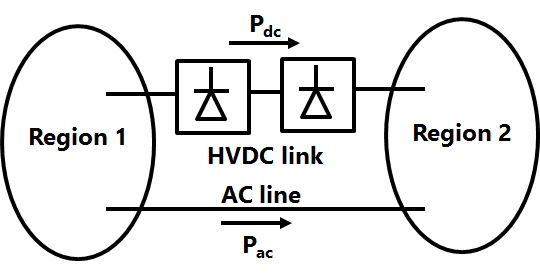
Both regions need not have the same frequency.
The total power now between the regions can be changed by controlling the HVDC converters alone.

The power sharing between the ac line and the HVDC link can be changed by controlling the HVDC converters alone.
The direction of power now in the HVDC link cannot be reversed.

Sign in to see the solution
Log in to view the explanation, track your attempts, and keep your progress.
Sign in to UnlockAn HVDC link consists of rectifier, inverter transmission line and other equipment’s. Which one of the following is true for this link?
Sign in to see the solution
Log in to view the explanation, track your attempts, and keep your progress.
Sign in to UnlockHigh Voltage DC (HVDC) transmission is mainly used for
Sign in to see the solution
Log in to view the explanation, track your attempts, and keep your progress.
Sign in to UnlockChoose two appropriate auxiliary components of a HVDC transmission system from the following
P. D.C. line inductor
Q. A.C. line inductor
R. Reactive power sources
S. Distance relays on D.C. line
T. Series capacitance of A.C. line
Sign in to see the solution
Log in to view the explanation, track your attempts, and keep your progress.
Sign in to UnlockOut of the considerations (i) and (iv) listed below
(i) No distance limitation related to steady state stability
(ii) No reactive power requirement from the system at the two terminals
(iii) No substantial effect fault level of the two systems at the terminals in spite of the interconnection
(iv) No corona problems
The considerations, which constitute advantage of HVDC transmission, are
Sign in to see the solution
Log in to view the explanation, track your attempts, and keep your progress.
Sign in to UnlockIn a DC transmission line
Sign in to see the solution
Log in to view the explanation, track your attempts, and keep your progress.
Sign in to UnlockBulk power transmission over long HVDC lines is preferred, on account of
Sign in to see the solution
Log in to view the explanation, track your attempts, and keep your progress.
Sign in to UnlockHVDC Transmission is preferred to EHV-AC because
Sign in to see the solution
Log in to view the explanation, track your attempts, and keep your progress.
Sign in to Unlock