Analog Electronics
BJT
Practice questions from BJT.
42
Total0
Attempted0
Correct0
IncorrectA BJT biasing circuit is shown in the figure, where and . The Quiescent Point values of and are respectively




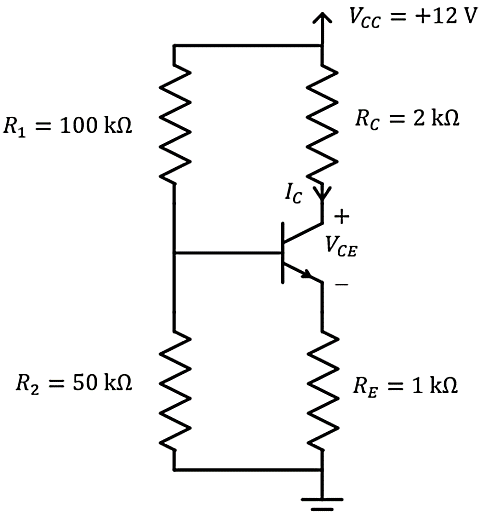
and


and

and


and
Explanation Locked!
Unlock this branch to view the explanation, track, bookmark and more.
Sign in to UnlockThe Zener diode in circuit has a breakdown voltage of . The current gain of the transistor in the active region in 99. Ignore base-emitter voltage drop . The current through the 20Ω resistance in milliamperes is _________ (Round off to 2 decimal places).



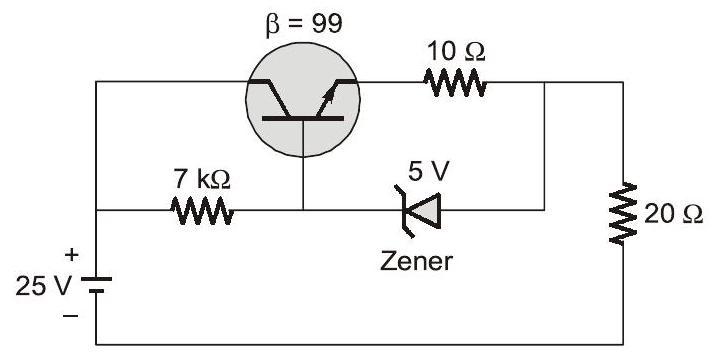
Explanation Locked!
Unlock this branch to view the explanation, track, bookmark and more.
Sign in to UnlockIn the BJT circuit shown, beta of the PNP transistor is 100. Assume . .


The voltage across will be 5 V when is ……… kΩ. (Round off 2 decimal places)


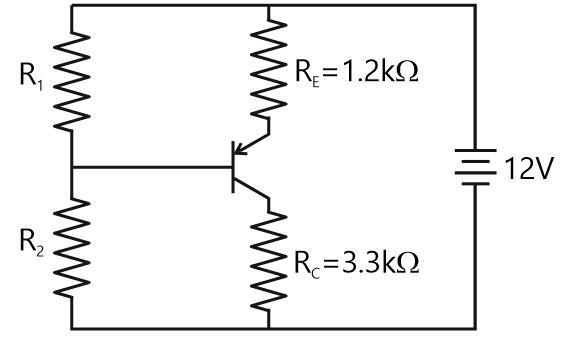
Explanation Locked!
Unlock this branch to view the explanation, track, bookmark and more.
Sign in to UnlockIn the circuit shown in the figure, the bipolar junction transistor (BJT) has a current gain. The base-emitter voltage drop is a constant. The value of the Thevenin equivalent resistance (in ) as shown in the figure is ________(up to 2 decimal places).



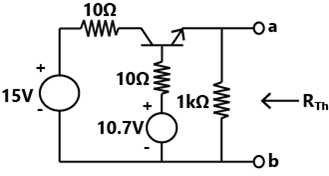
Explanation Locked!
Unlock this branch to view the explanation, track, bookmark and more.
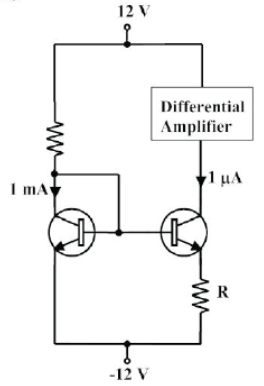
Sign in to UnlockThe circuit shown in the figure uses matched transistors with a thermal voltage . The base currents of the transistors are negligible. The value of the resistance R in that is required to provide 1 bias current for the differential amplifier block shown is __________ . (Give the answer up to one decimal place.)



Explanation Locked!
Unlock this branch to view the explanation, track, bookmark and more.
Sign in to UnlockFor the circuit shown in the figure below, it is given that . The transistor has and when the B-E junction is forward biased.



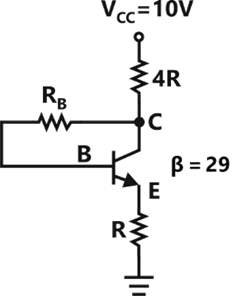
For this circuit, the value of is

Explanation Locked!
Unlock this branch to view the explanation, track, bookmark and more.
Sign in to UnlockA transistor circuit is given below. The Zener diode breakdown voltage is 5.3V as shown. Take base to emitter voltage drop to be 0.6V. The value of the current gain is __________.

Explanation Locked!
Unlock this branch to view the explanation, track, bookmark and more.
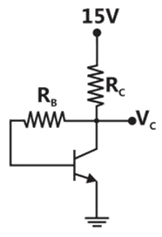
Sign in to UnlockIn the given circuit, the silicon transistor has and a collector voltage . Then the ratio of and is ____________.



Explanation Locked!
Unlock this branch to view the explanation, track, bookmark and more.
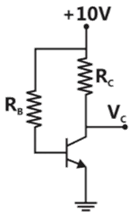
Sign in to UnlockIn the following circuit, the transistor is in active mode and . To get , we replace with . Then the ratio is _______________.





Explanation Locked!
Unlock this branch to view the explanation, track, bookmark and more.
Sign in to UnlockWhen a bipolar junction transistor is operating in the saturation mode, which one of the following statements is TRUE about the state of its collector – base (CB) and the base – emitter (BE) junctions?
Explanation Locked!
Unlock this branch to view the explanation, track, bookmark and more.
Sign in to UnlockThe magnitude of the mid – band voltage gain of the circuit shown in figure is (assuming of the transistor to be 100)

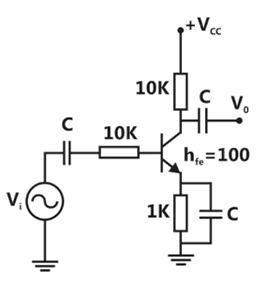
Explanation Locked!
Unlock this branch to view the explanation, track, bookmark and more.
Sign in to UnlockThe transistor in the given circuit should always be in active region. Take , . The maximum value of RC in which can be used, is __________.



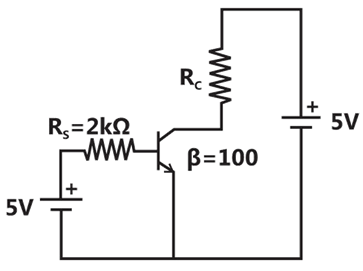
Explanation Locked!
Unlock this branch to view the explanation, track, bookmark and more.
Sign in to UnlockThe voltage gain of the circuit shown below is

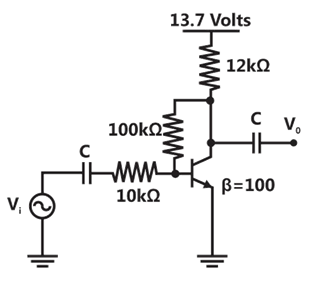




Explanation Locked!
Unlock this branch to view the explanation, track, bookmark and more.
Sign in to UnlockThe transistor used in the circuit shown below has a of 30 and is negligible.

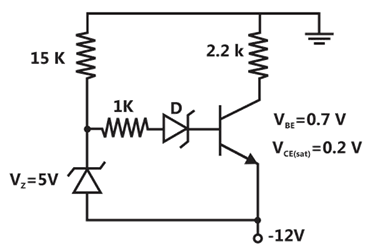
If the forward voltage drop of diode is 0.7V, then the current through collector will be
Explanation Locked!
Unlock this branch to view the explanation, track, bookmark and more.
Sign in to UnlockThe transistor circuit shown uses a silicon transistor with and a dc current gain of 100. The value of is


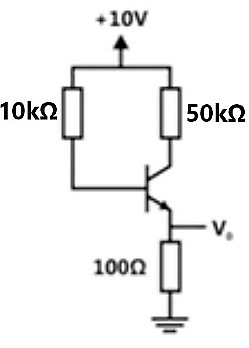
Explanation Locked!
Unlock this branch to view the explanation, track, bookmark and more.
Sign in to UnlockTransformer and emitter follower can both be used for impedance matching at the output of an audio amplifier. The basic relationship between the input power and output power in both the cases is


for both transformer and emitter follower

for both transformer and emitter follower

for transformer and for emitter follower

for transformer for emitter follower
Explanation Locked!
Unlock this branch to view the explanation, track, bookmark and more.
Sign in to UnlockTwo perfectly matched silicon transistors are connected as shown in the figure. Assuming the β of the transistors to be very high and the forward voltage drop in diodes to be 0.7V, the value of current I is
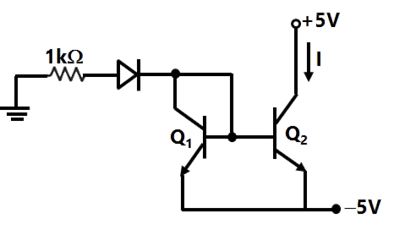
Explanation Locked!
Unlock this branch to view the explanation, track, bookmark and more.
Sign in to UnlockThe common emitter forward current gain of the transistor shown is .

The transistor is operating in
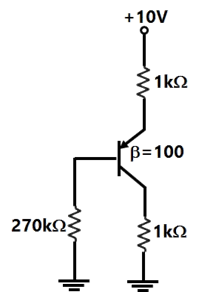
Explanation Locked!
Unlock this branch to view the explanation, track, bookmark and more.
Sign in to UnlockThe three-terminal linear voltage regulator is connected to a load resistor as shown in the figure. If is 10 V, what is the power dissipated in the transistor?


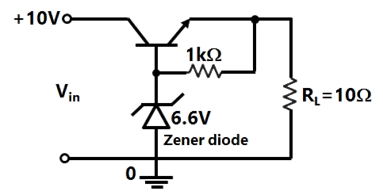
Explanation Locked!
Unlock this branch to view the explanation, track, bookmark and more.
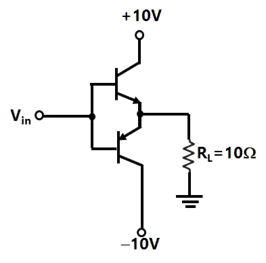
Sign in to UnlockThe input signal shown in the figure is a 1 kHz square wave voltage that alternates between +7V and −7V with a 50% duty cycle. Both transistors have the same current gain, which is large. The circuit delivers power to the load resistor . What is the efficiency of this circuit for the given input? Choose the closest answer.


Explanation Locked!
Unlock this branch to view the explanation, track, bookmark and more.
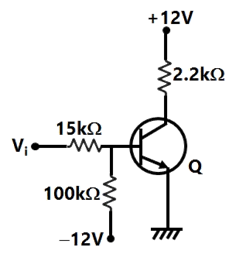
Sign in to UnlockConsider the circuit shown in figure. If the β of the transistor is 39 and is 20nA and the input voltage is +5V, then transistor would be operating in
Explanation Locked!
Unlock this branch to view the explanation, track, bookmark and more.
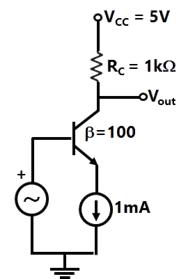
Sign in to UnlockThe common emitter amplifier shown in Figure is biased using a 1mA ideal current source. The approximate base current value is:
Explanation Locked!
Unlock this branch to view the explanation, track, bookmark and more.
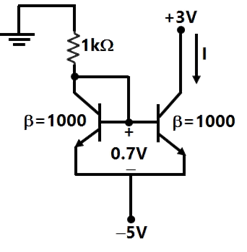
Sign in to UnlockTwo perfectly matched silicon transistors are connected as shown in figure. The value of the current I is
Explanation Locked!
Unlock this branch to view the explanation, track, bookmark and more.
Sign in to UnlockThe feedback used in the circuit shown in figure can be classified as
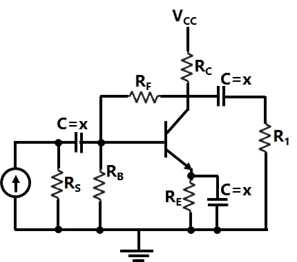
Explanation Locked!
Unlock this branch to view the explanation, track, bookmark and more.
Sign in to UnlockA bipolar junction transistor (BJT) is used as a power control switch by biasing it in the cut-off region (OFF state) or in the saturation region (ON state). In the ON state, for the BJT
Explanation Locked!
Unlock this branch to view the explanation, track, bookmark and more.
Sign in to UnlockThe trans-conductance of the transistor shown in figure is 10mS. The value of the input resistance is


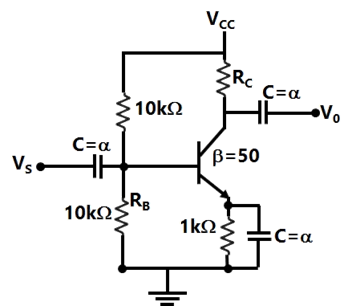




Explanation Locked!
Unlock this branch to view the explanation, track, bookmark and more.
Sign in to UnlockIn the Schmitt trigger circuit shown in figure, if , the output logic low level is


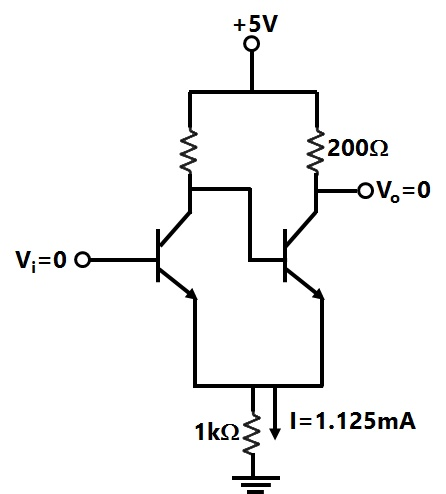
Explanation Locked!
Unlock this branch to view the explanation, track, bookmark and more.
Sign in to UnlockIn the circuit of Figure, assume that the transistor has . The value of collector current of the transistor is approximately


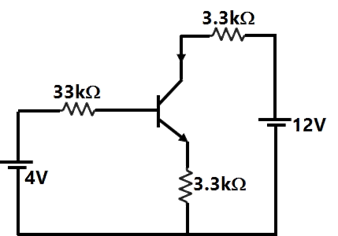
Explanation Locked!
Unlock this branch to view the explanation, track, bookmark and more.
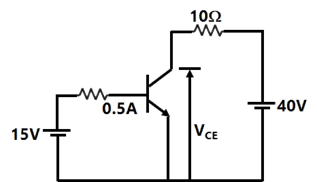
Sign in to UnlockIn the circuit shown in Figure, the current gain (β) of the ideal transistor is 10. The operating point of the transistor is

Explanation Locked!
Unlock this branch to view the explanation, track, bookmark and more.
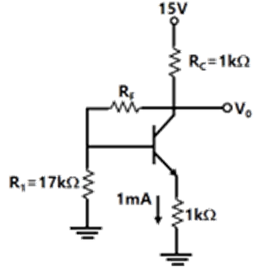
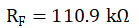
Sign in to UnlockFor the circuit shown in Figure, and . Determine






Explanation Locked!
Unlock this branch to view the explanation, track, bookmark and more.
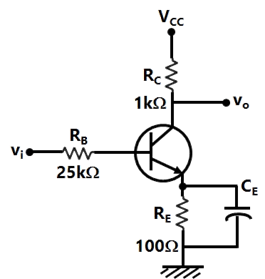
Sign in to UnlockIn the single-stage transistor amplifier circuit shown in Fig., the capacitor is removed. Then the ac small-signal mid-band voltage gain of the amplifier.


Explanation Locked!
Unlock this branch to view the explanation, track, bookmark and more.
Sign in to UnlockThe transistor in the amplifier circuit shown in figure is biased at . Use


AC small signal mid-band voltage gain = -6.623
AC small signal mid-band voltage gain = -5.565
Value of for the circuit to have a lower cutoff
frequency of 10 Hz = 265.08 micro F
Value of for the circuit to have a lower cutoff
frequency of 10 Hz = 365.08 micro F
Explanation Locked!
Unlock this branch to view the explanation, track, bookmark and more.
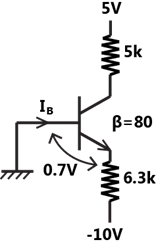
Sign in to UnlockIn the circuit of fig, the value of the base current will be

Explanation Locked!
Unlock this branch to view the explanation, track, bookmark and more.
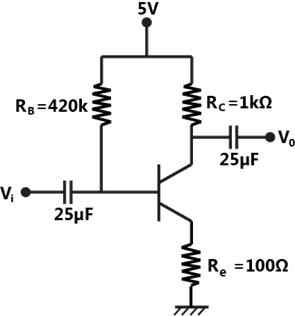
Sign in to UnlockFor the small signal BJT amplifier shown in fig, Assume β = 100 and Frequency =1 kHz
Explanation Locked!
Unlock this branch to view the explanation, track, bookmark and more.
Sign in to UnlockOne of the applications of current mirror is:
Explanation Locked!
Unlock this branch to view the explanation, track, bookmark and more.
Sign in to UnlockA NPN, silicon transistor is meant for low-current audio amplification. Match its following characteristics against their values:
Characteristics Values
(a) (P) 0.7V

(b) (Q) 0.2V

(c) (R) 6V

(S) 50V
Explanation Locked!
Unlock this branch to view the explanation, track, bookmark and more.
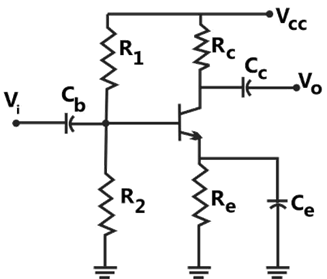
Sign in to UnlockIn the transistor amplifier shown in figure, the ratio of small signal voltage gain, when the emitter resistor , is bypassed by the capacitor to when it is not bypassed, (assuming simplified approximate h-parameter model for transistor), is


I



Explanation Locked!
Unlock this branch to view the explanation, track, bookmark and more.
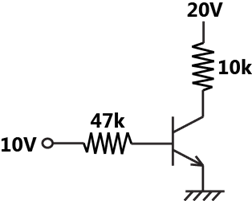
Sign in to UnlockIn the transistor circuit shown in figure, collector-to-ground voltage is +20V. Which of the following is the probable cause of error?
Explanation Locked!
Unlock this branch to view the explanation, track, bookmark and more.
Sign in to UnlockIn a Common Emitter amplifier, the un-bypassed emitter resistance provides
Explanation Locked!
Unlock this branch to view the explanation, track, bookmark and more.
Sign in to UnlockIn an RC-coupled Common Emitter amplifier, which of the following is true?
Explanation Locked!
Unlock this branch to view the explanation, track, bookmark and more.
Sign in to UnlockFigure below shows a common emitter amplifier. The quiescent collector voltage of the circuit is approximately
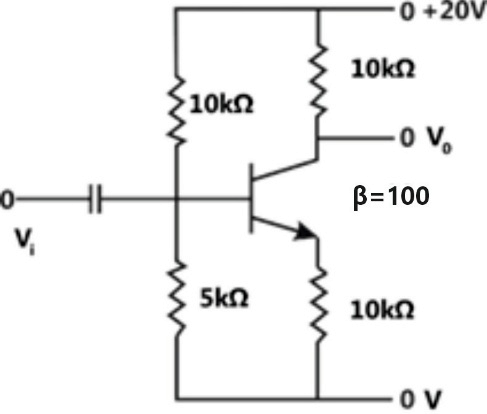

10 V
14 V
20 V
Explanation Locked!
Unlock this branch to view the explanation, track, bookmark and more.
Sign in to UnlockFigure shows a common emitter amplifier
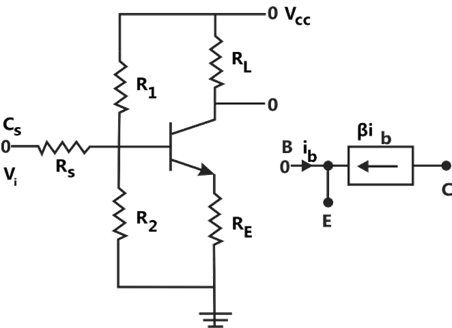
(a) Simplify the circuit by applying Thevenin’s theorem to the biasing network at the base of the transistor

(b) Assuming to be a short for the frequency range considered. Draw the small signal a.c. model of the circuit obtained in (a) by using the simple model for the transistor shown in figure.

(c) Evaluate the small signal gain of the amplifier.

Small signal a.c. model
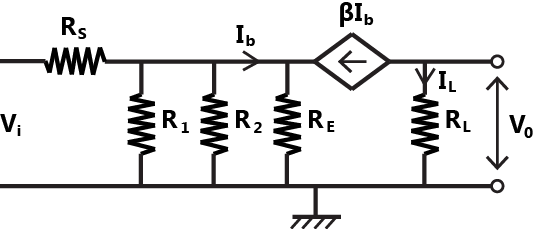



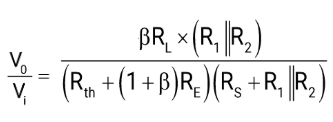
Explanation Locked!
Unlock this branch to view the explanation, track, bookmark and more.
Sign in to Unlock