Control Systems
State Variable Analysis
State Model Analysis
Questions mapped to State Model Analysis under State Variable Analysis.
27
Total0
Attempted0
Correct0
IncorrectA system is characterized by the following state equation and output equation ( : input, : state vector, : output)




What are the values of and for which the poles of the transfer function are at and ?








Sign in to see the solution
Log in to view the explanation, track your attempts, and keep your progress.
Sign in to UnlockConsider the state-space model


where are the state, input and output, respectively. The matrices are given below



The sum of the magnitudes of the poles is __________ (round off to nearest integer).
Sign in to see the solution
Log in to view the explanation, track your attempts, and keep your progress.
Sign in to UnlockConsider the state-space description of an LTI system with matrices

For the input, , the value of for which the steady-state output of the system will be zero, is __________ (Round off to the nearest integer).


Sign in to see the solution
Log in to view the explanation, track your attempts, and keep your progress.
Sign in to UnlockConsider a state-variable model of a system


where y is the output, and r is the input. The damping ratio and the undamped natural frequency (rad/sec) of the system are given by






Sign in to see the solution
Log in to view the explanation, track your attempts, and keep your progress.
Sign in to UnlockConsider a system governed by the following equations


The initial conditions are such that. Let and. Which one of the following is true?







Sign in to see the solution
Log in to view the explanation, track your attempts, and keep your progress.
Sign in to UnlockConsider the system described by the following state space representation
and


If u(t) is a unit step input and , the value of output y(t) at t = 1 sec (rounded off to three decimal places ) is ___________ .

Sign in to see the solution
Log in to view the explanation, track your attempts, and keep your progress.
Sign in to UnlockConsider the following state-space representation of a linear time-invariant system.
and .


The value of y(t) for is _______________.

Sign in to see the solution
Log in to view the explanation, track your attempts, and keep your progress.
Sign in to UnlockConsider a linear time invariant system , with initial condition at t = 0. Suppose and are eigenvectors of matrix A corresponding to distinct eigenvalues and respectively. Then the response x(t) of the system due to initial condition is











Sign in to see the solution
Log in to view the explanation, track your attempts, and keep your progress.
Sign in to UnlockThe following discrete – time equations result from the numerical integration of the differential equations of an un-damped simple harmonic oscillator with state variable x and y. The integration time step is h.


For this discrete – time system, which one of the following statements is TRUE?
The system is not stable for h > 0
The system is stable for

The system is stable for

The system is stable for

Sign in to see the solution
Log in to view the explanation, track your attempts, and keep your progress.
Sign in to UnlockConsider the system described by following state space equations


If u is unit step input, then the steady error of the system is
Sign in to see the solution
Log in to view the explanation, track your attempts, and keep your progress.
Sign in to UnlockThe state variable formulation of a system is given as
, , and




The response y (t) to a unit step input is




Sign in to see the solution
Log in to view the explanation, track your attempts, and keep your progress.
Sign in to UnlockThe system with is


Sign in to see the solution
Log in to view the explanation, track your attempts, and keep your progress.
Sign in to UnlockA system is described by the following state and output equations



Where u(t) is the input and y(t) is the output.
The system transfer function is




Sign in to see the solution
Log in to view the explanation, track your attempts, and keep your progress.
Sign in to UnlockA system is described by the following state and output equations
Where u(t) is the input and y(t) is the output.
The state-transition matrix of the above system is




Sign in to see the solution
Log in to view the explanation, track your attempts, and keep your progress.
Sign in to UnlockThe state space equation of a system is described by

Where x is state vector, u is input, y is output and

The transfer function G(s) of this system will be



Sign in to see the solution
Log in to view the explanation, track your attempts, and keep your progress.
Sign in to UnlockThe state space equation of a system is described by
Where x is state vector, u is input, y is output and
A unity feedback is provided to the above system G(s) to make it a closed loop system as shown in figure.
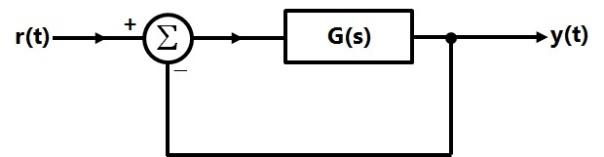
For a unit step input r(t), the steady state error In the output will be
0
1
2

Sign in to see the solution
Log in to view the explanation, track your attempts, and keep your progress.
Sign in to UnlockA state variable system
, with the initial condition and the unit step input u(t) has


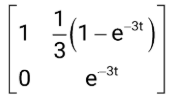
The state transition matrix



Sign in to see the solution
Log in to view the explanation, track your attempts, and keep your progress.
Sign in to UnlockA state variable system
, with the initial condition and the unit step input u(t) has and the state transition equation




Sign in to see the solution
Log in to view the explanation, track your attempts, and keep your progress.
Sign in to UnlockThe state variable description of a linear autonomous system is X = AX, where X is the two dimensional state vector and A is the system matrix given by
. The roots of the characteristic equation are

Sign in to see the solution
Log in to view the explanation, track your attempts, and keep your progress.
Sign in to UnlockA second order system starts with an initial condition of without any external input. The state transition matrix for the system is given by. The state of the system at the end of 1 second is given by






Sign in to see the solution
Log in to view the explanation, track your attempts, and keep your progress.
Sign in to UnlockThe state transition matrix for the system X = AX & with initial state X(0) is


Laplace inverse of

Laplace inverse of

Sign in to see the solution
Log in to view the explanation, track your attempts, and keep your progress.
Sign in to UnlockFor the system

with u as unit impulse and with zero initial state, the output, y, becomes

2

4
2

4
Sign in to see the solution
Log in to view the explanation, track your attempts, and keep your progress.
Sign in to UnlockGiven the homogeneous state-space equation

The steady state value, given the initial state value of is






Sign in to see the solution
Log in to view the explanation, track your attempts, and keep your progress.
Sign in to UnlockThe state-space representation of a system is given by:

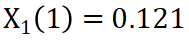
Find the Laplace transform of the state transition matrix. Find also the value of at if



Laplace transform of the state transition matrix

State transition matrix


Sign in to see the solution
Log in to view the explanation, track your attempts, and keep your progress.
Sign in to UnlockA system is described by the state equation. The output is given by Y=CX

Where . Transfer function G(s) of the system is :





Sign in to see the solution
Log in to view the explanation, track your attempts, and keep your progress.
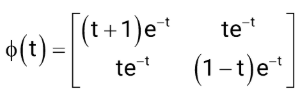
Sign in to UnlockThe state equation of a linear time-invariant system is given by

(i) Find state transition
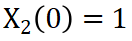
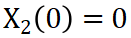
(ii) Determine the state vector for t=0 when r(t)=U(t). Assume values of states initially to be zero.



Sign in to see the solution
Log in to view the explanation, track your attempts, and keep your progress.
Sign in to UnlockThe transfer function for the state variable representation , , is given by






Sign in to see the solution
Log in to view the explanation, track your attempts, and keep your progress.
Sign in to Unlock