Power Systems
Power System Stability
Practice questions from Power System Stability.
33
Total0
Attempted0
Correct0
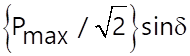
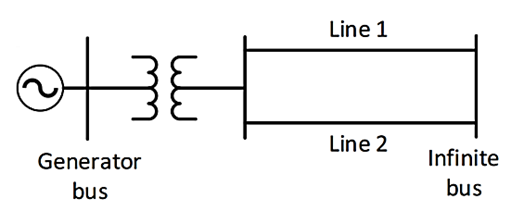
IncorrectThe single line diagram of a lossless system is shown in the figure. The system is operating in steady-state at a stable equilibrium point with the power output of the generator being , where is the load angle and the mechanical power input is . A fault occurs on line 2 such that the power output of the generator is less than during the fault. After the fault is cleared by opening line 2 , the power output of the generator is . If the critical fault clearing angle is radians, the accelerating area on the power angle curve is ________times (rounded off to 2 decimal places).





Explanation Locked!
Unlock this branch to view the explanation, track, bookmark and more.
Sign in to UnlockA 20 MVA, 11.2 kV, 4-pole, 50 Hz alternator has an inertia constant of 15 MJ /MVA. If the input and output powers of the alternator are 15 MW and 10 MW, respectively, the angular acceleration in mechanical degree/s² is ………………….. (round oft to nearest integer).
Explanation Locked!
Unlock this branch to view the explanation, track, bookmark and more.
Sign in to UnlockThe figure shows the single line diagram of a power system with a double circuit transmission line. The expression for electrical power is 1.5 sin , where is the rotor angle. The system is operating at the stable equilibrium point with mechanical power equal to 1 pu. If one of the transmission line circuits is removed, the maximum value of , as the rotor swings, is 1.221 radian. If the expression for electrical power with one transmission line circuit removed is , the value of , in pu is ____________. (Give the answer up to three decimal places)




Explanation Locked!
Unlock this branch to view the explanation, track, bookmark and more.
Sign in to UnlockA 3-phase, 2-pole, 50 Hz, synchronous generator has a rating of 250 MVA. 0.8 pf lagging. The kinetic energy of the machine at synchronous speed is 1000 MJ. The machine is running steadily at synchronous speed and delivering 60 MW power at a power angle of 10 electrical degrees. If the load is suddenly removed, assuming the acceleration is constant for 10 cycles, the value of the power angle after 5 cycles is ___________ electrical degrees.
Explanation Locked!
Unlock this branch to view the explanation, track, bookmark and more.
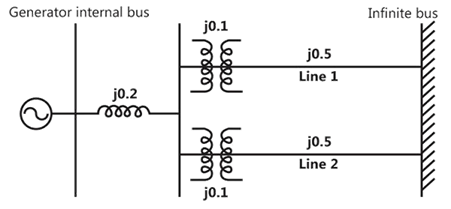
Sign in to UnlockThe single line diagram of a balanced power system is shown in the figure, The voltage magnitude at the generator internal bus is constant 1.0pu magnitude. The p.u. reactance’s of different components in the system are also shown in the figure. The infinite bus voltage magnitude is 1.0p.u. A three phase fault occurs at the middle of line 2. The ratio of the maximum real power that can be transferred during the pre-fault condition to the maximum real power that can be transferred under the faulted condition is_______________.
Explanation Locked!
Unlock this branch to view the explanation, track, bookmark and more.
Sign in to UnlockA 50 Hz generating unit has H-constant of 2 MJ/MVA. The machine is initially operating in steady state at synchronous speed, and producing 1 pu of real power. The initial value of the rotor angle is 5º, when a bolted there phase to ground short circuit fault occurs terminal of the generator. Assuming the input mechanical power to remain at 1 pu, the value of in degrees, 0.02 second after the fault is ____________.
Explanation Locked!
Unlock this branch to view the explanation, track, bookmark and more.
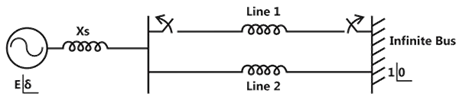
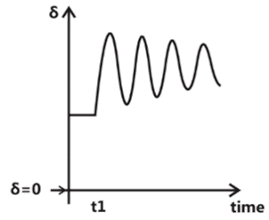
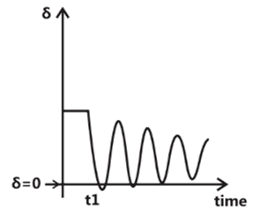
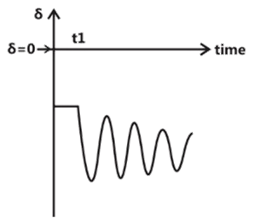
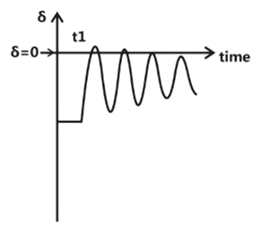
Sign in to UnlockThe synchronous generator shown in the figure is supplying active power to an infinite bus via two short, lossless transmission lines, and is initially in steady state. The mechanical power input to the generator and the voltage magnitude E are constant. If one line is tripped at time by opening the circuit breakers at the two ends (although there is no fault), then it is seen that the generator undergoes a stable transient. Which one of the following waveforms of the rotor angle shows the transient correctly?

Explanation Locked!
Unlock this branch to view the explanation, track, bookmark and more.
Sign in to UnlockThe figure shows the single line diagram of the single machine infinite bus system.

The inertia constant of the synchronous generator . Frequency is 50Hz. Mechanical power is 1pu. The system is operating at the stable equilibrium point with rotor angle equal to . A three phase short circuit fault occurs at a certain location on one of the circuits of the double circuit transmission line. During fault, electrical power in pu is . If the values of and at the instant of fault clearing are and 3.762 radian/s respectively, then (in pu) is _________.




Explanation Locked!
Unlock this branch to view the explanation, track, bookmark and more.
Sign in to UnlockThe angle δ in the swing equation of a synchronous generator is the
Explanation Locked!
Unlock this branch to view the explanation, track, bookmark and more.
Sign in to UnlockA cylindrical rotor generator delivers 0.5pu power in the steady state to an infinite bus through a transmission line of reactance 0.5pu. The generator no-load voltage is 1.5pu and the infinite bus voltage is 1pu. The inertia constant of the generator is 5 MW-s/MVA and the generator reactance is 1pu. The critical clearing angle, in degrees, for a three-phase dead short circuit fault at the generator terminal is
Explanation Locked!
Unlock this branch to view the explanation, track, bookmark and more.
Sign in to UnlockA 500 MW, 21 kV, 50 Hz, 3-phase, 2-pole synchronous generator having a rated p.f = 0.9, has a moment of inertia of . The inertia constant (H) will be

Explanation Locked!
Unlock this branch to view the explanation, track, bookmark and more.
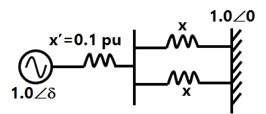
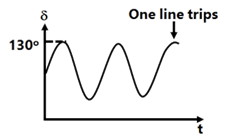
Sign in to UnlockConsider a synchronous generator connected to an infinite bus by two identical parallel transmission lines. The transient reactance x' of the generator is 0.1pu and the mechanical power input to it is constant at 1.0pu. Due to some previous disturbance, the rotor angle (δ) is undergoing an un-damped oscillation, with the maximum value of equal to . One of the parallel lines trips due to relay mal-operation at an instant when · as shown in the figure. The maximum value of the per unit line reactance, x, such that the system does not lose synchronism subsequent to this tripping is



Explanation Locked!
Unlock this branch to view the explanation, track, bookmark and more.
Sign in to UnlockA generator feeds power to an infinite bus through a double circuit transmission line. A 3 phase fault occurs at the middle point of one of the lines. The infinite bus voltage is 1 pu., the transient internal voltage of the generator is 1.1 pu. & the equivalent transfer admittance during fault is 0.8 pu. The 100 MVA generator has an inertia constant of 5 MJ/MVA & it was delivering 1 pu power prior to the fault with rotor power angle of 30°. The system frequency is 50 Hz.
The initial accelerating power (in pu) will be
Explanation Locked!
Unlock this branch to view the explanation, track, bookmark and more.
Sign in to UnlockIf the initial accelerating power is X pu, the initial acceleration in , and the inertia constant in MJ-sec/select deg respectively will be

Explanation Locked!
Unlock this branch to view the explanation, track, bookmark and more.
Sign in to UnlockA generator with constant 1.0p.u. terminal voltage supplies power through a step-up transformer of 0.12p.u. reactance and a double-circuit line to an infinite bus bas as shown in Figure. The infinite bus voltage is maintained at 1.0p.u. Neglecting the resistances and susceptances of the system, the steady state stability power limit of the system is 6.25p.u. If one of the double-circuit is tripped, the resulting steady state stability power limit in p.u. will be
Explanation Locked!
Unlock this branch to view the explanation, track, bookmark and more.
Sign in to UnlockA 50 Hz, 4-pole, 500 MVA, 22 kV turbo-generator is delivering rated megavolt amperes at 0.8 power factor. Suddenly a fault occurs reducing is electric power output by 40%. Neglect losses and assume constant power input to the shaft. The accelerating torque in the generator in MNm at the time of the fault will be
Explanation Locked!
Unlock this branch to view the explanation, track, bookmark and more.
Sign in to UnlockA round rotor generator with internal voltage and X = 1.1 p.u. is connected to a round rotor synchronous motor with internal voltage and X = 1.2 p.u. The reactance of the line connecting the generator to the motor is 0.5 p.u. when the generator supplies 0.5 p.u. power, the rotor angle difference between the machines will be


Explanation Locked!
Unlock this branch to view the explanation, track, bookmark and more.
Sign in to UnlockA generator delivers power of 1.0 p.u. to an infinite bus through a purely reactive network. The maximum power that could be delivered by the generator is 2.0 p.u. A three phase fault occurs at the terminals of the generator which reduces the generator output to zero. The fault is cleared after second. The original network is then restored. The maximum swing of the rotor angle is found to be electrical degree. Then the rotor angle in electrical degrees at t = is



Explanation Locked!
Unlock this branch to view the explanation, track, bookmark and more.
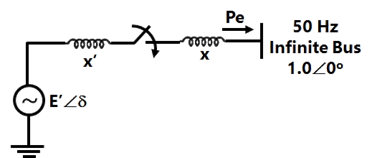
Sign in to UnlockA synchronous generator is to be connected to an infinite bus through a transmission line of reactance X = 0.2pu, as shown in Figure, the generator data is as follows:
x’ = 0.1pu, E’=1.0pu, H = 5MJ/MVA, mechanical power rad/sec.

All quantities are expressed on a common base.
The generator is initially running on open circuit with the frequency of the open circuit voltage slightly higher than that of the infinite bus. If at the instant of switch closure δ = 0 and , compute the maximum value of so that the generator pulls into synchronism.


Hint: Use the equation

Explanation Locked!
Unlock this branch to view the explanation, track, bookmark and more.
Sign in to UnlockA synchronous generator is connected to an infinite bus through a lossless double circuit transmission line. The generator is delivering 1.0 per unit power at a load angle of 30° when a sudden fault reduces the peak power that can be transmitted to 0.5 per unit. After clearance of fault, the peak power that can be transmitted becomes 1.5 per unit. Find the critical clearing angle.
Explanation Locked!
Unlock this branch to view the explanation, track, bookmark and more.
Sign in to UnlockA transmission line has equal voltages at the two ends, maintained constant by two sources. A third source is to be provided to maintain constant voltage (equal to end voltages) at either the midpoint of the line or at 75% of the distance from the sending end. Then the maximum power transfer capabilities of the line in the original case and the other two cases respectively will be in the following ratios.:
1 : 1 : 1

1 : 2 : 4
1 : 4 : 16
Explanation Locked!
Unlock this branch to view the explanation, track, bookmark and more.
Sign in to UnlockA synchronous generator, having a reactance of 0.15p.u, is connected to an infinite bus through two identical parallel transmission lines having reactance of 0.3p.u. each. In steady state, the generator is delivering 1p.u. Power to the infinite bus. For a three-phase fault at the receiving end of one line, calculate the rotor angle at the end of first time step of 0.05 seconds. Assume the voltage behind transient reactance for the generator as 1.1p.u. and infinite bus voltage as 1.0p.u.

When breaker clears the fault at the end of an interval, Accelerating power will be considered as the average of before and after faults.

When breaker clears the fault at the middle of an interval then we will have to consider the accelerating power same as that of beginning of that interval, i.e.

Explanation Locked!
Unlock this branch to view the explanation, track, bookmark and more.
Sign in to UnlockSteady state stability of a power system is the ability of the power system to
Explanation Locked!
Unlock this branch to view the explanation, track, bookmark and more.
Sign in to UnlockA power station consists of two synchronous generators A and B of ratings 250MVA and 500MVA with inertia 1.6p.u. and 1p.u., respectively on their own base MVA ratings. The equivalent p.u. inertia constant for the system on 100MVA common base is:
Explanation Locked!
Unlock this branch to view the explanation, track, bookmark and more.
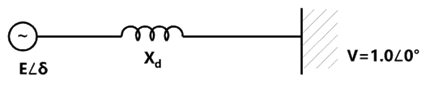
Sign in to UnlockAn alternator is connected to an infinite bus as shown in fig, It delivers 1.0p.u. current at 0.8pf lagging at
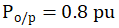
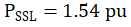
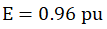
V=1.0 p.u. The reactance of the alternator is 1.2p.u. Determine the active power output and the steady state power limit. Keeping the active power fixed, if the excitation is reduced, find the critical excitation corresponding to operation at stability limit.


Explanation Locked!
Unlock this branch to view the explanation, track, bookmark and more.
Sign in to UnlockA 100MVA, 11kV, 3-phase, 50Hz, 8-pole synchronous generator has an inertia constant H equal to 4 seconds. The stored energy in the rotor of the generator at synchronous speed will be

Explanation Locked!
Unlock this branch to view the explanation, track, bookmark and more.
Sign in to UnlockThe use of high-speed circuit breakers
Explanation Locked!
Unlock this branch to view the explanation, track, bookmark and more.
Sign in to UnlockA synchronous motor is receiving 50% of the power. It is capable of receiving from an infinite bus. If the load on the motor is suddenly reduced to 80% of the previous value, swing of the motor around its new equilibrium position.
Explanation Locked!
Unlock this branch to view the explanation, track, bookmark and more.
Sign in to UnlockDuring a disturbance on a synchronous machine, the rotor swings from A to B before finally settling down to a steady state at point C on the power angle curve. The speed of the machine during oscillation is synchronous at point(s)
Explanation Locked!
Unlock this branch to view the explanation, track, bookmark and more.
Sign in to UnlockA loss-alternator supplies 50 MW to an infinite bus, the steady state stability limit being 100MW. Determine if the alternator will remain stable if the input to the prime mover of the alternator is abruptly increased by 40 MW.
(Yes=1/No=0)
Explanation Locked!
Unlock this branch to view the explanation, track, bookmark and more.
Sign in to UnlockIn a system, there are two generators operating in parallel. One generator, of rating 250 MVA, has an inertia-constant of 6 MJ/MVA while the other generator of 150 MVA has an inertia-constant of 4 MJ/MVA. The inertia-constant for the combined system on 100 MVA common base is ________________ MJ/MVA.
Explanation Locked!
Unlock this branch to view the explanation, track, bookmark and more.
Sign in to UnlockThe transient stability of the power system can be effectively improved by
Explanation Locked!
Unlock this branch to view the explanation, track, bookmark and more.
Sign in to UnlockA generator is supplying 1 per unit power to an infinite bus through the system shown in figure. Following fault at F, circuit breakers and open simultaneously. The relationships in per unit are given by



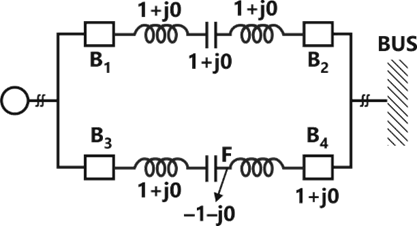
Pre-fault condition:

During fault condition:
When remain closed:


After open:

Calculate the critical angel before which breakers

and must open so that synchronism is not lost.
Explanation Locked!
Unlock this branch to view the explanation, track, bookmark and more.
Sign in to Unlock