Communication System
Analog Communication
Practice questions from Analog Communication.
97
Total0
Attempted0
Correct0
IncorrectConsider a frequency-modulated (FM) signal

where and are, respectively, the amplitude and frequency (in Hz) of the carrier waveform. The frequency is in Hz, and assume that .




The peak frequency deviation of the FM signal in Hz is __________.




Sign in to see the solution
Log in to view the explanation, track your attempts, and keep your progress.
Sign in to UnlockConsider a message signal which is bandlimited to , where is in Hz. Consider the following two modulation schemes for the message signal:



- Double sideband-suppressed carrier (DSB-SC):

- Amplitude modulation (AM):

Here, and are the amplitude and frequency (in Hz) of the carrier, respectively. In the case of AM, denotes the modulation index.

Consider the following statements:
(i) An envelope detector can be used for demodulation in the DSB-SC scheme if for all .


(ii) An envelope detector can be used for demodulation in the AM scheme only if for all .
Which of the following options is/are correct?
Sign in to see the solution
Log in to view the explanation, track your attempts, and keep your progress.
Sign in to UnlockAn amplitude modulator has output (in Volts)

The carrier power normalized to resistance is 50 Watts. The ratio of the total sideband power to the total power is . The value of (in Volts, rounded off to two decimal places) is_______.


Sign in to see the solution
Log in to view the explanation, track your attempts, and keep your progress.
Sign in to UnlockLet a frequency modulated (FM) signal , where is a message signal of bandwidth . It is passed through a non-linear system with output . Let denote the FM bandwidth. The minimum value of required to recover from is













Sign in to see the solution
Log in to view the explanation, track your attempts, and keep your progress.
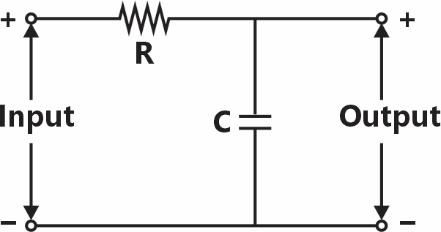
Sign in to UnlockConsider an FM broadcast that employs the pre-emphasis filter with frequency response

Where .

For the network shown in the figure to act as a corresponding de-emphasis filter, the appropriate pair(s) of values is/are ________.





Sign in to see the solution
Log in to view the explanation, track your attempts, and keep your progress.
Sign in to UnlockConsider a carrier signal which is amplitude modulated by a single-tone sinusoidal message signal with a modulation index of . If the carrier and one of the sidebands are suppressed in the modulated signal, the percentage of power saved (rounded off to one decimal place) is_________

Sign in to see the solution
Log in to view the explanation, track your attempts, and keep your progress.
Sign in to UnlockConsider a superheterodyne receiver tuned to . If the local oscillator feeds a signal to the mixer, the image frequency (in integer) is ________ kHz.


Sign in to see the solution
Log in to view the explanation, track your attempts, and keep your progress.
Sign in to UnlockA sinusoidal message signal having amplitude is fed to a delta modulator (DM) operating at a sampling rate of . The minimum step size required to avoid slope overload noise in the DM (rounded off to two decimal places) is __________ V.



Sign in to see the solution
Log in to view the explanation, track your attempts, and keep your progress.
Sign in to UnlockA sinusoidal message signal having root mean square value of and frequency of 1kHz is fed to a phase modulator with phase deviation constant . If the carrier signal is , the maximum instantaneous frequency of the phase modulated signal (rounded off to one decimal place) is _________ .



Sign in to see the solution
Log in to view the explanation, track your attempts, and keep your progress.
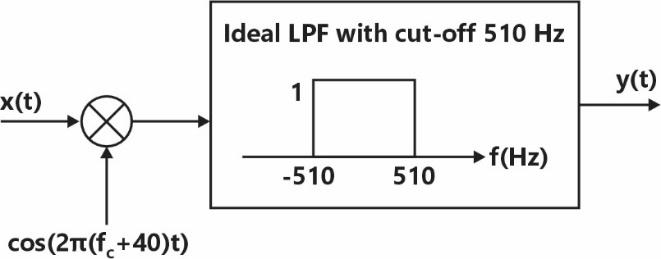
Sign in to UnlockFor the modulated signal , the message signal and the carrier frequency is . The signal is passed through a demodulator, as shown in the figure below. The output of the demodulator is











Sign in to see the solution
Log in to view the explanation, track your attempts, and keep your progress.
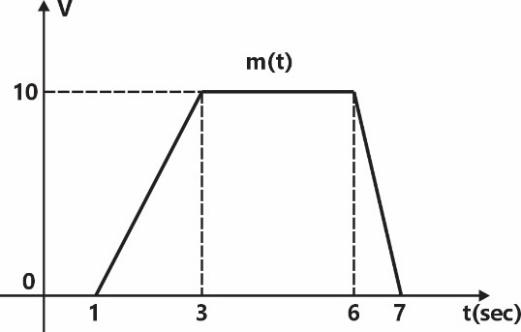
Sign in to Unlockand as defined below, are the phase modulated and the frequency modulated waveforms, respectively, corresponding to the message signal shown in the figure.




and

where is the phase deviation constant in radians/volt and is the frequency deviation constant in radians/second/volt. If the highest instantaneous frequencies of and are same, then the value of the ratio is __________ seconds.



Sign in to see the solution
Log in to view the explanation, track your attempts, and keep your progress.
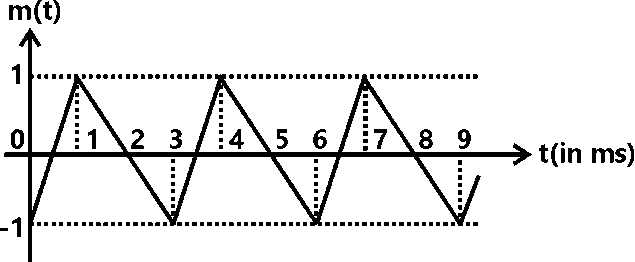
Sign in to UnlockThe baseband signal shown in the figure is phase modulated to generate the PM signal. The time t on the x-axis in the figure is in milliseconds. If the carrier frequency isand, then the ratio of the minimum instantaneous frequency (in kHz) to the maximum instantaneous frequency (in kHz) is _______ (rounded off to 2 decimal places)



Sign in to see the solution
Log in to view the explanation, track your attempts, and keep your progress.
Sign in to UnlockConsider the following amplitude modulated signal:
The ratio (accurate to three decimal places) of the power of the message signal to the power of the carrier signal is ________

Sign in to see the solution
Log in to view the explanation, track your attempts, and keep your progress.
Sign in to UnlockLet and . It is given that. The signal is applied to the input of a non-linear device, whose output is related to the input as, where a and b are positive constants. The output of the non-linear device is passed through an ideal band-pass filter with centre frequency and bandwidth to produce amplitude modulated (AM) wave. If it is desired to have the sideband power of the AM wave to be half of the carrier power, then a/b is








Sign in to see the solution
Log in to view the explanation, track your attempts, and keep your progress.
Sign in to UnlockA modulating signal given by x(t)=5 sin V is fed to a phase modulator with phase deviation constant If the carrier frequency is 20 kHz, the instantaneous frequency (in kHz) at t = 0.5 ms is ____________


Sign in to see the solution
Log in to view the explanation, track your attempts, and keep your progress.
Sign in to UnlockThe unmodulated carrier power in an AM transmitter is 5 kW. This carrier is modulated by a sinusoidal modulating signal. The maximum percentage of modulation is 50%. If it is reduced to 40% then the maximum unmodulated carrier power (in kW) that can be used without overloading the transmitter is ___________
Sign in to see the solution
Log in to view the explanation, track your attempts, and keep your progress.
Sign in to UnlockA super-heterodyne receiver operates in the frequency range of 58 MHz - 68 MHz. The intermediate frequency and local oscillator frequency are chosen Such that It is required that the image frequencies fall outside the 58 MHz - 68 MHz band. The minimum required (in MHz) is______________



Sign in to see the solution
Log in to view the explanation, track your attempts, and keep your progress.
Sign in to UnlockThe amplitude of a sinusoidal carrier is modulated by a single sinusoid to obtain the amplitude modulated signal s(t) = 5cos 1600πt + 20cos 1800πt + 5cos 2000πt. The value of the modulation index is________________
Sign in to see the solution
Log in to view the explanation, track your attempts, and keep your progress.
Sign in to UnlockFor a super-heterodyne receiver, the intermediate frequency is 15 MHz and the local oscillator frequency is 3.5 GHz. If the frequency of the received signal is greater than the local oscillator frequency, then the image frequency (in MHz) is ________
Sign in to see the solution
Log in to view the explanation, track your attempts, and keep your progress.
Sign in to UnlockConsider the signal
where denotes the Hilbert transform of m(t) and the bandwidth of m(t) is very small compared to . The signals s(t) is a



Sign in to see the solution
Log in to view the explanation, track your attempts, and keep your progress.
Sign in to UnlockIn the system shown in Figure (a), m(t) is a low-pass signal with bandwidth W Hz. The frequency response of the band-pass filter H( f ) is shown in Figure (b). If it is desired that the output signal z(t)=10x(t), the maximum value of W (in Hz) should be strictly less than ________


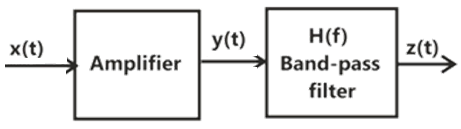
Figure a
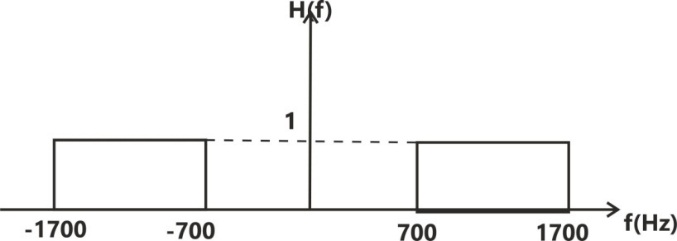
Figure b
Sign in to see the solution
Log in to view the explanation, track your attempts, and keep your progress.
Sign in to UnlockA message signal m(t) =is used to modulate the phase of a carrier to get the modulated signal y(t)= .The bandwidth of y(t)



Depends on but not on


Depends on but not on
Depends on both and
Does not depend on or
Sign in to see the solution
Log in to view the explanation, track your attempts, and keep your progress.
Sign in to UnlockThe complex envelope of the band-pass signal , centred about , is






Sign in to see the solution
Log in to view the explanation, track your attempts, and keep your progress.
Sign in to UnlockConsider sinusoidal modulation in an AM system. Assuming no over modulation, the modulation index (μ) when the maximum and minimum values of the envelope, respectively, are 3 V and 1 V, is ________.
Sign in to see the solution
Log in to view the explanation, track your attempts, and keep your progress.
Sign in to UnlockIn the figure, M(f) is the Fourier transform of the message signal m(t) where A = 100 Hz and B = 40 Hz. Given and , where . The cut-off frequencies of both the filters are .



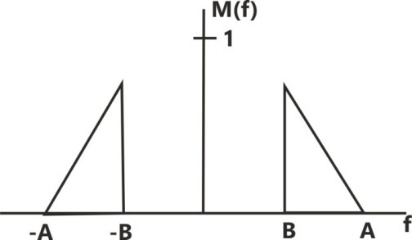
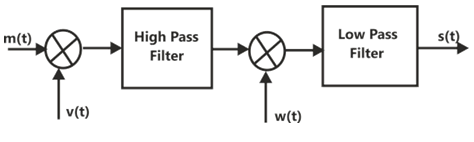
The bandwidth of the signal at the output of the modulator (in Hz) is _____
Sign in to see the solution
Log in to view the explanation, track your attempts, and keep your progress.
Sign in to UnlockA modulated signal is, where the baseband signal m(t) has frequency components less than 5 kHz only. The minimum required rate (in kHz) at which y(t) should be sampled to recover m(t) is _______.

Sign in to see the solution
Log in to view the explanation, track your attempts, and keep your progress.
Sign in to UnlockThe phase response of a pass-band waveform at the receiver is given by

Where is the centre frequency, and α and β are positive constants. The actual signal propagation delay from the transmitter to receiver is


α
β
Sign in to see the solution
Log in to view the explanation, track your attempts, and keep your progress.
Sign in to UnlockConsider an FM signal
.

The maximum deviation of the instantaneous frequency from the carrier frequency is




Sign in to see the solution
Log in to view the explanation, track your attempts, and keep your progress.
Sign in to UnlockIn a double side-band (DSB) full carrier AM transmission system, if the modulation index is doubled, then the ratio of total sideband power to the carrier power increases by a factor of ______.
Sign in to see the solution
Log in to view the explanation, track your attempts, and keep your progress.
Sign in to UnlockThe signal m(t) as shown is applied both to a phase modulator (with as the phase constant) and a frequency modulator (with as the frequency constant) having the same carrier frequency.


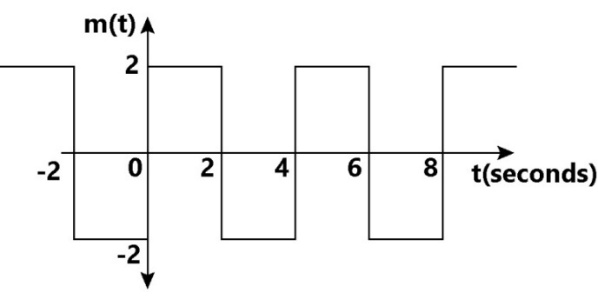
The ratio (in rad/Hz) for the same maximum phase deviation is

Sign in to see the solution
Log in to view the explanation, track your attempts, and keep your progress.
Sign in to UnlockThe Column-1 lists the attributes and the Column-2 lists the modulation systems. Match the attribute to the modulation system that best meets is.
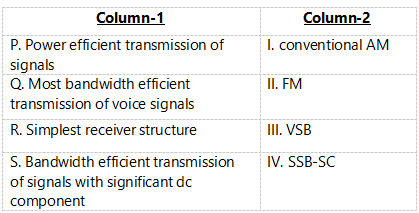
Sign in to see the solution
Log in to view the explanation, track your attempts, and keep your progress.
Sign in to UnlockA message signal
modulates the carrier where MHz to produce an AM signal. For demodulating the generated AM signal using an envelope detector, the time constant RC of the detector circuit should satisfy







Sign in to see the solution
Log in to view the explanation, track your attempts, and keep your progress.
Sign in to UnlockSuppose that the modulating signal is and the carrier signal is , which one of the following is a conventional AM signal without over-modulation?






Sign in to see the solution
Log in to view the explanation, track your attempts, and keep your progress.
Sign in to UnlockConsider an angle modulated signal . The average power of x(t) is

Sign in to see the solution
Log in to view the explanation, track your attempts, and keep your progress.
Sign in to UnlockFor a message signal and carrier of frequency, which of the following represents a single side-band (SSB) signal?






Sign in to see the solution
Log in to view the explanation, track your attempts, and keep your progress.
Sign in to UnlockA message signal given by

Is amplitude-modulated with a carrier of frequency to generate


What is the power efficiency achieved by this modulation scheme?
Sign in to see the solution
Log in to view the explanation, track your attempts, and keep your progress.
Sign in to UnlockConsider the amplitude modulated (AM) signal . For demodulating the signal using envelope detector, the minimum value of should be


Sign in to see the solution
Log in to view the explanation, track your attempts, and keep your progress.
Sign in to UnlockConsider the frequency modulated signal with carrier frequency of Hz. The modulation index is


Sign in to see the solution
Log in to view the explanation, track your attempts, and keep your progress.
Sign in to UnlockThe signal is

Sign in to see the solution
Log in to view the explanation, track your attempts, and keep your progress.
Sign in to UnlockIn the following scheme, if the spectrum M(f) of m(t) is as shown, then the spectrum Y(f) of y(t) will be
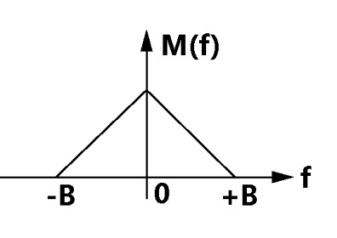
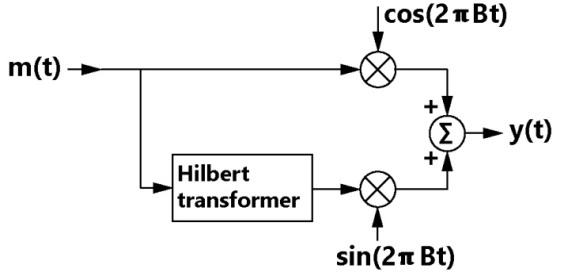
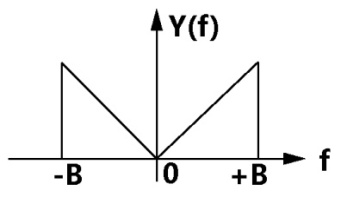
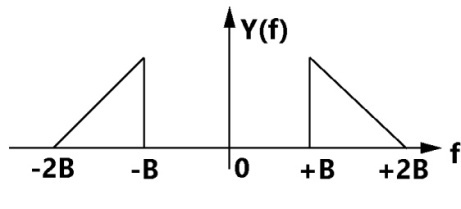
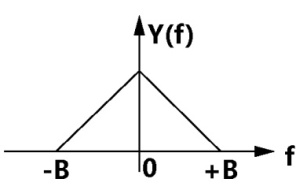
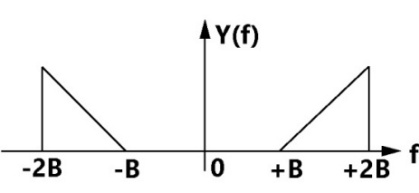
Sign in to see the solution
Log in to view the explanation, track your attempts, and keep your progress.
Sign in to UnlockA signal m(t) with bandwidth 500 Hz is first multiplied by a signal g(t) where

The resulting signal is then passed through an ideal low-pass filter with bandwidth 1 kHz. The output of the low-pass filter would be:

m (t)
0

Sign in to see the solution
Log in to view the explanation, track your attempts, and keep your progress.
Sign in to UnlockThe diagonal clipping in Amplitude Demodulation (using envelope detector) can be avoided if RC time-constant of the envelope detector satisfies the following condition, (here W is message bandwidth and is carrier frequency both in rad/sec)




Sign in to see the solution
Log in to view the explanation, track your attempts, and keep your progress.
Sign in to UnlockA message signal with bandwidth 10 kHz is Lower-Side Band SSB modulated with carrier frequency Hz. The resulting signal is then passed through a Narrow-Band Frequency Modulator with carrier frequency.


The bandwidth of the output would be:




Sign in to see the solution
Log in to view the explanation, track your attempts, and keep your progress.
Sign in to UnlockLet , where * denotes convolution and with u(t) being the unit step function


The impulse response of filter matched to the signal is given as:



–s(t)
s(t)
Sign in to see the solution
Log in to view the explanation, track your attempts, and keep your progress.
Sign in to UnlockLet , where * denotes convolution and with u(t) being the unit step function
An Amplitude Modulated signal is given as

In the interval . One set of possible values of the modulating signal and modulation index would be

t, 0.5
t, 1.0
t, 2.0
, 0.5

Sign in to see the solution
Log in to view the explanation, track your attempts, and keep your progress.
Sign in to UnlockConsider the following Amplitude Modulated (AM) signal, where:


The average side band power for the AM signal given above is:
Sign in to see the solution
Log in to view the explanation, track your attempts, and keep your progress.
Sign in to UnlockConsider the following Amplitude Modulated (AM) signal, where:
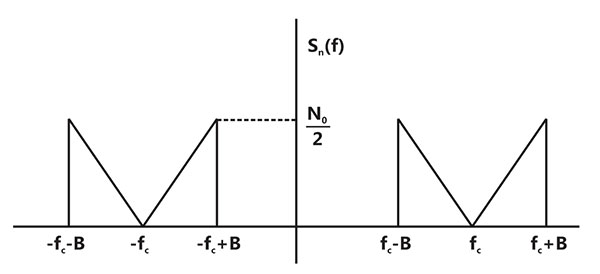
The AM signal gets added to a noise with power Spectral Density given in the figure below. The ratio of average sideband power to mean noise power would be:





Sign in to see the solution
Log in to view the explanation, track your attempts, and keep your progress.
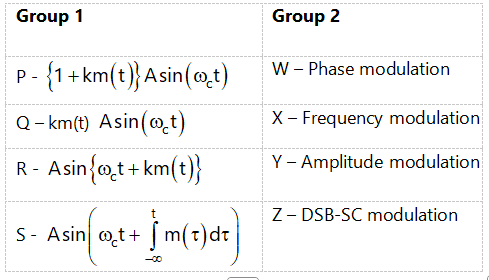
Sign in to Unlock Find the correct match between group 1 and group 2.
Sign in to see the solution
Log in to view the explanation, track your attempts, and keep your progress.
Sign in to UnlockThe power in the signal is:

Sign in to see the solution
Log in to view the explanation, track your attempts, and keep your progress.
Sign in to UnlockWhich of the following Analog modulation scheme requires the minimum transmitted power and minimum channel bandwidth?
Sign in to see the solution
Log in to view the explanation, track your attempts, and keep your progress.
Sign in to UnlockA device with input x (t) and output y (t) is characterized by . An FM signal with frequency deviation of 90 kHz and modulating signal bandwidth of 5 kHz is applied to this device. The bandwidth of the output signal is

Sign in to see the solution
Log in to view the explanation, track your attempts, and keep your progress.
Sign in to UnlockA carrier is phase modulated (PM) with frequency deviation of 10 kHz by a single tone frequency of 1 kHz. If the single tone frequency is increased to 2 kHz, assuming that phase deviation remains unchanged, the bandwidth of the PM signal is
Sign in to see the solution
Log in to view the explanation, track your attempts, and keep your progress.
Sign in to UnlockAn AM signal is detected using an envelope detector. The carrier frequency and modulating signal frequency are 1 KHz and 2 KHz respectively. An appropriate value for the time constant of the envelope detector is
Sign in to see the solution
Log in to view the explanation, track your attempts, and keep your progress.
Sign in to UnlockAn AM signal and a narrow-band FM signal with identical carriers, modulating signals and modulation indices of 0.1 are added together. The resultant signal can be closely approximated by
Sign in to see the solution
Log in to view the explanation, track your attempts, and keep your progress.
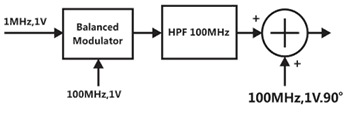
Sign in to UnlockA 100 MHz carrier of 1V amplitude and a 1 MHz modulating signal of 1V amplitude are fed to a balanced modulator. The output of the modulator is passed through an ideal high-pass filter with cut-off frequency of 100MHz. The output of the filter is added with 100 MHz signals of 1 V amplitude and 90º phase shift as shown in Figure, the envelope of the resultant signal is
constant



Sign in to see the solution
Log in to view the explanation, track your attempts, and keep your progress.
Sign in to UnlockTwo sinusoidal signals of same amplitude and frequencies 10 kHz and 10.1 kHz are added together. The combined signal is given to an ideal frequency detector. The output of the detector is
Sign in to see the solution
Log in to view the explanation, track your attempts, and keep your progress.
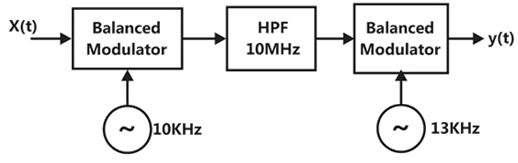
Sign in to UnlockConsider a system shown in Figure. Let X (f) and Y (f) denote the Fourier transforms of x (t) and y (t) respectively. The ideal HPF has the cut-off frequency 10 kHz.
The positive frequencies where Y (f) has spectral peaks are
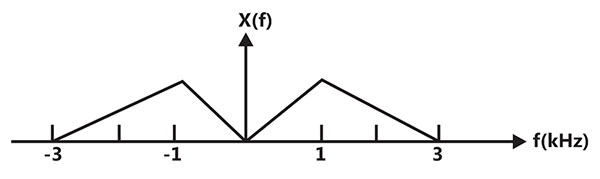
Sign in to see the solution
Log in to view the explanation, track your attempts, and keep your progress.
Sign in to UnlockThe input to a coherent detector is DSB-SC signal plus noise. The noise at the detector output is
Sign in to see the solution
Log in to view the explanation, track your attempts, and keep your progress.
Sign in to UnlockA DSB-SC signal is to be generated with a carrier frequency using a nonlinear device with the input-output characteristic


Where and are constants, the output of the nonlinear device can be filtered by an appropriate band-pass filter. Let where m(t) is the message signal. Then the value of (in MHz) is




Sign in to see the solution
Log in to view the explanation, track your attempts, and keep your progress.
Sign in to UnlockLet be the message signal and be the carrier.


c(t) and m(t) are used to generate an AM signal. The modulation index of the generated AM signal is
0.5. Then the quantity is





Sign in to see the solution
Log in to view the explanation, track your attempts, and keep your progress.
Sign in to UnlockLet be the message signal and be the carrier.
c(t) and m(t) are used to generate an AM signal. If the peak frequency deviation of the generated FM signal is three times the transmission bandwidth of the AM signal, then the coefficient of the term in the FM signal (in terms of the Bessel coefficients) is





Sign in to see the solution
Log in to view the explanation, track your attempts, and keep your progress.
Sign in to UnlockChoose the correct one from among the alternatives A, B, C, D after matching an item in Group 1 with the most appropriate item in Group 2.
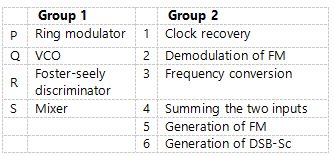
Sign in to see the solution
Log in to view the explanation, track your attempts, and keep your progress.
Sign in to UnlockA super-heterodyne receiver is to operate in the frequency range 550 kHz – 1650 kHz, with the intermediate frequency of 450 kHz. Let denote the required capacitance ratio of the local oscillator and I denote the image frequency (in KHz) of the incoming signal. If the receiver is tuned to 700 kHz, then

Sign in to see the solution
Log in to view the explanation, track your attempts, and keep your progress.
Sign in to UnlockA 1 MHz sinusoidal carrier is amplitude modulated by a symmetrical square wave of period 100μsec. Which of the following frequencies will NOT be present in the modulated signal?
Sign in to see the solution
Log in to view the explanation, track your attempts, and keep your progress.
Sign in to UnlockConsider a sampled signal

where and


When y(t) is passed through an ideal low-pass filter with a cut-off frequency of 5 KHz, the output of the filter is




Sign in to see the solution
Log in to view the explanation, track your attempts, and keep your progress.
Sign in to UnlockAn angle modulated signal is given by
. The maximum frequency and phase deviations of s (t) are

Sign in to see the solution
Log in to view the explanation, track your attempts, and keep your progress.
Sign in to UnlockIn Figure , and . The output y(t) will be



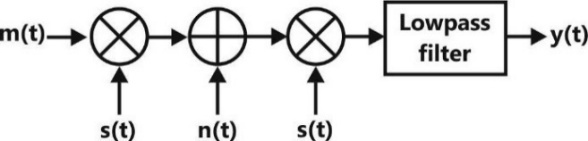




Sign in to see the solution
Log in to view the explanation, track your attempts, and keep your progress.
Sign in to UnlockA DSBSC modulated signal is corrupted by an additive white Gaussian noise of power spectral density W/Hz. The message power spectral density is as shown in Figure and is uniformly distributed over the range 0 to 2π.




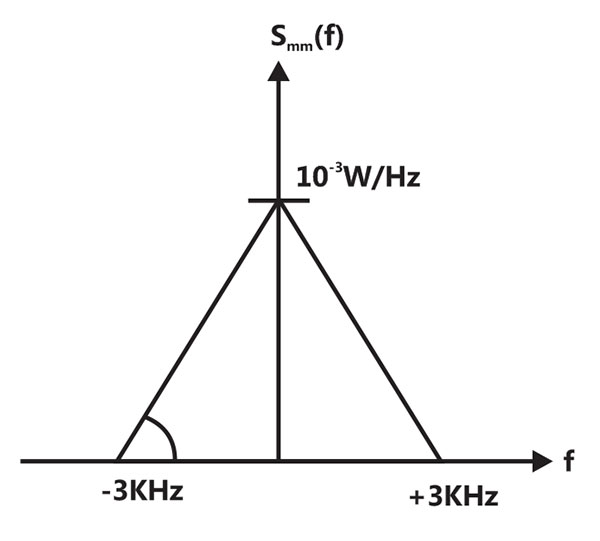
(a) Express the signal autocorrelation function in terms of the message autocorrelation function. Clearly state the necessary assumptions.


(b) Determine the signal power spectral density

(c) Find the power of the modulated signal and the noise power in the transmissions bandwidth.
(a)

(b)

(c)
Power of modulated signal = 150 W
Noise power in transmitted. BW = 1.2 W
(c)
Power of modulated signal = 1.2 W
Noise power in transmitted. BW = 150 W
Sign in to see the solution
Log in to view the explanation, track your attempts, and keep your progress.
Sign in to UnlockThe periodic modulating signal m(t) is shown in Figure Using Carson’s rule estimate (bandwidth of the FM signal) and (bandwidth of the PM signal) for and. Assume the essential bandwidth of m(t) to consist only up to and including the third harmonic.




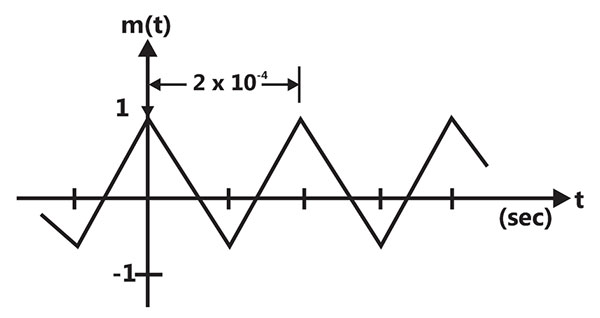
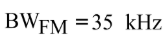


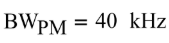
Sign in to see the solution
Log in to view the explanation, track your attempts, and keep your progress.
Sign in to UnlockA baseband signal g(t) band limited to 100 Hz modulates a carrier of frequency Hz. The modulated signal is transmitted over a channel whose input x and output y are related by . The spectrum of g(t) is shown in Figure. Sketch the spectrum of the transmitted signals and the spectrum of the received signal.



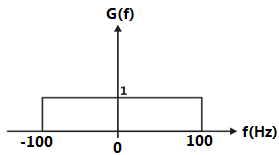
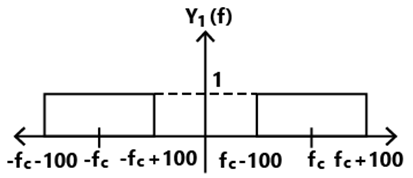
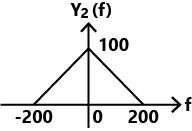
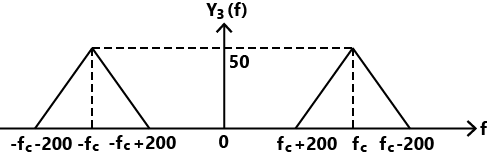
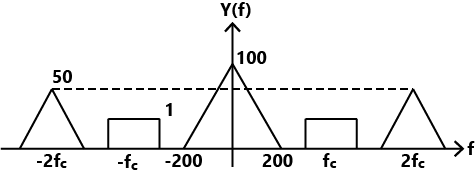
Sign in to see the solution
Log in to view the explanation, track your attempts, and keep your progress.
Sign in to UnlockThe amplitude modulated wave from is fed to an ideal envelope detector. The maximum magnitude of is greater than 1. Which of the following could be the detector output?






Sign in to see the solution
Log in to view the explanation, track your attempts, and keep your progress.
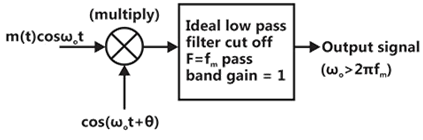
Sign in to UnlockA message m(t) band-limited to the frequency has a power of . The power of the output signal in the Figure is






Sign in to see the solution
Log in to view the explanation, track your attempts, and keep your progress.
Sign in to UnlockIn an FM system, a carrier of 100 MHz is modulated by a sinusoidal signal of 5 KHz. The bandwidth by Carson’s approximation is 1MHz. If , than by using

Carson’s approximation, the bandwidth of y(t) around
300 MHz and the spacing of spectral components are, respectively.
Sign in to see the solution
Log in to view the explanation, track your attempts, and keep your progress.
Sign in to UnlockThe input to a channel is a band pass signal. It is obtained by linearly modulating a sinusoidal carrier with a single-tone signal. The output of the channel due to this input is given by

The group delay and the phase delay in seconds, of the channel are


,


,


,


,
Sign in to see the solution
Log in to view the explanation, track your attempts, and keep your progress.
Sign in to UnlockA modulated signal is given by,

where the baseband signal and have bandwidths of 10 kHz and 15 kHz, respectively. The bandwidth of the modulated signal, in kHz, is


Sign in to see the solution
Log in to view the explanation, track your attempts, and keep your progress.
Sign in to UnlockA modulated signal is given by
, where a, and are positive constants, and .



The complex envelope of s(t) is given by




Sign in to see the solution
Log in to view the explanation, track your attempts, and keep your progress.
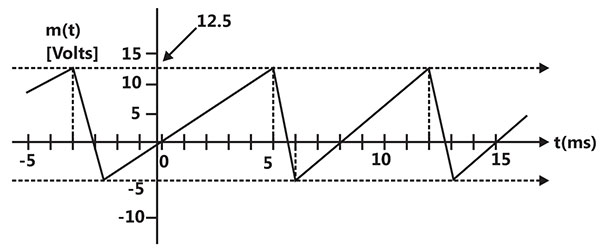
Sign in to UnlockA baseband signal m(t) modulates a carrier to produce the angle modulated signal, , where m(t) is shown in Figure. Determine the value of so that the peak-to-peak frequency deviation of the carrier is 100 kHz.


Sign in to see the solution
Log in to view the explanation, track your attempts, and keep your progress.
Sign in to UnlockThe image channel selectivity of super heterodyne receiver depends upon
Sign in to see the solution
Log in to view the explanation, track your attempts, and keep your progress.
Sign in to UnlockA DSB-SC signal is generated using the carrier and modulating signal x(t). The envelope of the DSB-SC signal is

x(t)

Only positive portion of x(t)

Sign in to see the solution
Log in to view the explanation, track your attempts, and keep your progress.
Sign in to UnlockAn SSB signal is demodulated by using a synchronous demodulator. However, the locally arranged carrier has a phase error θ . Determine the effect of the error on demodulation. What will be the effect of this error if the input is DSB-SC in place of SSB?
For a DSB-SC input, the demodulated output suffers from amplitude attenuation proportional to cos(θ ), but experiences zero phase distortion.
For an SSB input, the phase error introduces a combination of the original message m(t) and its Hilbert transform , leading to severe waveform phase distortion.

If the phase error reaches exactly θ =±90, a complete loss of the demodulated signal power occurs for both DSB-SC and SSB inputs.
For a DSB-SC input, when the phase error is exactly θ =±90, the system experiences the Quadrature Null Effect (QNE).
Sign in to see the solution
Log in to view the explanation, track your attempts, and keep your progress.
Sign in to UnlockThe figure is shows the first stage of a super heterodyne receiver. The desired input signal is at a frequency of 700MHz. The local oscillator (L. O) frequency is 1 GHz. The mixer is an ideal multiplier with a gain independent of frequency. A band-pass filter (BPF) is used to select the Intermediate Frequency (IF) output at 300MHz.
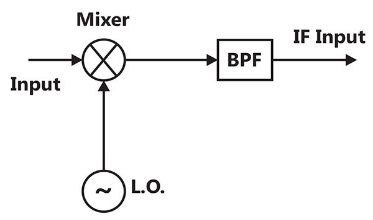
(a) What is the image frequency of the desired input?
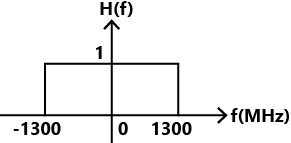
(b) A Low Pass Filter (LPF) can be used before the mixer to reject the image frequency. If a perfect rejection (zero transmission) of the image is desired, what type of LPF should be employed?
(c) The input in the figure is corrupted by an undesired 750 MHz signal which has the same amplitude as that of the desired signal at 700MHz. Let the BPF be of second order. At the BPF output, the undesired signal should be 20 dB below the desired signal. Calculate the Q required for the BPF.
(a)

(b) Frequency response of ideal LPF
(c) Q=7
(c) Q=14
Sign in to see the solution
Log in to view the explanation, track your attempts, and keep your progress.
Sign in to UnlockA block diagram of a system is shown in the figure. Draw the spectrum of the output signal with relative amplitudes of the frequencies.
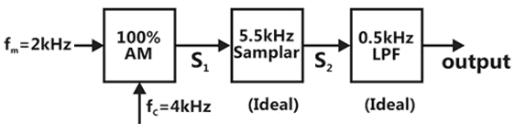
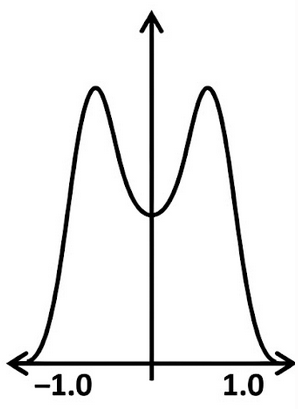
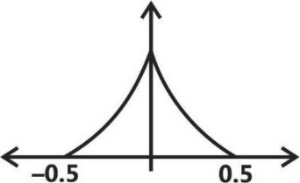
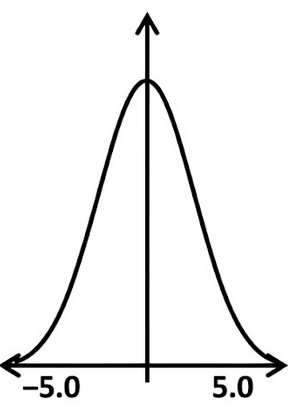
None
Sign in to see the solution
Log in to view the explanation, track your attempts, and keep your progress.
Sign in to UnlockThe image channel rejection in a super heterodyne receiver comes from
Sign in to see the solution
Log in to view the explanation, track your attempts, and keep your progress.
Sign in to UnlockAn FM signal with a modulation index 9 is applied to a frequency Tripler. The modulation index in the output signal will be
Sign in to see the solution
Log in to view the explanation, track your attempts, and keep your progress.
Sign in to UnlockThe image (second) channel selectivity of a super heterodyne communication receiver is determined by
Sign in to see the solution
Log in to view the explanation, track your attempts, and keep your progress.
Sign in to UnlockA PLL can be used to demodulate
Sign in to see the solution
Log in to view the explanation, track your attempts, and keep your progress.
Sign in to UnlockMatch the following
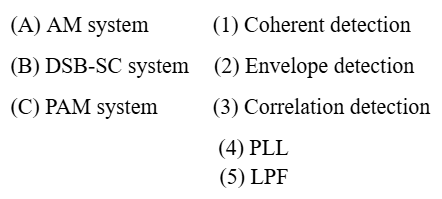
Sign in to see the solution
Log in to view the explanation, track your attempts, and keep your progress.
Sign in to UnlockMatch the following
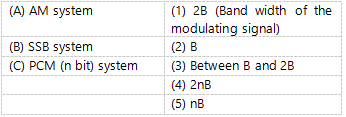
Sign in to see the solution
Log in to view the explanation, track your attempts, and keep your progress.
Sign in to Unlockrepresents

Sign in to see the solution
Log in to view the explanation, track your attempts, and keep your progress.
Sign in to UnlockA 10 MHz carrier is frequency modulated by a sinusoidal signal of 500Hz, the maximum frequency deviation being 50 kHz. The bandwidth required, as given by the Carson’s rule is _________.
Sign in to see the solution
Log in to view the explanation, track your attempts, and keep your progress.
Sign in to UnlockMatch The Following
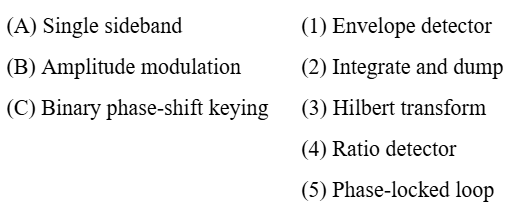
Sign in to see the solution
Log in to view the explanation, track your attempts, and keep your progress.
Sign in to UnlockWhich of the following demodulator(s) can be used for demodulating the signal

Sign in to see the solution
Log in to view the explanation, track your attempts, and keep your progress.
Sign in to UnlockA super-heterodyne radio receiver with an intermediate frequency of 455 KHz is tuned to a station operating at 1200 KHz. The associated image frequency is __________ KHz.
Sign in to see the solution
Log in to view the explanation, track your attempts, and keep your progress.
Sign in to UnlockObtain an expression for the signal in figure, for . Assume that and that the BPF is an ideal unity gain filter with pass band form 800 Hz to 1200 Hz.







None
Sign in to see the solution
Log in to view the explanation, track your attempts, and keep your progress.
Sign in to UnlockThe maximum power efficiency of an AM modulator is
Sign in to see the solution
Log in to view the explanation, track your attempts, and keep your progress.
Sign in to UnlockCoherent demodulation of FSK signal can be effected using
Sign in to see the solution
Log in to view the explanation, track your attempts, and keep your progress.
Sign in to UnlockA sinusoidal signal of 4 kHz frequency is used as a modulating signal for an FM and an AM transmitter. Both of the transmitters use the same amplitude for the un-modulated carrier. The peak frequency deviation in the FM transmitter is set to four times the bandwidth of the AM transmitter and, the magnitudes of the spectral components at (= carrier frequency) are same for both of the transmitters.

Determine the modulation indices for the AM and FM transmitters.
[If required use the values of the Bessel function given below:
, , ,



]

Sign in to see the solution
Log in to view the explanation, track your attempts, and keep your progress.
Sign in to Unlock