Signals and Systems
LTI Systems
Practice questions from LTI Systems.
34
Total0
Attempted0
Correct0
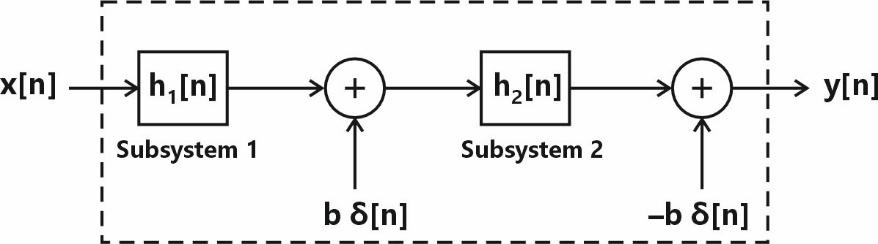
IncorrectConsider the discrete-time system below with input and output . In the figure, and denote the impulse responses of LTI Subsystems 1 and 2, respectively. Also, is the unit impulse, and .






Assuming , the overall system (denoted by the dashed box) is _________.


Sign in to see the solution
Log in to view the explanation, track your attempts, and keep your progress.
Sign in to UnlockA causal and stable LTI system with impulse response h(t) produces an output y(t) for an input signal x(t). A signal x(0.5 t) is applied to another causal and stable LTI system with impulse response h(0.5t). The resulting output is_________.




Sign in to see the solution
Log in to view the explanation, track your attempts, and keep your progress.
Sign in to UnlockConsider a system with input and output . The system is


Sign in to see the solution
Log in to view the explanation, track your attempts, and keep your progress.
Sign in to UnlockLet and , where denotes the unit step function.



If denotes the convolution of and , then ________(rounded off to one decimal place).




Sign in to see the solution
Log in to view the explanation, track your attempts, and keep your progress.
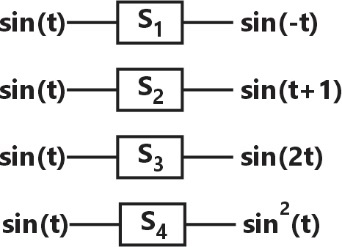
Sign in to UnlockThe outputs of four systems , and corresponding to the input signal , for all time , are shown in the figure. Based on the given information, which of the four systems is/are definitely NOT LTI (linear and time. invariant)?








Sign in to see the solution
Log in to view the explanation, track your attempts, and keep your progress.
Sign in to UnlockThe output of a discrete-time system for an input is



The unit impulse response of the system is
0 for all .

1 for all
unit step signal .

unit impulse signal .

Sign in to see the solution
Log in to view the explanation, track your attempts, and keep your progress.
Sign in to UnlockLet the input be u and the output be y of a system, and the other parameters are real constants. Identify which among the following systems is not a linear system:




Sign in to see the solution
Log in to view the explanation, track your attempts, and keep your progress.
Sign in to UnlockConsider a single input single output discrete-time system with x[n] as input and y[n] as output, where the two are related as

Which one of the following statements is true about the system?
Sign in to see the solution
Log in to view the explanation, track your attempts, and keep your progress.
Sign in to UnlockConsider the following statements for continuous-time linear time invariant (LTI) systems.
I. There is no bounded input bounded output (BIBO) stable system with a pole in the right half of the complex plane.
II. There is no causal and BIBO stable system with a pole in the right half of the complex plane.
Which one among the following is correct?
Sign in to see the solution
Log in to view the explanation, track your attempts, and keep your progress.
Sign in to UnlockTwo discrete-time signals x[n] and h[n] are both non-zero only for n = 0, 1, 2, and are zero otherwise. It is given that

Let y[n] be the linear convolution of x[n] and h[n]. Given that y[1] = 3 and y[2] = 4, the value of the expression (10y[3] + y[4]) is _____________ .
Sign in to see the solution
Log in to view the explanation, track your attempts, and keep your progress.
Sign in to UnlockThe input x(t) and the output y(t) of a continuous-time system are related as
The system is

Sign in to see the solution
Log in to view the explanation, track your attempts, and keep your progress.
Sign in to UnlockConsider the parallel combination of two LTI systems shown in the figure.
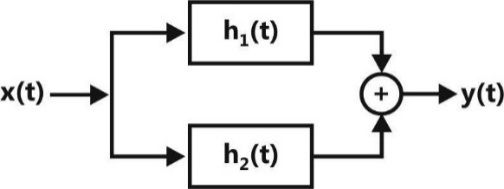
The implulse responses of the systems are


If the input x(t) is a unit step signal, then the energy of y (t) is _______________j
Sign in to see the solution
Log in to view the explanation, track your attempts, and keep your progress.
Sign in to UnlockThe result of the convolution is





Sign in to see the solution
Log in to view the explanation, track your attempts, and keep your progress.
Sign in to UnlockA continuous linear time-invariant filter has an impulse response h(t) described by
. When a constant input of value 5 is applied to this filter, the steady state output is ________.

Sign in to see the solution
Log in to view the explanation, track your attempts, and keep your progress.
Sign in to UnlockConsider a discrete-time signal. If y[n] is the convolution of x[n] with itself, the value of y[4] is _________.

Sign in to see the solution
Log in to view the explanation, track your attempts, and keep your progress.
Sign in to UnlockWhich one of the following statements is NOT TRUE for a continuous time causal and stable LTI system?
All the poles of the system must lie on the left side of the axis.

Zeros of the system can lie anywhere in the s-plane
All the poles must lie within

All the roots of the characteristic equation must be located on the left side of the axis.
Sign in to see the solution
Log in to view the explanation, track your attempts, and keep your progress.
Sign in to UnlockThe impulse response of a continuous time system is given by . The value of the step response at t = 2 is

Sign in to see the solution
Log in to view the explanation, track your attempts, and keep your progress.
Sign in to UnlockA system is defined by its impulse response . The system is

Sign in to see the solution
Log in to view the explanation, track your attempts, and keep your progress.
Sign in to UnlockConsider a system whose input x and output y are related by the equation
,

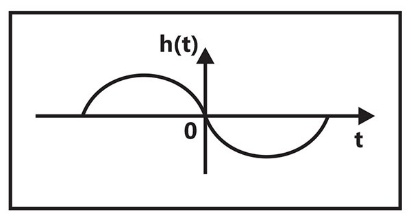
Where h(t) is shown in the graph
Which of the following four properties are possessed by the system?
BIBO: Bounded input gives a bounded output.
Causal: The system is causal
LP: The system is low pass
LTI: The system is linear and time-invariant.
Sign in to see the solution
Log in to view the explanation, track your attempts, and keep your progress.
Sign in to UnlockThe input and output of a continuous time system are respectively denoted by x(t) and y(t). Which of the following descriptions corresponds to a causal system?




Sign in to see the solution
Log in to view the explanation, track your attempts, and keep your progress.
Sign in to UnlockA discrete time linear shift-invariant system has an impulse response h[n] with , , , and zero otherwise. The system is given an input sequence x[n] with and zero otherwise. The number of nonzero samples in the output sequence y[n], and the value of y[2] are, respectively




Sign in to see the solution
Log in to view the explanation, track your attempts, and keep your progress.
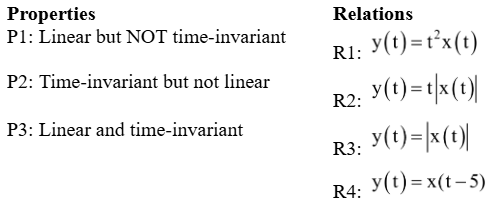
Sign in to UnlockLet x(t) be the input and y(t) be the output of a continuous time system. Match the system properties P1, P2, and P3 with system relations R1, R2, R3, R4.
Sign in to see the solution
Log in to view the explanation, track your attempts, and keep your progress.
Sign in to UnlockA system with input x[n] and output y[n] is given as . The system is:

Sign in to see the solution
Log in to view the explanation, track your attempts, and keep your progress.
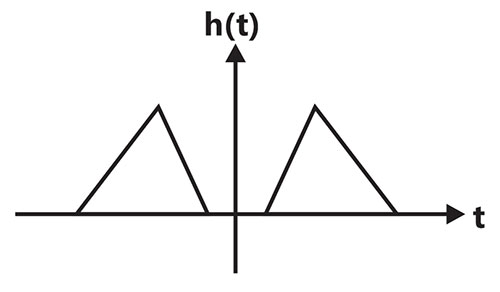
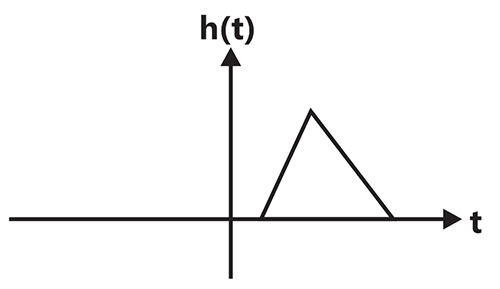
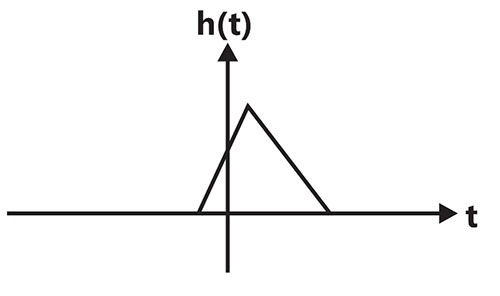
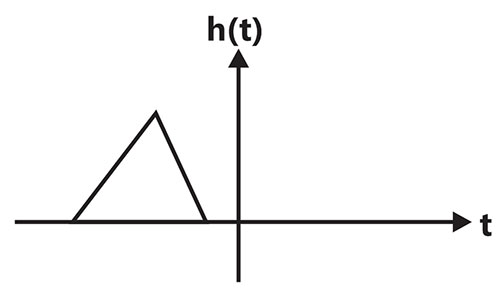
Sign in to UnlockWhich of the following can be impulse response of a causal system?
Sign in to see the solution
Log in to view the explanation, track your attempts, and keep your progress.
Sign in to UnlockThe impulse response h[n] of a linear time-invariant system is given by

Where u[n] is the unit step sequence. The above system is
Sign in to see the solution
Log in to view the explanation, track your attempts, and keep your progress.
Sign in to UnlockThe impulse response h[n] of a linear time invariant system is given as

If the input to the above system is the sequence, then the output is





Sign in to see the solution
Log in to view the explanation, track your attempts, and keep your progress.
Sign in to UnlockLet P be linearly, Q be time-invariance, R be causality and S be stability. A discrete time system has the input-output relationship,

Where x(n) is the input and y(n) is the output. The above system has the properties
Sign in to see the solution
Log in to view the explanation, track your attempts, and keep your progress.
Sign in to UnlockConvolution of x (t + 5) with impulse function is equal to

Sign in to see the solution
Log in to view the explanation, track your attempts, and keep your progress.
Sign in to UnlockThe impulse response functions of four linear systems are given respectively by





Where U(t) is the unit step function. Which of these systems is time invariant, causal and stable?




Sign in to see the solution
Log in to view the explanation, track your attempts, and keep your progress.
Sign in to UnlockA system with an input x(t) and output y(t) is described by the relation: . This system is

Sign in to see the solution
Log in to view the explanation, track your attempts, and keep your progress.
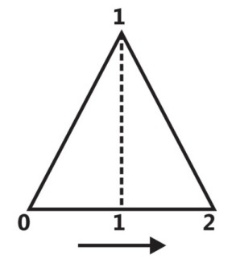
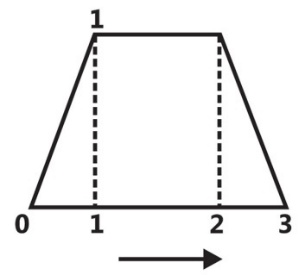
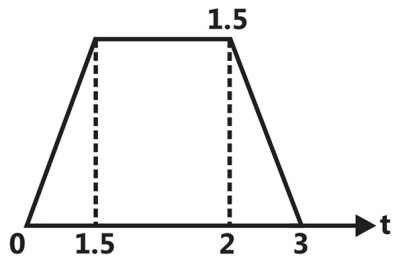
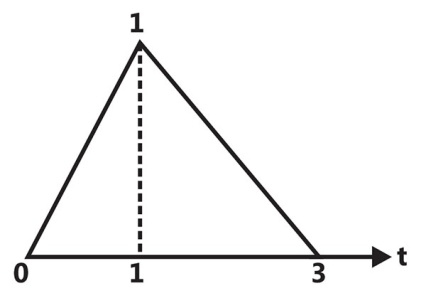
Sign in to UnlockLet u(t) be the step function. Which of the waveforms in figures given in the options (a) – (d) corresponds to the convolution of with

?

Sign in to see the solution
Log in to view the explanation, track your attempts, and keep your progress.
Sign in to UnlockMatch the followings
In the case of a linear time invariant system
(1) Poles in the right half plane implies
(2) Impulse response zero for implies
(a) Exponential decay of output
(b) System is causal
(c) No stored energy in the system
(d) System is unstable

Sign in to see the solution
Log in to view the explanation, track your attempts, and keep your progress.
Sign in to UnlockLet h(t) be the impulse response of a linear time-invariant system. Then the response of the system for any input u(t) is




Sign in to see the solution
Log in to view the explanation, track your attempts, and keep your progress.
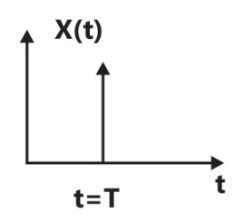
Sign in to UnlockAn excitation is applied to a system at and its response is zero for . Such a system is


Sign in to see the solution
Log in to view the explanation, track your attempts, and keep your progress.
Sign in to Unlock