Engineering Mathematics
Transform Theory
Practice questions from Transform Theory.
13
Total0
Attempted0
Correct0
IncorrectThe position of a particle y(t) is described by the differential equation: . The initial conditions areand . The position (accurate to two decimal places) of the particle at is ______.




Sign in to see the solution
Log in to view the explanation, track your attempts, and keep your progress.
Sign in to UnlockA sequence x|n] is specified as
for n≥2.

The initial conditions are x|0| = 1, x[1] = 1, and x[n] = 0 for n < 0. The value of x[12] is_____________
Sign in to see the solution
Log in to view the explanation, track your attempts, and keep your progress.
Sign in to UnlockThe bilateral Laplace transform of a function is





Sign in to see the solution
Log in to view the explanation, track your attempts, and keep your progress.
Sign in to UnlockConsider the function where u(t) is the unit step function. The area under g(t) is ________

Sign in to see the solution
Log in to view the explanation, track your attempts, and keep your progress.
Sign in to UnlockFor a function g(t), it is given that for any real value ω. If , then is ______________.



0
–j


Sign in to see the solution
Log in to view the explanation, track your attempts, and keep your progress.
Sign in to UnlockThe unilateral Laplace transform of f(t)is . Which one of the following is the unilateral Laplace transform of ?






Sign in to see the solution
Log in to view the explanation, track your attempts, and keep your progress.
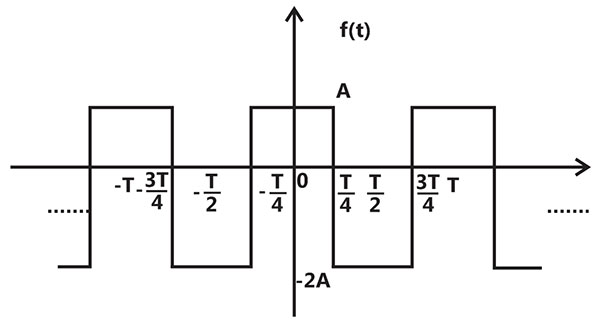
Sign in to UnlockThe trigonometric Fourier series for the waveform f(t) shown below contains
Sign in to see the solution
Log in to view the explanation, track your attempts, and keep your progress.
Sign in to UnlockThe Fourier series of a real periodic function has only
P. cosine terms if it is even
Q. Sine terms if it even
R. cosine terms if it is odd
S. sine terms if it is odd
Which of the above statements are correct?
Sign in to see the solution
Log in to view the explanation, track your attempts, and keep your progress.
Sign in to UnlockGiven that F(s) is the one-sided Laplace transform of f(t), the Laplace transform of is





Sign in to see the solution
Log in to view the explanation, track your attempts, and keep your progress.
Sign in to UnlockConsider the function f(t) having Laplace transform . The final value of f (t) would be:

0
1


Sign in to see the solution
Log in to view the explanation, track your attempts, and keep your progress.
Sign in to UnlockChoose the function, for which a Fourier series cannot be defined.




1
Sign in to see the solution
Log in to view the explanation, track your attempts, and keep your progress.
Sign in to UnlockFourier series of the periodic function (period) defined by



By putting in the above, one can deduce that the sum of the series

is





Sign in to see the solution
Log in to view the explanation, track your attempts, and keep your progress.
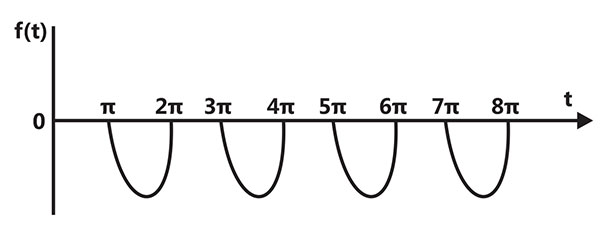
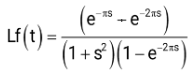
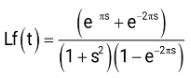
Sign in to UnlockThe Laplace transform of the periodic function f(t) described by the curve below i.e.

is ________

None
Sign in to see the solution
Log in to view the explanation, track your attempts, and keep your progress.
Sign in to Unlock