Signals and Systems
Laplace Transform
Practice questions from Laplace Transform.
47
Total0
Attempted0
Correct0
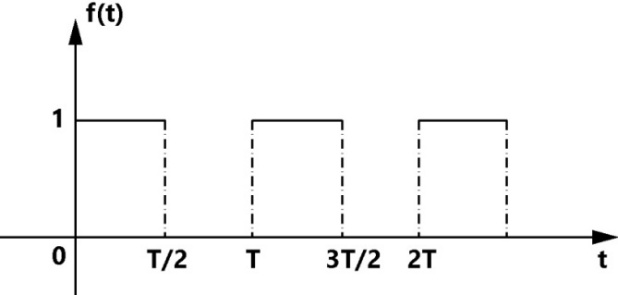
IncorrectThe Laplace transform of the causal periodic square wave of period T shown in the figure below is




Sign in to see the solution
Log in to view the explanation, track your attempts, and keep your progress.
Sign in to UnlockA first-order low-pass filter of time constant T is excited with different input signals (with zero initial conditions up to t = 0). Match the excitation signals X, Y, Z with the corresponding time responses for t ≥ 0:
X: Impulse

Y: Unit step

Z: Ramp

Sign in to see the solution
Log in to view the explanation, track your attempts, and keep your progress.
Sign in to UnlockThe response of the system to the unit input u(t) is y(t). The value of at is _____________.



Sign in to see the solution
Log in to view the explanation, track your attempts, and keep your progress.
Sign in to UnlockLet the signal outside the interval where and are finite. Furthermore, . The region of convergence (ROC) of the signal’s bilateral Laplace transform F(s) is





Sign in to see the solution
Log in to view the explanation, track your attempts, and keep your progress.
Sign in to UnlockBy performing cascading and/or summing/differencing operations using transfer function blocks and, one CANNOT realize a transfer function of the form






Sign in to see the solution
Log in to view the explanation, track your attempts, and keep your progress.
Sign in to UnlockInput x(t) and output y(t) of an LTI system are related by the differential equation . If the system is neither causal nor stable, the impulse response h(t) of the system is





Sign in to see the solution
Log in to view the explanation, track your attempts, and keep your progress.
Sign in to UnlockLet with , where u(t) is unit step function. If the bilateral Laplace transform of x(t) is



Then the value of β is __________.
Sign in to see the solution
Log in to view the explanation, track your attempts, and keep your progress.
Sign in to UnlockA system is described by the following differential equation, where u(t) is the input to the system and y(t) is the output of the system. . When y(0)=1 and u(t) is a unit step function, y(t) is





Sign in to see the solution
Log in to view the explanation, track your attempts, and keep your progress.
Sign in to UnlockThe input , where u(t) is the unit step function, is applied to a system with transfer function .If the initial value of output is -2, then the value of the steady state is ___________.


Sign in to see the solution
Log in to view the explanation, track your attempts, and keep your progress.
Sign in to UnlockLet h(t) denote the impulse response of a causal system with transfer function .

Consider the following three statements.
S1: The system is stable.
S2: is independent of t for t>0.

S3: A non-causal system with the same transfer function is stable.
For the above system,
Sign in to see the solution
Log in to view the explanation, track your attempts, and keep your progress.
Sign in to UnlockA stable linear time invariant (LTI) system has a transfer function . To make this system causal it needs to be cascaded with another LTI system having a transfer function . A correct choice for among the following options is


Sign in to see the solution
Log in to view the explanation, track your attempts, and keep your progress.
Sign in to UnlockA causal LTI system has zero initial conditions and impulse response h(t). Its input x(t) and output y(t) are related through the linear constant-coefficient differential equation
.

Let another signal g(t) be defined as
.

If G(s) is the Laplace transform of g(t), then the number of poles of G(s) is _______.
Sign in to see the solution
Log in to view the explanation, track your attempts, and keep your progress.
Sign in to UnlockAssuming zero initial condition, the response y(t) of the system given below to a unit step input u(t) is
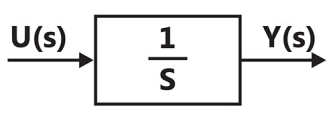
u(t)
t u(t)


Sign in to see the solution
Log in to view the explanation, track your attempts, and keep your progress.
Sign in to UnlockA system is described by the differential equation. Let x(t) be a rectangular pulse given by . Assuming that and at , the Laplace transform of y(t) is









Sign in to see the solution
Log in to view the explanation, track your attempts, and keep your progress.
Sign in to UnlockA system described by a linear, constant coefficient, ordinary, first order differential equation has an exact solution given by y(t) for , when the forcing function is x(t) and the initial condition is y(0). If one wishes to modify the system so that the solution becomes for , we need to


Change the initial condition to and the forcing function to


Change the initial condition to and the forcing function to


Change the initial condition to and the forcing function to


Change the initial condition to and the forcing function to


Sign in to see the solution
Log in to view the explanation, track your attempts, and keep your progress.
Sign in to UnlockA system with transfer function is excited by sin (ωt).

The steady-state output of the system is zero at




Sign in to see the solution
Log in to view the explanation, track your attempts, and keep your progress.
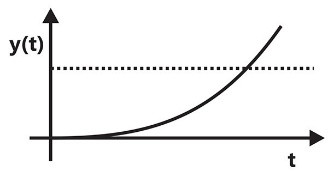
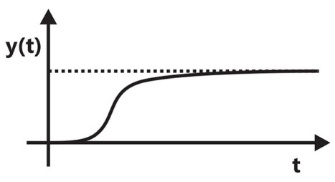
Sign in to UnlockThe differential equation describes a system with an input x(t) and an output y(t). The system, which is initially relaxed, is excited by a unit step input.

The output y(t) can be represented by the waveform
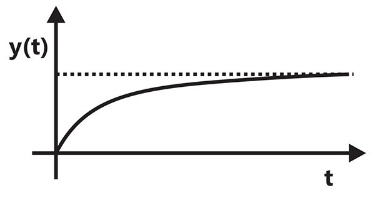
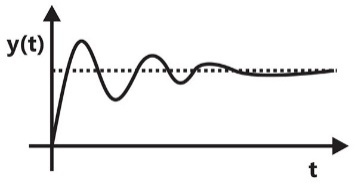
Sign in to see the solution
Log in to view the explanation, track your attempts, and keep your progress.
Sign in to UnlockIf the unit step response of a network is .

Then its unit impulse response is




Sign in to see the solution
Log in to view the explanation, track your attempts, and keep your progress.
Sign in to UnlockAn input is applied to an LTI system with impulse response.


The output is




Sign in to see the solution
Log in to view the explanation, track your attempts, and keep your progress.
Sign in to UnlockIf then the initial and final values of f (t) are respectively

Sign in to see the solution
Log in to view the explanation, track your attempts, and keep your progress.
Sign in to UnlockA system with the transfer function has an output for the input signal . Then, the system parameter ‘p’ is





1

Sign in to see the solution
Log in to view the explanation, track your attempts, and keep your progress.
Sign in to UnlockA continuous time LTI system is described by .

Assuming Zero initial conditions, the response y(t) of the above system for the input is given by





Sign in to see the solution
Log in to view the explanation, track your attempts, and keep your progress.
Sign in to UnlockThe impulse response h(t) of a linear time-invariant continuous time system is described by , where u(t) denotes the unit step function, and and are real constants. This system is stable if



is positive and is positive
is negative and is negative
is positive and is negative
is negative and is positive
Sign in to see the solution
Log in to view the explanation, track your attempts, and keep your progress.
Sign in to UnlockA linear, time-invariant, causal continuous time system has a rational transfer function with simple poles at s = -2 and s = -4, and one simple zero at s = -1. A unit step u(t) is applied at the input of the system. At steady state, the output has constant value of 1. The impulse response of this system is




Sign in to see the solution
Log in to view the explanation, track your attempts, and keep your progress.
Sign in to UnlockIf the Laplace transform of a signal y(t) is then its final value is

Sign in to see the solution
Log in to view the explanation, track your attempts, and keep your progress.
Sign in to UnlockThe frequency response of a linear, time-invariant-system is given by. The step response of the system is





Sign in to see the solution
Log in to view the explanation, track your attempts, and keep your progress.
Sign in to UnlockThe unit-step response of a system starting from rest is given by for


The transfer function of the system is:




Sign in to see the solution
Log in to view the explanation, track your attempts, and keep your progress.
Sign in to UnlockIn what range should Re(s) remain so that the Laplace transform of the function exists?

Sign in to see the solution
Log in to view the explanation, track your attempts, and keep your progress.
Sign in to UnlockA system described by the following differential equation is initially at rest.

For input x(t) =2u(t), the output y(t) is




Sign in to see the solution
Log in to view the explanation, track your attempts, and keep your progress.
Sign in to UnlockA causal system having the transfer function is excited with 10u(t). The time at which the output reaches 99% of its steady state value is

Sign in to see the solution
Log in to view the explanation, track your attempts, and keep your progress.
Sign in to UnlockThe Laplace transform of i(t) is given by As, the value of i(t) tends to


0
1
2

Sign in to see the solution
Log in to view the explanation, track your attempts, and keep your progress.
Sign in to UnlockThe Laplace transform of a continuous-time signal x(t) is . If the Fourier transform of this signal exists, then x(t) is





Sign in to see the solution
Log in to view the explanation, track your attempts, and keep your progress.
Sign in to UnlockThe transfer function of a system is given by. The impulse response of the system is: (* denotes convolution, and U(t) is unit step function)





Sign in to see the solution
Log in to view the explanation, track your attempts, and keep your progress.
Sign in to UnlockGiven that , , . is







None of the above
Sign in to see the solution
Log in to view the explanation, track your attempts, and keep your progress.
Sign in to UnlockA linear time invariant system has an impulse response, . If the initial conditions are zero and the input is, the output for is






None of the above
Sign in to see the solution
Log in to view the explanation, track your attempts, and keep your progress.
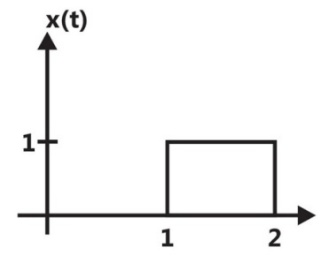
Sign in to UnlockFor the linear, time invariant system whose block diagram is shown in Figure (a), with input x(t) and output y(t),
(a) Find the transfer function.
(b) For the step response of the system [i.e. find y(t) when x(t) is a unit step function and the initial conditions are zero]
(c) Find y(t), if x(t) is as shown in Figure (b), and the initial conditions are zero.
Figure (a)
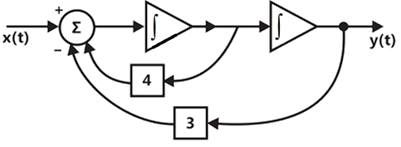
Figure (b)
Sign in to see the solution
Log in to view the explanation, track your attempts, and keep your progress.
Sign in to UnlockIf , then is equal to






Sign in to see the solution
Log in to view the explanation, track your attempts, and keep your progress.
Sign in to UnlockIf , then the value of


Sign in to see the solution
Log in to view the explanation, track your attempts, and keep your progress.
Sign in to UnlockThe unit impulse response of a linear time invariant system is the unit step function u(t). For , the response of the system to an excitation , will be






Sign in to see the solution
Log in to view the explanation, track your attempts, and keep your progress.
Sign in to UnlockThe Laplace Transform of $\scriptstyle e^{\alpha t} \cos(\alpha t)$ is equal to



None of these
Sign in to see the solution
Log in to view the explanation, track your attempts, and keep your progress.
Sign in to UnlockThe inverse Laplace transform of the function is





Sign in to see the solution
Log in to view the explanation, track your attempts, and keep your progress.
Sign in to UnlockIf then and are given by



[Note: ‘L’ stand for ‘Laplace’ Transform of’]
Sign in to see the solution
Log in to view the explanation, track your attempts, and keep your progress.
Sign in to UnlockMatch the following
(A) Fourier transform of a Gaussian function
(B) Convolution of a rectangular pulse with itself
(C) Current through an inductor for a step input voltage
(1) Gaussian function
(2) Rectangular pulse
(3) Triangular pulse
(4) Ramp function
(5) Zero
Sign in to see the solution
Log in to view the explanation, track your attempts, and keep your progress.
Sign in to UnlockThe Laplace transform of a unit ramp function starting at , is





Sign in to see the solution
Log in to view the explanation, track your attempts, and keep your progress.
Sign in to UnlockIf G(s) is a stable transfer function, then is always a stable transfer function
(True=1,False=0)

Sign in to see the solution
Log in to view the explanation, track your attempts, and keep your progress.
Sign in to UnlockIf then is given by


Zero
undefined
Sign in to see the solution
Log in to view the explanation, track your attempts, and keep your progress.
Sign in to UnlockThe voltage across an impedance in a network is , where , are the Laplace transforms of the corresponding time function v(t), z(t) and i(t). The voltage v(t) is:







Sign in to see the solution
Log in to view the explanation, track your attempts, and keep your progress.
Sign in to Unlock