Communication System
Information Theory and Error Control coding
Practice questions from Information Theory and Error Control coding.
34
Total0
Attempted0
Correct0
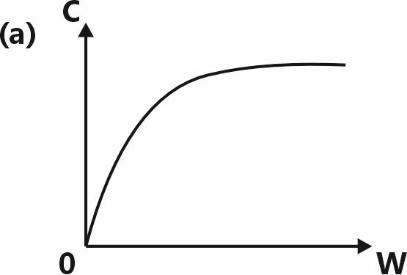
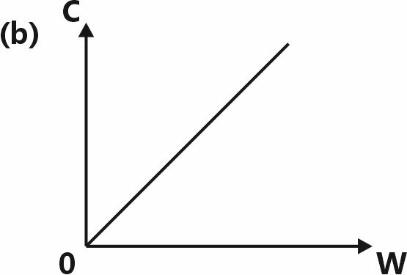
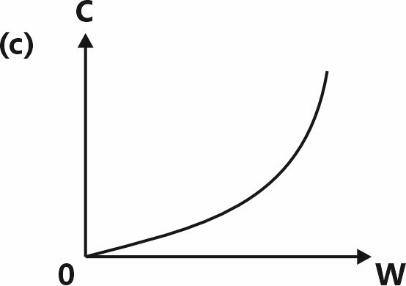
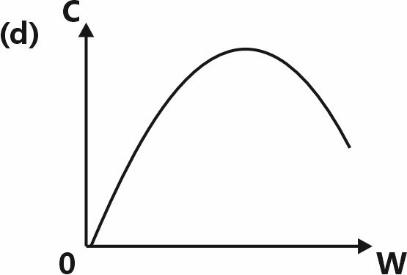
IncorrectConsider an additive white Gaussian noise (AWGN) channel with bandwidth and noise power spectral density . Let denote the average transmit power constraint.



Which one of the following plots illustrates the dependence of the channel capacity on the bandwidth (keeping and fixed)?


Sign in to see the solution
Log in to view the explanation, track your attempts, and keep your progress.
Sign in to UnlockThe generator matrix of a binary linear block code is given by


The minimum Hamming distance between codewords equals _________ (answer in integer).

Sign in to see the solution
Log in to view the explanation, track your attempts, and keep your progress.
Sign in to Unlockand are Bernoulli random variables taking values in . The joint probability mass function of the random variables is given by:







The mutual information is _________ (rounded off to two decimal places).

Sign in to see the solution
Log in to view the explanation, track your attempts, and keep your progress.
Sign in to UnlockA source transmits symbols from an alphabet of size 16. The value of maximum achievable entropy (in bits) is _________.
Sign in to see the solution
Log in to view the explanation, track your attempts, and keep your progress.
Sign in to UnlockThe information bit sequence is to be transmitted by encoding with Cyclic Redundancy Check 4 (CRC-4) code, for which the generator polynomial is . The encoded sequence of bits is ___________.






Sign in to see the solution
Log in to view the explanation, track your attempts, and keep your progress.
Sign in to UnlockThe frequency of occurrence of 8 symbols (a-h) is shown in the table below. A symbol is chosen and it is determined by asking a series of "yes/no" questions which are assumed to be truthfully answered. The average number of questions when asked in the most efficient sequence, to determine the chosen symbol, is _______ (rounded off to two decimal places).

Sign in to see the solution
Log in to view the explanation, track your attempts, and keep your progress.
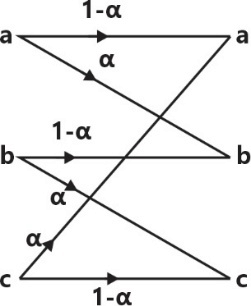
Sign in to UnlockThe transition diagram of a discrete memoryless channel with three input symbols and three output symbols is shown in the figure. The transition probabilities are as marked.
The parameter lies in the interval . The value of for which the capacity of this channel is maximized, is ________ (rounded off to two decimal places).


Sign in to see the solution
Log in to view the explanation, track your attempts, and keep your progress.
Sign in to UnlockConsider communication over a memoryless binary symmetric channel using a Hamming code. Each transmitted bit is received correctly with probability ( ), and flipped with probability . For each codeword transmission, the receiver performs minimum Hamming distance decoding, and correctly decodes the message bits if and only if the channel introduces at most one bit error.



For , the probability that a transmitted codeword is decoded correctly is ________ (rounded off to two decimal places).

Sign in to see the solution
Log in to view the explanation, track your attempts, and keep your progress.
Sign in to UnlockA digital transmission system uses a systematic linear Hamming code for transmitting data over a noisy channel. If three of the message-codeword pairs in this code , where is the codeword corresponding to the message are known to be , (1110 ; and , then which of the following is a valid codeword in this code?







Sign in to see the solution
Log in to view the explanation, track your attempts, and keep your progress.
Sign in to UnlockA linear Hamming code is used to map 4-bit message to 7-bit code words. The encoder mapping is linear. If the message 0001 is mapped to the codeword 0000111 and the message 0011 is mapped to the codeword 1100110, then the message 0010 is mapped to
Sign in to see the solution
Log in to view the explanation, track your attempts, and keep your progress.
Sign in to UnlockConsider a binary channel code in which each codeword has a fixed length of 5 bits. The Hamming distance between any pair of distinct code words in this code is at least 2. The maximum number of code words such a code can contain is _____
Sign in to see the solution
Log in to view the explanation, track your attempts, and keep your progress.
Sign in to UnlockLet be independent random variables, has mean 0 and variance 1, while has mean 1 and variance 4. The mutual information I between and in bits is ______________.




Sign in to see the solution
Log in to view the explanation, track your attempts, and keep your progress.
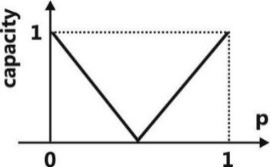
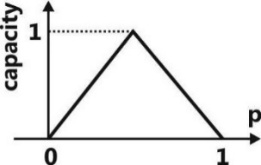
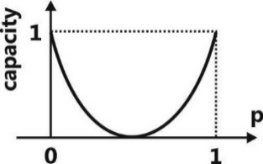
Sign in to UnlockWhich one of the following graphs shows the Shannon capacity (channel capacity) in bits of a memory less binary symmetric channel with crossover probability p ?
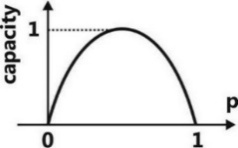
Sign in to see the solution
Log in to view the explanation, track your attempts, and keep your progress.
Sign in to UnlockConsider a binary memoryless channel characterized by the transition probability diagram shown in the figure.
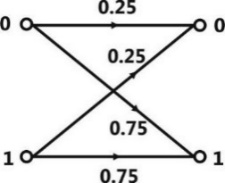
Sign in to see the solution
Log in to view the explanation, track your attempts, and keep your progress.
Sign in to UnlockConsider a discrete memory-less source with alphabetand respective probabilities of occurrence the entropy of the source (in bits) is____________


Sign in to see the solution
Log in to view the explanation, track your attempts, and keep your progress.
Sign in to UnlockA digital communication system uses a repetition code for channel encoding/decoding. During transmission, each bit is repeated three times (0 is transmitted as 000, and 1 is transmitted as 111). It is assumed that the source puts out symbols independently and with equal probability. The decoder operates as follows: In a block of three received bits, if the number of zeros exceeds the number of ones, the decoder decides in favor of a 0, and if the number of ones exceeds the number of zeros, the decoder decides in favor of a 1. Assuming a binary symmetric channel with crossover probability p = 0.1, the average probability of error is______________
Sign in to see the solution
Log in to view the explanation, track your attempts, and keep your progress.
Sign in to UnlockA discrete memoryless source has an alphabet
{,,,} with corresponding probabilities . The minimum required average codeword length in bits to represent this source for error-free reconstruction is _____.





Sign in to see the solution
Log in to view the explanation, track your attempts, and keep your progress.
Sign in to UnlockA binary communication system makes use of the symbols “zero” and “one”. There are channel errors. Consider the following events:
: a "zero" is transmitted

: a "one" is transmitted : a "zero" is received


: a "one" is received

The following probabilities are given:
, and . The information in bits that you obtain when you learn which symbol has been received (while you know that a “zero” has been transmitted) is ________.


Sign in to see the solution
Log in to view the explanation, track your attempts, and keep your progress.
Sign in to UnlockThe bit error probability of a memory-less binary symmetric channel is . If bits are sent over this channel, then the probability that not more than one bit will be in error is________

Sign in to see the solution
Log in to view the explanation, track your attempts, and keep your progress.
Sign in to UnlockThe input X to the Binary Symmetric Channel (BSC) shown in the figure is ‘1’ with probability 0.8. The cross-over probability is 1/7. If the received bit Y = 0, the conditional probability that ‘1’ was transmitted is _______.
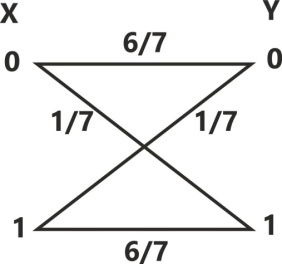
P[X=0]=0.2
P[X=1]=0.8
Sign in to see the solution
Log in to view the explanation, track your attempts, and keep your progress.
Sign in to UnlockA source emits bit 0 with probability and bit 1 with probability . The emitted bits are communicated to the receiver. The receiver decides for either 0 or 1 based on the received value R . It is given that the conditional density functions of R are as



And

The minimum decision error probability is
Sign in to see the solution
Log in to view the explanation, track your attempts, and keep your progress.
Sign in to UnlockThe capacity of a Binary Symmetric Channel (BSC) with cross-over probability 0.5 is _________.
Sign in to see the solution
Log in to view the explanation, track your attempts, and keep your progress.
Sign in to UnlockA fair coin is tossed repeatedly until a ‘Head’ appears for the first time. Let L be the number of tosses to get this first ‘Head’. The entropy H(L) in bits is __________.
Sign in to see the solution
Log in to view the explanation, track your attempts, and keep your progress.
Sign in to UnlockA binary random variable X takes the value of 1 with probability 1/3. X is input to a cascade of 2 independent identical binary symmetric channels (BSCs) each with crossover probability 1/2. The output of BSCs are the random variables and as shown in the figure.


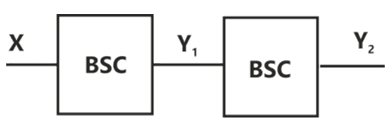
The value of in bits is __________.

Sign in to see the solution
Log in to view the explanation, track your attempts, and keep your progress.
Sign in to UnlockConsider the Z-channel given in the figure. The input is 0 or 1 with equal probability.
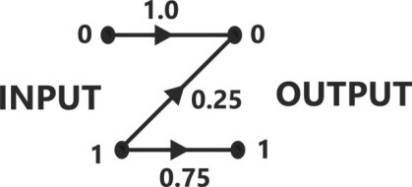
If the output is 0, the probability that the input is also 0 equals ____________
Sign in to see the solution
Log in to view the explanation, track your attempts, and keep your progress.
Sign in to UnlockA source alphabet consists of N symbols with the probability of the first two symbols being the same. A source encoder increases the probability of the first symbol by a small amount ε and decreases that of the second by ε. After encoding, the entropy of the source
Sign in to see the solution
Log in to view the explanation, track your attempts, and keep your progress.
Sign in to UnlockA binary symmetric channel (BSC) has a transition probability of 1/8. If the binary transmit symbol M is such that P(X=0)=9/10, then the probability of error for an optimum receiver will be
Sign in to see the solution
Log in to view the explanation, track your attempts, and keep your progress.
Sign in to UnlockA communication channel with AWGN operating at a signal to noise ratio SNR >> 1 and bandwidth B has capacity . If the SNR is doubled keeping B constant, the resulting capacity is given by






Sign in to see the solution
Log in to view the explanation, track your attempts, and keep your progress.
Sign in to UnlockA memory-less source emits n symbols each with a probability P. The entropy of the source as a function of n
Sign in to see the solution
Log in to view the explanation, track your attempts, and keep your progress.
Sign in to UnlockConsider a Binary Symmetric Channel (BSC) with probability of error being . To transmit a bit, say 1, we transmit a sequence of three 1s. The receiver will interpret the received sequence to represent 1 if at least two bits are 1. The probability that the transmitted bit will be received in error is





Sign in to see the solution
Log in to view the explanation, track your attempts, and keep your progress.
Sign in to UnlockA source generates three symbols with probabilities 0.25, 0.25, 0.50 at a rate of 3000 symbols per second. Assuming independent generation of symbols, the most efficient source encoder would have average bit rate as
Sign in to see the solution
Log in to view the explanation, track your attempts, and keep your progress.
Sign in to UnlockConsider a binary digital communication system with equally likely 0’s and 1’s. When binary 0 is transmitted the voltage at the detector input can lie between the level s-0.25V and +0.25V with equal probability: when binary 1 is transmitted, the voltage at the detector can have any value between 0 and 1 V with equal probability. If the detector has a threshold of 2.0V (i.e., if the received signal is greater than 0.2 V, the bit is taken as 1), the average bit error probability is
Sign in to see the solution
Log in to view the explanation, track your attempts, and keep your progress.
Sign in to UnlockA discrete memory-less source generates either 0 or 1 at a rate of 160 kbps; 0 is generated three times more frequently than 1. A coherent binary PSK modulator is employed to transmit these bits over a noisy channel. The received bits are detected in a correlator fed with the basis function of unit energy (for this binary PSK scheme) as the reference signal. The receiver makes a decision in favour of 1 if the correlator output is positive, else decides in favour of 0. If 0 and 1 are represented as and respectively, then


(a) Determine the transmitted signal energy per bit.
(b) Determine the basis function of unit energy for this binary PSK scheme.
(c) Determine the probability that the receiver makes a decision in favour of 1 when the channel noise is characterized as zero-mean AWGN with power spectral density

Sign in to see the solution
Log in to view the explanation, track your attempts, and keep your progress.
Sign in to UnlockA binary source has symbol probabilities 0.8 and 0.2. If extension coding (blocks of 4 symbols) is used, the lower and upper bounds on the average code word length are
(a) Lower _______(b) Higher ______
Sign in to see the solution
Log in to view the explanation, track your attempts, and keep your progress.
Sign in to Unlock