Engineering Mathematics
Numerical Methods
Practice questions from Numerical Methods.
13
Total0
Attempted0
Correct0
IncorrectStarting with x = 1, the solution of the equation , after two iterations of Newton-Raphson’s method (up to two decimal places) is ____________

Sign in to see the solution
Log in to view the explanation, track your attempts, and keep your progress.
Sign in to UnlockThe ordinary differential equation, with is to be solved using the forward Euler method. The largest time step that can be used to solve the equation without making the numerical solution unstable is ________.


Sign in to see the solution
Log in to view the explanation, track your attempts, and keep your progress.
Sign in to UnlockConsider the first order initial value problem , y(0)=1, with exact solution for x=0.1, the percentage difference between the exact solution and the solution obtained using a single iteration of the second-order Runge-kutta method with step-size h=0. 1is ______________.



Sign in to see the solution
Log in to view the explanation, track your attempts, and keep your progress.
Sign in to UnlockThe Newton-Raphson method is used to solve the equation. Taking the initial guess as x = 5, the solution obtained at the end of the first iteration is __________.

Sign in to see the solution
Log in to view the explanation, track your attempts, and keep your progress.
Sign in to UnlockMatch the application to appropriate numerical method.
Application
P1: Numerical integration
P2: Solution to a transcendental equation
P3: Solution to a system of linear equations
P4: Solution to a differential equation
Numerical Method
M1: Newton-Raphson Method
M2: Runge-Kutta Method
M3: Simpson’s 1/3-rule
M4: Gauss Elimination Method
Sign in to see the solution
Log in to view the explanation, track your attempts, and keep your progress.
Sign in to UnlockA polynomial with all coefficients positive has

Sign in to see the solution
Log in to view the explanation, track your attempts, and keep your progress.
Sign in to UnlockA numerical solution of the equation can be obtained using Newton-Raphson method. If the starting value is x = 2 for the iteration, the value of x that is to be used in the next step is

Sign in to see the solution
Log in to view the explanation, track your attempts, and keep your progress.
Sign in to UnlockConsider differential equation with the initial condition . Using Euler’s first order method with a step size of 0.1, the value of y (0.3) is


Sign in to see the solution
Log in to view the explanation, track your attempts, and keep your progress.
Sign in to UnlockThe recursion relation to solve using Newton-Raphson method is





Sign in to see the solution
Log in to view the explanation, track your attempts, and keep your progress.
Sign in to UnlockThe equation is to be solved using the Newton-Raphson method. If x = 2 is taken as the initial approximation of the solution, then the next approximation using this method will be



1

Sign in to see the solution
Log in to view the explanation, track your attempts, and keep your progress.
Sign in to UnlockMatch the following and choose the correct combination:
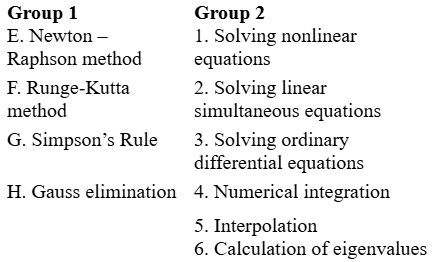
Sign in to see the solution
Log in to view the explanation, track your attempts, and keep your progress.
Sign in to UnlockSimpson’s rule for integration gives exact result when f(x) is a polynomial of degree
Sign in to see the solution
Log in to view the explanation, track your attempts, and keep your progress.
Sign in to UnlockGiven the differential equation, with the initial condition . The value of calculated numerically up to the third place of decimal by the second order Runge Kutta method with step size is _________




Sign in to see the solution
Log in to view the explanation, track your attempts, and keep your progress.
Sign in to Unlock