Engineering Mathematics
Differential Equations
Practice questions from Differential Equations.
35
Total0
Attempted0
Correct0
IncorrectThe function satisfies


where and denote the first and second derivatives of respectively.


Given and , the maximum value of over is _________ (rounded off to two decimal places).



Sign in to see the solution
Log in to view the explanation, track your attempts, and keep your progress.
Sign in to UnlockThe general form of the complementary function of a differential equation is given by where A and B are real constants determined by the initial condition. The corresponding differential equation is__________.





Sign in to see the solution
Log in to view the explanation, track your attempts, and keep your progress.
Sign in to UnlockConsider the following partial differential equation (PDE)

where and are distinct positive real numbers. Select the combination(s) of values of the real parameters and such that is a solution of the given PDE.









Sign in to see the solution
Log in to view the explanation, track your attempts, and keep your progress.
Sign in to UnlockConsider the following wave equation,

Which of the given options is/are solution(s) to the given wave equation?




Sign in to see the solution
Log in to view the explanation, track your attempts, and keep your progress.
Sign in to UnlockConsider the differential equation given below:

The integrating factor of the differential equation is




Sign in to see the solution
Log in to view the explanation, track your attempts, and keep your progress.
Sign in to UnlockThe general solution of is





Sign in to see the solution
Log in to view the explanation, track your attempts, and keep your progress.
Sign in to UnlockWhich one of the following options contains two solutions of the differential equation ?

and


and


and
and
Sign in to see the solution
Log in to view the explanation, track your attempts, and keep your progress.
Sign in to UnlockThe families of curves represented by the solution of the equation

For n=-1 and n=+1, respectively, are
Sign in to see the solution
Log in to view the explanation, track your attempts, and keep your progress.
Sign in to UnlockConsider the homogeneous ordinary differential equation

with as a general solution. Given that


The value of , rounded off to two decimal places, is ____________.

Sign in to see the solution
Log in to view the explanation, track your attempts, and keep your progress.
Sign in to UnlockA curve passes through the pointand satisfies the differential equation. The equation that describes the curve is






Sign in to see the solution
Log in to view the explanation, track your attempts, and keep your progress.
Sign in to UnlockWhich one of the following is the general solution of the first order differential equation

where x, y are real?




Sign in to see the solution
Log in to view the explanation, track your attempts, and keep your progress.
Sign in to UnlockThe general solution of the differential equation. In terms of arbitrary constants is






Sign in to see the solution
Log in to view the explanation, track your attempts, and keep your progress.
Sign in to UnlockThe particular solution of the initial value problem given below is
with y(0)=3 and






Sign in to see the solution
Log in to view the explanation, track your attempts, and keep your progress.
Sign in to UnlockThe solution of the differential equation with y(0)=y'(0)=1 is





Sign in to see the solution
Log in to view the explanation, track your attempts, and keep your progress.
Sign in to UnlockThe general solution of the differential equation is

( c is a constant)

( c is a constant)

( c is a constant)

( c is a constant)

Sign in to see the solution
Log in to view the explanation, track your attempts, and keep your progress.
Sign in to UnlockConsider the differential equation with initial condition x(0) = 1. The response x(t) for t > 0 is





Sign in to see the solution
Log in to view the explanation, track your attempts, and keep your progress.
Sign in to UnlockConsider the differential equation. Given x(0) = 20 and x(1) = 10/e, where e = 2.718, the value of x(2) is _________.

Sign in to see the solution
Log in to view the explanation, track your attempts, and keep your progress.
Sign in to UnlockIf the characteristic equation of the differential equation ,has two equal roots, then the values of α are

Sign in to see the solution
Log in to view the explanation, track your attempts, and keep your progress.
Sign in to UnlockWhich ONE of the following is a linear non-homogeneous differential equation, where x and y are the independent and dependent variables respectively?




Sign in to see the solution
Log in to view the explanation, track your attempts, and keep your progress.
Sign in to UnlockIf a and b are constants, the most general solution of the differential equation is





Sign in to see the solution
Log in to view the explanation, track your attempts, and keep your progress.
Sign in to UnlockWith initial values y(0) = y' (0) = 1, the solution of the differential equation at x=1 is _____.

Sign in to see the solution
Log in to view the explanation, track your attempts, and keep your progress.
Sign in to UnlockWith initial condition x(1) =0.5, the solution of the differential equation, is





Sign in to see the solution
Log in to view the explanation, track your attempts, and keep your progress.
Sign in to UnlockConsider the differential equation
With and



The numerical value of is

Sign in to see the solution
Log in to view the explanation, track your attempts, and keep your progress.
Sign in to UnlockThe solution of the differential equation, is






Sign in to see the solution
Log in to view the explanation, track your attempts, and keep your progress.
Sign in to UnlockA function n(x) satisfied the differential equation where L is a constant. The boundary conditions are: and . The solution to this equation is







Sign in to see the solution
Log in to view the explanation, track your attempts, and keep your progress.
Sign in to UnlockThe order of the differential equation is

Sign in to see the solution
Log in to view the explanation, track your attempts, and keep your progress.
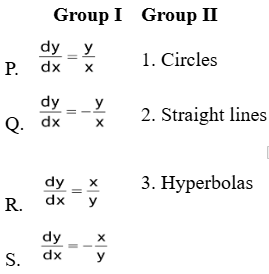
Sign in to UnlockMatch each differential equation in Group I to its family of solution curves from Group II
Sign in to see the solution
Log in to view the explanation, track your attempts, and keep your progress.
Sign in to UnlockWhich of the following is a solution to the differential equation ?





Sign in to see the solution
Log in to view the explanation, track your attempts, and keep your progress.
Sign in to UnlockThe solution of the differential equation under the boundary conditions

(i) , at x = 0 and

(ii) at x = ∞, where k, and are constants, is







Sign in to see the solution
Log in to view the explanation, track your attempts, and keep your progress.
Sign in to UnlockA solution for the differential equation With initial condition is:






Sign in to see the solution
Log in to view the explanation, track your attempts, and keep your progress.
Sign in to UnlockFor the differential equation the boundary conditions are

(i) y = 0 for x = 0 and
(ii) y = 0 for x = a
The form of non-zero solutions of y (where m varies over all integers) are




Sign in to see the solution
Log in to view the explanation, track your attempts, and keep your progress.
Sign in to UnlockThe following differential equation has

Sign in to see the solution
Log in to view the explanation, track your attempts, and keep your progress.
Sign in to UnlockA solution of the following differential equation is given by





Sign in to see the solution
Log in to view the explanation, track your attempts, and keep your progress.
Sign in to UnlockFind the correct statement for the given differential equations
(A)

(B)

(C)

Sign in to see the solution
Log in to view the explanation, track your attempts, and keep your progress.
Sign in to UnlockThe differential equation, , is:

Sign in to see the solution
Log in to view the explanation, track your attempts, and keep your progress.
Sign in to Unlock