Signals and Systems
Sampling
Practice questions from Sampling.
20
Total0
Attempted0
Correct0
IncorrectConsider a continuous-time finite-energy signal whose Fourier transform vanishes outside the frequency interval , where is in .




The signal is uniformly sampled to obtain . Here,


with being the Dirac impulse, , and . The sampled signal is passed through an ideal lowpass filter with cutoff frequency and passband gain .






The output of the filter is given by ___________.
if




Sign in to see the solution
Log in to view the explanation, track your attempts, and keep your progress.
Sign in to UnlockA continuous time signal is sampled at a rate of 15 Hz. The sampled signal when passed through an LTI system with impulse response



Produces an output The expression for is __________.






Sign in to see the solution
Log in to view the explanation, track your attempts, and keep your progress.
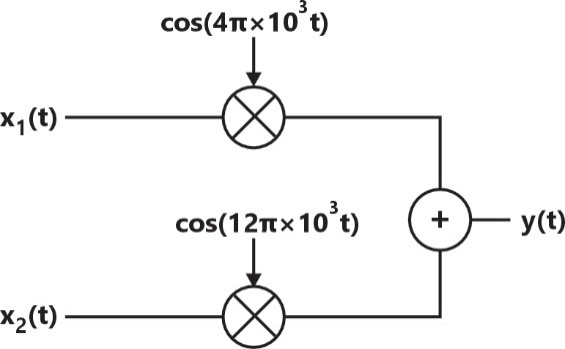
Sign in to UnlockLet and be two band-limited signals having bandwidth each. In the figure below, the Nyquist sampling frequency, in , required to sample , is









Sign in to see the solution
Log in to view the explanation, track your attempts, and keep your progress.
Sign in to UnlockConsider a real-valued base-band signal , band limited to . The Nyquist rate for the signal is







Sign in to see the solution
Log in to view the explanation, track your attempts, and keep your progress.
Sign in to UnlockA band limited low-pass signal x(t) of bandwidth 5kHz is sampled at a sampling rate . The signal x(t) is reconstructed using the reconstruction filter H(f) whose magnitude response is shown below:


The minimum sampling rate f, (in kHz) for perfect reconstruction of x(t) is _______
Sign in to see the solution
Log in to view the explanation, track your attempts, and keep your progress.
Sign in to UnlockThe signal , where t is in seconds, is sampled at a rate of 9000 samples per second. The sampled signal is the input to an ideal lowpass filter with frequency response H (f) as follows:


What is the number of sinusoids in the output and their frequencies in kHz?
Sign in to see the solution
Log in to view the explanation, track your attempts, and keep your progress.
Sign in to UnlockA continuous-time function x(t) is periodic with period T. The function is sample uniformly with a sampling period In which one of the following cases is the sampled signal periodic?

Sign in to see the solution
Log in to view the explanation, track your attempts, and keep your progress.
Sign in to UnlockA continuous-time sinusoid of frequency 33 Hz is multiplied with a periodic Dirac impulse train of frequency 46 Hz. The resulting signal is passed through an ideal analog low pass filter with a cut-off frequency of 23 Hz. The fundamental frequency (in Hz) of the output is____________
Sign in to see the solution
Log in to view the explanation, track your attempts, and keep your progress.
Sign in to UnlockA continuous-time filter with transfer function is converted to a discrete-time filter with transfer function so that the impulse of the continuous-time, sampled at 2Hz, is identical at the sampling instants to the impulse response of the discrete time filter. The value of k is ___________.


Sign in to see the solution
Log in to view the explanation, track your attempts, and keep your progress.
Sign in to UnlockConsider the signal, where t is in seconds. The Nyquist sampling rate (in samples/second) for the signal y(t) = x(2t + 5) is

Sign in to see the solution
Log in to view the explanation, track your attempts, and keep your progress.
Sign in to UnlockThe signal is ideally sampled at a sampling frequency of 15 Hz. The sampled signal is passed through a filter with impulse response. The filter output is






Sign in to see the solution
Log in to view the explanation, track your attempts, and keep your progress.
Sign in to UnlockConsider a continuous-time signal defined as .

Where ‘∗’ denotes the convolution operation and t is in seconds. The Nyquist sampling rate (in samples/sec) for x(t) is _____.
Sign in to see the solution
Log in to view the explanation, track your attempts, and keep your progress.
Sign in to UnlockConsider two real values signals, x(t) band-limited to
[-500Hz, 500Hz] and y(t) band limited to [-1kHz, 1kHz].
For, the Nyquist sampling frequency (in kHz) is _______.

Sign in to see the solution
Log in to view the explanation, track your attempts, and keep your progress.
Sign in to UnlockLet be sampled at 20 Hz and reconstructed using an ideal low-pass filter with cut-off frequency of 20 Hz. The frequency/frequencies present in the reconstructed signal is/are

Sign in to see the solution
Log in to view the explanation, track your attempts, and keep your progress.
Sign in to UnlockThe Nyquist sampling rate for the signal is given by

Sign in to see the solution
Log in to view the explanation, track your attempts, and keep your progress.
Sign in to UnlockAn LTI system having transfer function and input is in steady state. The output is sampled at a rate rad/s to obtain the final output {y(t)}. Which of the following is true?



is zero for all sampling frequencies

is nonzero for all sampling frequencies
is nonzero for , but zero for


is zero for but nonzero for
Sign in to see the solution
Log in to view the explanation, track your attempts, and keep your progress.
Sign in to UnlockA 1 KHz sinusoidal signal is ideally sampled at 1500 samples/sec and the sampled signal is passed through an ideal low-pass filter with cut-off frequency 800 Hz. The output signal has the frequency
Sign in to see the solution
Log in to view the explanation, track your attempts, and keep your progress.
Sign in to UnlockA band limited signal is sampled at the Nyquist rate. The signal can be recovered by passing the samples through
Sign in to see the solution
Log in to view the explanation, track your attempts, and keep your progress.
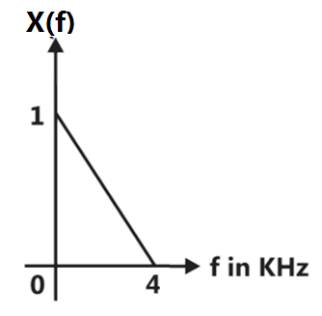
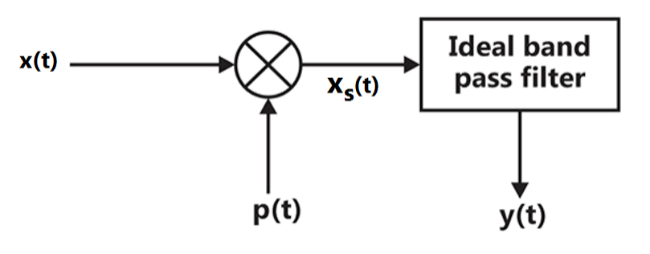
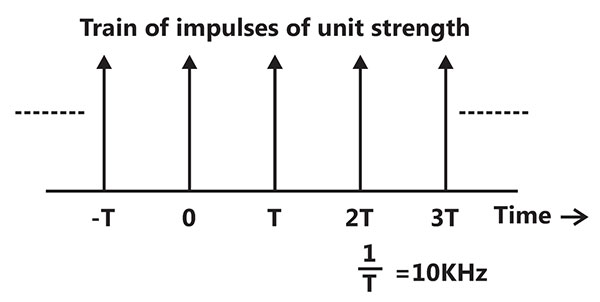
Sign in to UnlockA band-limited signal x(t) with a spectrum X(f) as shown in Figure (a) is processed as shown in Figure (b). p(t) is a periodic train of impulses as in Figure (c). The ideal band-pass filter has a pass band from 26 KHz to 34 KHz.
(a) Calculate the Fourier series coefficients in the Fourier expansion of p(t) in the form


(b) Find the Fourier Transform of p(t)
(c) Obtain and sketch the spectrum of .

(d) Obtain and sketch the spectrum of y(t).
(a)
(b)
(c)
(a) \(\scriptstyle {C_n = 10^4}\)
(b) \(\scriptstyle {\therefore p(f) = \frac{1}{T} \sum_{n=-\infty}^{\infty} \delta(f - nf_0)}\)
\(\scriptstyle {f_0 = \frac{1}{T} = 10^4 = 10 \text{ kHz}}\)
(c)
\(\scriptstyle {X_s(f) = \frac{1}{T} \sum_{n=-\infty}^{\infty} X(f - nf_0)}\)
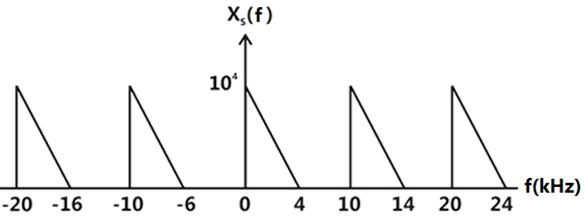
(d) \(\scriptstyle {Y(f) = \frac{1}{T} [X(f - 3f_0) + X(f + 3f_0)]}\)
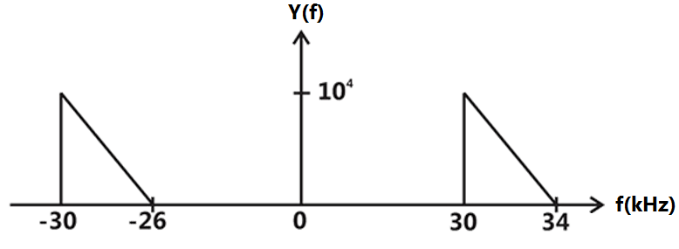
Sign in to see the solution
Log in to view the explanation, track your attempts, and keep your progress.
Sign in to UnlockA signal has frequency components from 300 Hz to 1.8 KHz. The minimum possible rate at which the signal has to be sampled is _________Hz.
Sign in to see the solution
Log in to view the explanation, track your attempts, and keep your progress.
Sign in to Unlock