Signals and Systems
Z Transform
Practice questions from Z Transform.
44
Total0
Attempted0
Correct0
IncorrectLet be a discrete-time signal whose -transform is .



Which of the following statements is/are TRUE?
The discrete-time Fourier transform (DTFT) of always exists
The region of convergence (RoC) of contains neither poles nor zeros
The discrete-time Fourier transform (DTFT) exists if the region of convergence (RoC) contains the unit circle
If , where is the unit impulse and is a scalar, then the region of convergence is the entire -plane




Sign in to see the solution
Log in to view the explanation, track your attempts, and keep your progress.
Sign in to UnlockFor a causal discrete-time LTI system with transfer function

Which of the following statements is/are true?
Sign in to see the solution
Log in to view the explanation, track your attempts, and keep your progress.
Sign in to UnlockFor a unit step input , a discrete-time LTI system produces an output signal


Let be the output of the system for an input . The value of is ________.



Sign in to see the solution
Log in to view the explanation, track your attempts, and keep your progress.
Sign in to UnlockWhich one of the following pole-zero corresponds to the transfer function of an LTI system characterized by the input-output difference equation given below?

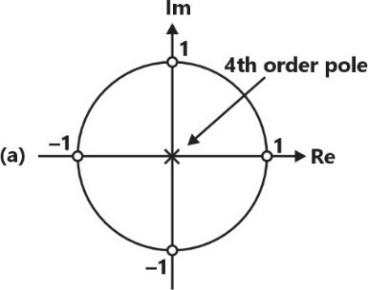
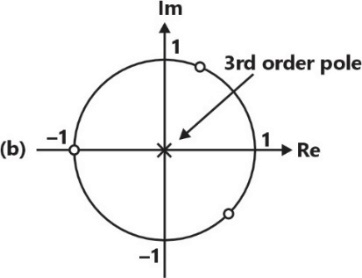
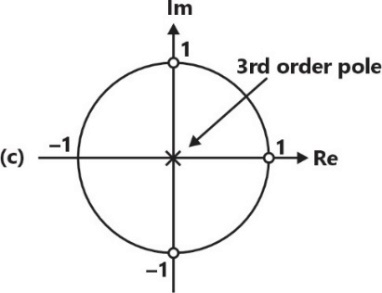
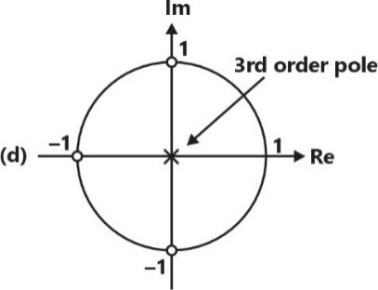
Sign in to see the solution
Log in to view the explanation, track your attempts, and keep your progress.
Sign in to UnlockThe transfer function of a stable discrete-time LTI system is . where and are real numbers. The value of (rounded off to one decimal place) with , for which the magnitude response of the system is constant over all frequencies, is __________.




Sign in to see the solution
Log in to view the explanation, track your attempts, and keep your progress.
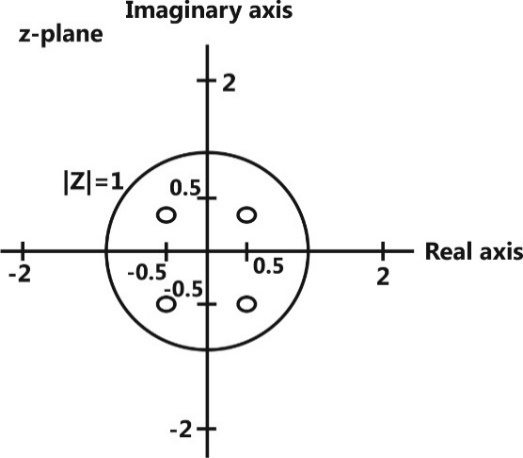
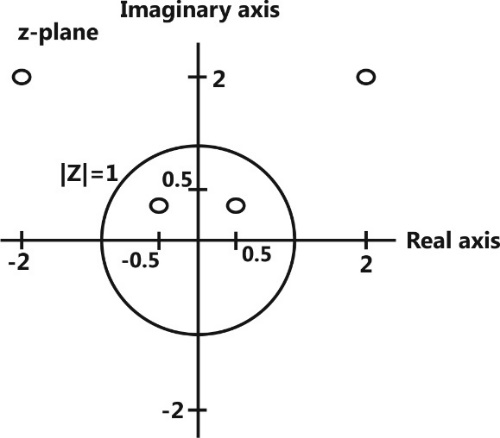
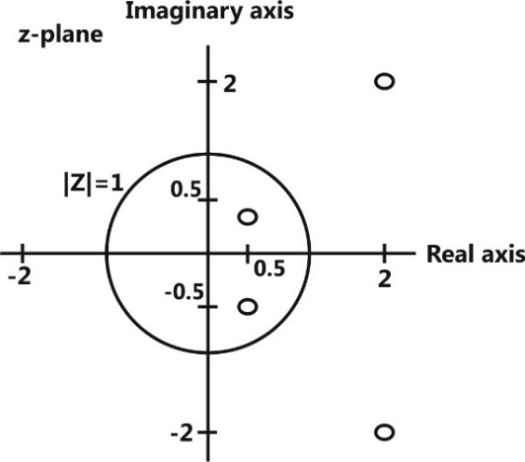
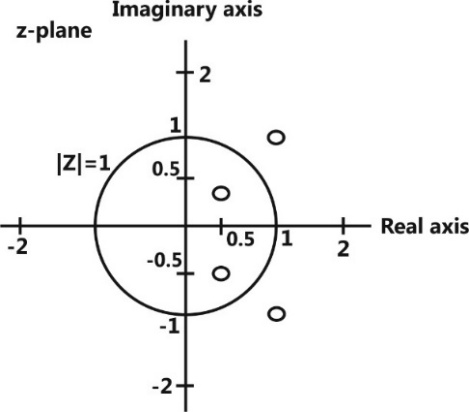
Sign in to UnlockLet H(z) be the z-transform of a real-valued discrete time signal h[n]. If has a zero at , and P(z) has a total of four zeros, which one of the following poles represents all the zeros correctly?


Sign in to see the solution
Log in to view the explanation, track your attempts, and keep your progress.
Sign in to UnlockA discrete-time all-pass system has two of its poles at and ". Which one of the following statements about the system is TRUE?


It has two more poles at and.


It is stable only when the impulse response is two-sided.
It has constant phase response over all frequencies.
It has constant phase response over the entire z-plane.
Sign in to see the solution
Log in to view the explanation, track your attempts, and keep your progress.
Sign in to UnlockConsider the sequence where u[n] denotes the unit-step sequence and 0 < |a| < |b| < 1. The region of convergence (ROC) of the z-transform of x[n] is

Sign in to see the solution
Log in to view the explanation, track your attempts, and keep your progress.
Sign in to UnlockA discrete-time signal has z-transform X(z). If Y(z)= X(–z) is the z-transform of another signal y[n], then

Sign in to see the solution
Log in to view the explanation, track your attempts, and keep your progress.
Sign in to UnlockThe ROC (region of convergence) of the z-transform of a discrete-time signal is represented by the shaded region in the z-plane. If the signal then the ROC of its z-transform is represented by


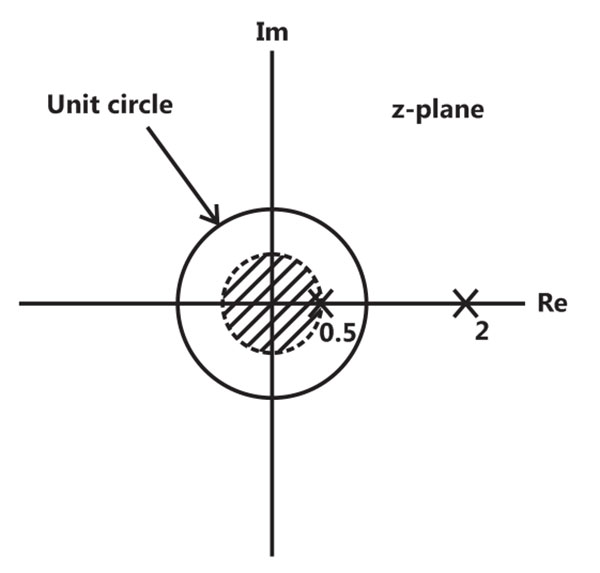
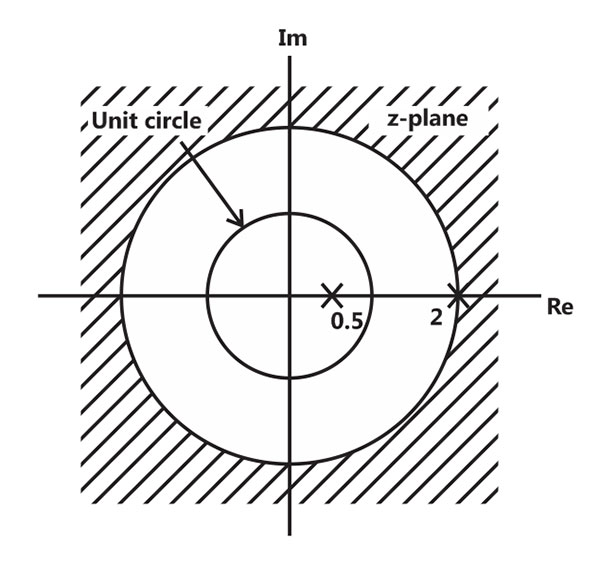
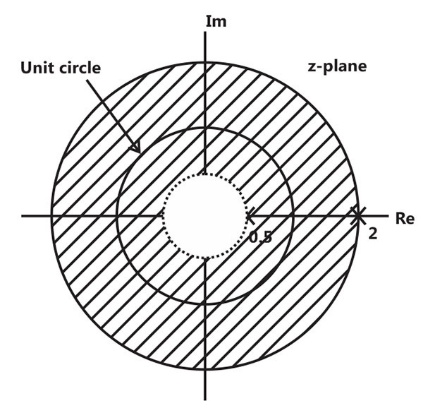
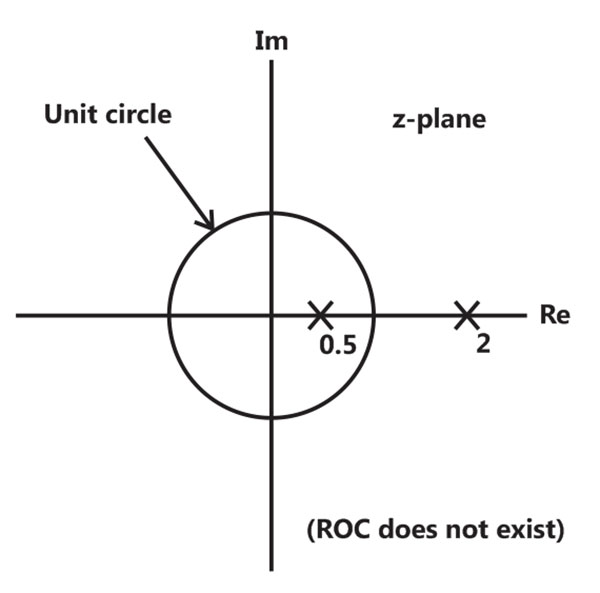
Sign in to see the solution
Log in to view the explanation, track your attempts, and keep your progress.
Sign in to UnlockFor the discrete-time system shown in the figure, the poles of the system transfer function are located at
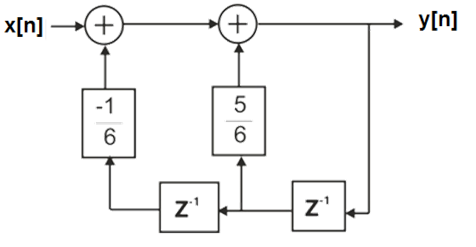
2,3
, 3

,

2,
Sign in to see the solution
Log in to view the explanation, track your attempts, and keep your progress.
Sign in to UnlockThe pole-zero diagram of a causal and stable discrete-time system is shown in the figure. The zero at the origin has multiplicity 4. The impulse response of the system is h[n]. If h[0] = 1, we can conclude
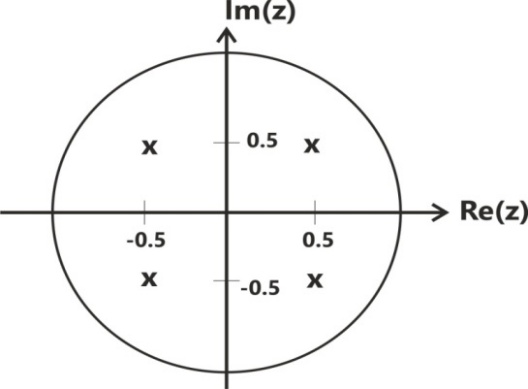
Sign in to see the solution
Log in to view the explanation, track your attempts, and keep your progress.
Sign in to UnlockTwo causal discrete-time signals x[n] and y[n] are related as. If the z-transform of y[n] is , the value of x[2] is _______.


Sign in to see the solution
Log in to view the explanation, track your attempts, and keep your progress.
Sign in to UnlockThe value of is ______.

Sign in to see the solution
Log in to view the explanation, track your attempts, and keep your progress.
Sign in to UnlockConsider a four-point moving average filter defined by the equation. The condition on the filter coefficients that results in a null at zero frequency is





Sign in to see the solution
Log in to view the explanation, track your attempts, and keep your progress.
Sign in to UnlockSuppose x[n] is an absolutely summable discrete-time signal. Its z-transform is a rational function with two poles and two zeroes. The poles are at . Which one of the following statements is TRUE for the signal x[n]?

Sign in to see the solution
Log in to view the explanation, track your attempts, and keep your progress.
Sign in to UnlockA realization of a stable discrete time system is shown in the figure. If the system is excited by a unit step sequence input x[n], the response y[n] is
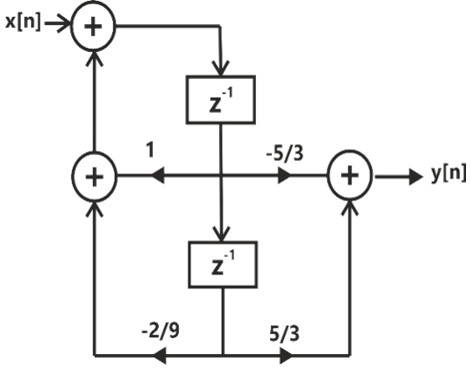




Sign in to see the solution
Log in to view the explanation, track your attempts, and keep your progress.
Sign in to UnlockLet . The Region of Convergence (ROC) of the z-transform of x[n]

is .

is .

is

does not exist
Sign in to see the solution
Log in to view the explanation, track your attempts, and keep your progress.
Sign in to UnlockLet . Let X(z) be the z-transform of x[n]. If is a zero of X(z), which one of the following must also be a zero of X(z).






Sign in to see the solution
Log in to view the explanation, track your attempts, and keep your progress.
Sign in to UnlockThe input-output relationship of a causal stable LTI system is given as .

If the impulse response h[n] of this system satisfies the condition, the relationship between α and β is





Sign in to see the solution
Log in to view the explanation, track your attempts, and keep your progress.
Sign in to UnlockFor an all-pass system , where , for all ω. If Re(a) ≠ 0, , then b equals



a

1/
1/a
Sign in to see the solution
Log in to view the explanation, track your attempts, and keep your progress.
Sign in to UnlockLet


The quantities p, q, r are real numbers. Consider

If the zero of H(z) lies on the unit circle, then r = _____.
Sign in to see the solution
Log in to view the explanation, track your attempts, and keep your progress.
Sign in to UnlockThe z-transform of the sequence x[n] is given by , with the region of convergence . Then, x[n] is ________.


Sign in to see the solution
Log in to view the explanation, track your attempts, and keep your progress.
Sign in to UnlockThe sequence , where u[n] is the unit step sequence, is convolved with itself to obtain y[n].

Then is _______

Sign in to see the solution
Log in to view the explanation, track your attempts, and keep your progress.
Sign in to UnlockTwo systems and are connected in cascade as shown below. The overall output y[n] is the same as the input x[n] with a one unit delay. The transfer function of the second system is


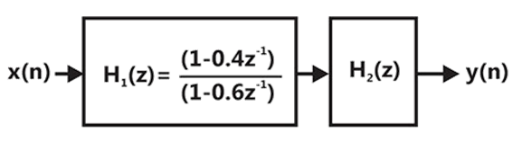




Sign in to see the solution
Log in to view the explanation, track your attempts, and keep your progress.
Sign in to UnlockConsider the z-transform; .


The inverse z-transform x[n] is




Sign in to see the solution
Log in to view the explanation, track your attempts, and keep your progress.
Sign in to UnlockTwo discrete time systems with impulse responses and are connected in cascade. The overall impulse response of the cascaded system is






Sign in to see the solution
Log in to view the explanation, track your attempts, and keep your progress.
Sign in to UnlockThe transfer function of a discrete time LTI system is given by

Consider the following statements:
S1: The system is stable and causal for

S2: The system is stable and not causal for

S3: The system is neither stable nor causal for

Which one of the following statements is valid?
Sign in to see the solution
Log in to view the explanation, track your attempts, and keep your progress.
Sign in to UnlockThe ROC of Z-transform of the discrete time sequence is





Sign in to see the solution
Log in to view the explanation, track your attempts, and keep your progress.
Sign in to UnlockIn the following network, the switch is closed at t = 0- and the sampling starts from t = 0. The sampling frequency is 10 Hz.
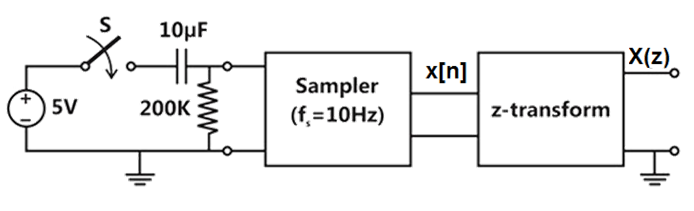
The samples x[n] (n = 0, 1, 2, ………) are given by




Sign in to see the solution
Log in to view the explanation, track your attempts, and keep your progress.
Sign in to UnlockIn the following network, the switch is closed at t = 0- and the sampling starts from t = 0. The sampling frequency is 10 Hz.
The expression and the region of convergence of the z-transform of the sampled signal are




Sign in to see the solution
Log in to view the explanation, track your attempts, and keep your progress.
Sign in to UnlockThe z-transform of a sequence is given by . It is given that the region of convergence of includes the unit circle. The value of is




Sign in to see the solution
Log in to view the explanation, track your attempts, and keep your progress.
Sign in to UnlockIf the region of convergence of is , then the region of convergence of includes






Sign in to see the solution
Log in to view the explanation, track your attempts, and keep your progress.
Sign in to UnlockThe region of convergence of Z-transform of the sequence must be





Sign in to see the solution
Log in to view the explanation, track your attempts, and keep your progress.
Sign in to UnlockThe z-transform of a system is . If the ROC is |z|<0.2, then the impulse response of the system is





Sign in to see the solution
Log in to view the explanation, track your attempts, and keep your progress.
Sign in to UnlockA causal LTI system is described by the difference equation.

The system is stable only if
Sign in to see the solution
Log in to view the explanation, track your attempts, and keep your progress.
Sign in to UnlockA sequence x[n] with the z-transform is applied as an input to a linear, time-invariant system with the impulse response where .



The output at n=4 is
Sign in to see the solution
Log in to view the explanation, track your attempts, and keep your progress.
Sign in to UnlockIf the impulse response of a discrete- time system is , then the system function H(z) is equal to

and the system is stable

and the system is stable

and the system is unstable
and the system is unstable
Sign in to see the solution
Log in to view the explanation, track your attempts, and keep your progress.
Sign in to UnlockThe region of convergence of the z-transform of a unit step function is
Sign in to see the solution
Log in to view the explanation, track your attempts, and keep your progress.
Sign in to UnlockThe z-transform F(z) of the function is





Sign in to see the solution
Log in to view the explanation, track your attempts, and keep your progress.
Sign in to UnlockThe z-transform of a signal is given by . Its final value is


Zero
1
Infinity
Sign in to see the solution
Log in to view the explanation, track your attempts, and keep your progress.
Sign in to UnlockThe Z-transform of the time function is





Sign in to see the solution
Log in to view the explanation, track your attempts, and keep your progress.
Sign in to Unlock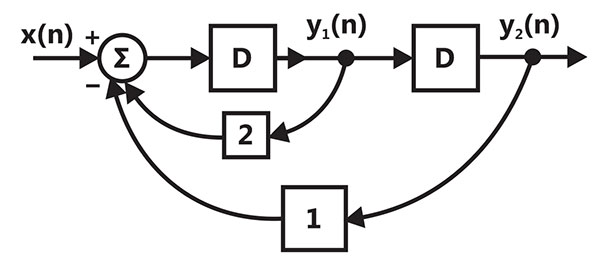
In the figure is a linear time invariant discrete system is shown. Blocks labelled D represent unit delay elements. For , you may assume that , , are all zero.




(a) Find the expression for and in terms of x(n)
(b) Find the transfer function in the z – domain

(c) If , find

Sign in to see the solution
Log in to view the explanation, track your attempts, and keep your progress.
Sign in to UnlockA linear discrete time system has the characteristic equation, . The system

Sign in to see the solution
Log in to view the explanation, track your attempts, and keep your progress.
Sign in to Unlock